Grayscale GBTC and ETHE tax reporting for US holders in 2026
GBTC and ETHE trade like exchange-traded products, but their US federal tax discussion is built around grantor-trust treatment. Under that position, a shareholder is treated as owning a pro rata share of the trust's Bitcoin or Ether. This can create small taxable gains or losses when the trust sells or uses crypto to pay sponsor fees, even if the shareholder did not sell shares and received no cash. A broker's share-sale statement alone may therefore be insufficient.
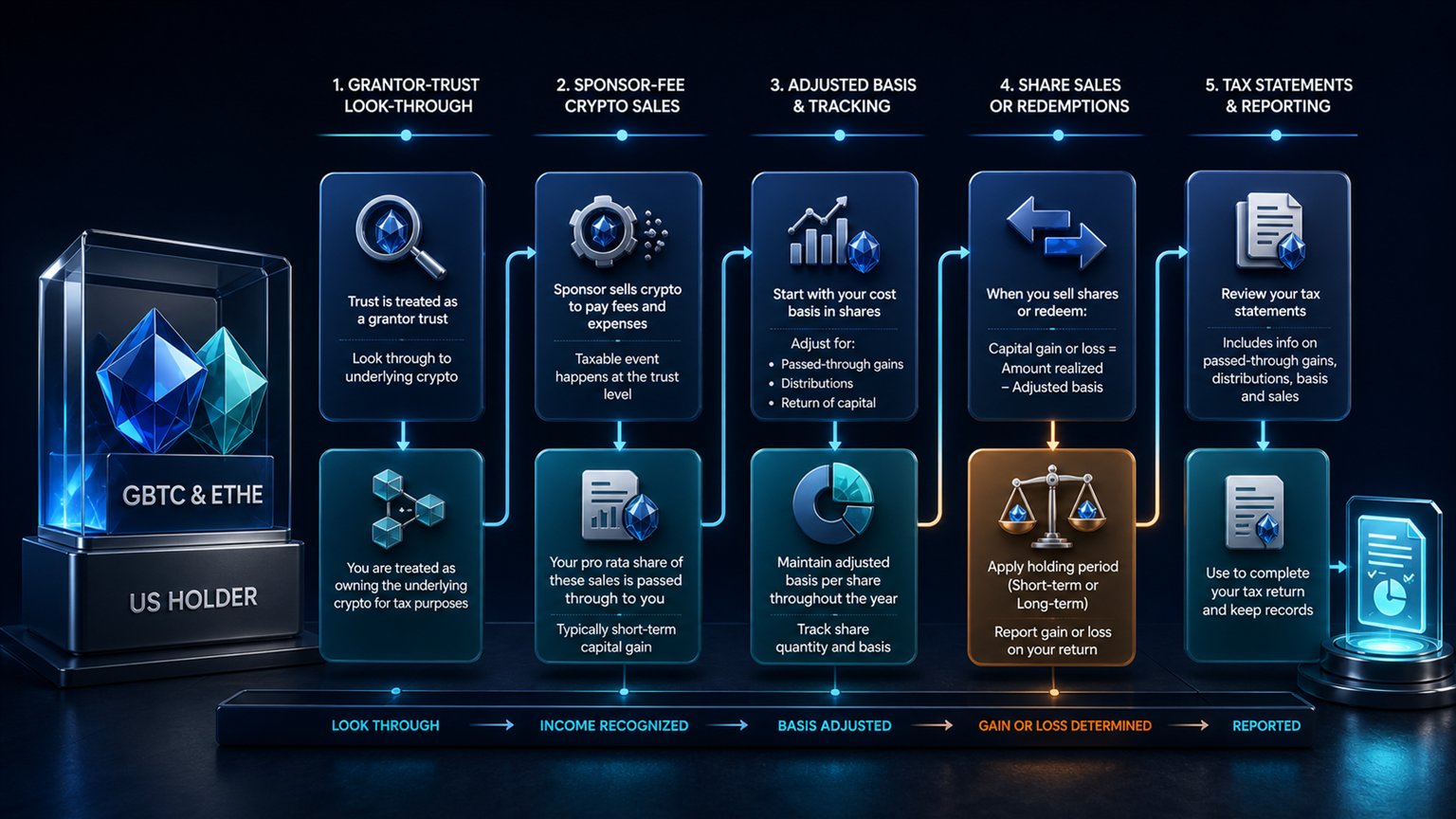
Why grantor-trust treatment matters
Prepare Your Crypto Tax Workpapers
Import your transactions, review the results and generate detailed tax workpapers without building the entire calculation manually in spreadsheets.
Start for free →Grayscale's SEC filings state that the sponsor takes the position that GBTC and ETHE are grantor trusts for US federal income-tax purposes. Assuming that treatment applies, the trust is not itself subject to federal income tax. Each beneficial owner is treated as directly owning a pro rata portion of the underlying Bitcoin or Ether and a pro rata share of trust income, gain, loss and deductions.
This is a look-through model, not ordinary corporate-stock treatment. The tax result can have two layers of activity:
- underlying crypto sold or used by the trust, commonly to pay sponsor fees or expenses;
- the shareholder's sale or other disposition of GBTC or ETHE shares.
The products' exchange listing or “ETF” description does not remove the grantor-trust calculation. Always use the current prospectus and annual tax information for the exact ticker and year.
Trust sales for sponsor fees can be taxable to holders
When the trust sells Bitcoin or Ether for cash to pay an expense, or is treated as selling crypto by using it to pay the sponsor fee, each shareholder generally recognises their pro rata gain or loss. This can occur without a cash distribution to the shareholder.
For each expense sale, the calculation uses the holder's share of amount realised less the holder's basis in the portion of underlying crypto sold. The remaining basis in underlying crypto is reduced by the basis allocated to the units sold. Repeating this for each trust sale produces the adjusted basis needed when shares are later sold.
Example: a holder's pro rata underlying crypto immediately before a fee sale has USD 10,000 basis. If 0.10% of that crypto is treated as sold, USD 10 of basis is allocated to the sale. If the holder's share of proceeds is USD 25, the holder has USD 15 gain and the remaining underlying basis becomes USD 9,990, before other changes.
Trust expenses can flow through too, but the SEC disclosure warns that an individual, estate or trust may have to treat them as miscellaneous itemized deductions. Current limitations can make them nondeductible for a non-corporate holder even while fee-related crypto gain remains recognised.
How to maintain GBTC and ETHE adjusted basis
Start with the cost of the shares, including acquisition brokerage fees where applicable. Under the look-through model, that represents basis in the pro rata underlying crypto. Then process each annual trust event using Grayscale's per-share factor or gross-proceeds and expense file.
- Separate each acquisition lot of GBTC or ETHE shares.
- Record shares, purchase date, price and commissions.
- For each trust crypto sale, calculate the lot's pro rata underlying units.
- Allocate basis to the underlying units sold.
- Recognise the resulting gain or loss.
- Reduce the remaining underlying basis.
- Preserve separate holding periods where lots differ.
Do not simply use original share purchase cost after years of fee sales. Do not subtract the sponsor fee twice: the trust-level crypto sale and any deductible expense are separate pieces, and deduction limits apply.
Grayscale's historical tax files illustrate use of Bitcoin or Ether per share, gross proceeds and expenses. Obtain the document for the actual calendar year; an old factor is not a valid estimate for 2026.
Tax result when you sell GBTC or ETHE shares
Under the grantor-trust disclosure, selling shares is treated as selling the portion of underlying Bitcoin or Ether attributable to those shares. Gain or loss generally equals share-sale amount realised, reduced by selling brokerage fees, minus the adjusted basis allocated to the shares sold.
If the holder has separate lots with different basis or holding periods, the trust disclosure treats the relevant percentage of each underlying lot as sold under its described method. Broker lot instructions and the product tax materials must be reconciled. Do not assume an unrecorded FIFO default without checking the account and applicable identification rules.
Gain is generally long-term when the relevant underlying holding period exceeds one year and short-term when it is one year or less. Capital-loss deduction limits apply. The wash-sale rule applies because GBTC and ETHE shares are securities; substantially identical replacement analysis belongs in the securities workflow.
Cash and in-kind redemptions can have different mechanics from an ordinary market sale. The current prospectus describes whether crypto delivery, cash sale and redemption-related gains are allocated only to the redeeming holder. Retail investors should not infer redemption treatment from a ticker symbol.
ETHE staking and other trust events
Current ETHE filings discuss possible staking consideration and basis equal to income recognised by the holder when such income is recognised. Whether a particular ETHE period generated staking income must come from that year's official tax information, not a generic Ethereum-wallet rule.
Forks, airdrops, incidental rights, cash redemptions and reorganisations can produce additional tax consequences. A trust may create holder income without a matching distribution. Keep these events separate from direct-wallet ETH rewards.
The 2024 conversions and distributions involving related Grayscale products had transaction-specific tax materials. A current share basis should carry the consequences already calculated for those events; do not restart basis at the post-conversion market price unless the official transaction treatment supports it.
Which documents should a holder collect?
- broker trade confirmations and year-end statements;
- Forms 1099-B or other broker information for share sales;
- Grayscale annual tax information for the exact ticker;
- per-share crypto, gross-proceeds and expense factors;
- records of prior distributions, conversions or redemptions;
- the prospectus or SEC filing for special events;
- the holder's own adjusted-basis rollforward.
Grantor trusts generally do not issue a partnership Schedule K-1 merely because gains flow through. Do not wait for a K-1 unless official product documentation says one applies. Likewise, a broker's Form 1099-B for the final share sale may not capture the holder's annual pro rata fee sales or adjusted underlying basis.
If annual factors are missing, mark the basis rollforward incomplete. A broker value of zero or original unadjusted share cost is not a verified substitute.
GBTC and ETHE reporting workflow
- Confirm ticker, account type and holding dates.
- Import every share acquisition and disposition lot.
- Obtain annual Grayscale tax files for each holding year.
- Allocate underlying crypto sales and basis per lot.
- Record trust-level gains or losses and expense treatment separately.
- Roll remaining underlying basis forward.
- Calculate share-sale gain or loss from adjusted basis.
- Determine holding period and securities wash-sale adjustments.
- Reconcile broker statements without duplicating proceeds.
- Review staking, distribution, conversion and redemption events.
- Retain the full per-share calculation with the return.
The US capital-gains guide explains rates and holding periods. Use the IRS reporting guide, records checklist and Bitcoin tax guide alongside the product-specific workpaper.
Frequently asked questions
Can GBTC create tax when I do not sell shares?
Yes. Under grantor-trust treatment, pro rata Bitcoin sales or deemed sales for trust expenses can create holder gain or loss.
Does ETHE issue a Schedule K-1?
Grantor-trust reporting generally uses product tax information rather than a partnership K-1. Check the current official documents.
Can I use my original purchase price as basis when I sell?
Not without adjustment. Prior trust-level crypto sales can reduce the basis remaining in the underlying assets.
Are GBTC and ETHE sales eligible for long-term capital-gain treatment?
Generally yes when the relevant underlying holding period exceeds one year, subject to the trust disclosure and taxpayer facts.
Does my broker statement contain every trust tax event?
Not necessarily. Reconcile broker share sales with Grayscale's annual grantor-trust tax information.
Primary product and SEC sources
- SEC: GBTC 2026 filing and grantor-trust treatment
- SEC: ETHE annual filing and US holder tax discussion
- Grayscale: example grantor-trust tax calculation methodology
- Grayscale: GBTC annual reporting and basis example
Primary-source review completed 1 September 2026. Obtain the final Grayscale tax package for the specific ticker and calendar year before filing.
Related Resources
Generate Your Crypto Tax Report
Import your transactions, review the results and generate a detailed PDF report with a transaction-level audit trail.
Start for free →Disclaimer: This article is for general informational purposes only and does not constitute tax advice. For individual tax advice, consult a licensed tax professional.