Do you have to report crypto to the IRS in 2026?
You must report income, gain or loss from every taxable digital-asset transaction for the year, regardless of amount and regardless of whether a broker sends Form 1099-DA. But merely buying crypto with US dollars, holding it, or transferring it between wallets you own generally does not create income or a disposal. The Form 1040 digital-asset question and the forms used to calculate tax are related but different obligations. This guide separates them and explains what changed with broker reporting.
Every filer answers the digital-asset question
Prepare Your Crypto Tax Workpapers
Import your transactions, review the results and generate detailed tax workpapers without building the entire calculation manually in spreadsheets.
Start for free →Form 1040 asks whether the taxpayer received a digital asset as a reward, award or payment, or sold, exchanged or otherwise disposed of a digital asset during the year. The exact wording belongs to the form for the relevant tax year. You must answer the question even if no broker statement arrived.
The checkbox is not the tax calculation. A “Yes” answer tells the IRS that specified activity occurred; the related gain, loss or income still goes on the appropriate form. A “No” answer can be correct for someone who only bought crypto with US dollars, held it, or moved it between accounts they own, subject to the fee exception.
| Activity | Digital-asset question | Separate tax entry? |
|---|---|---|
| Bought BTC with USD and held it | Generally No, if that was the only activity | No gain or loss yet |
| Sold, swapped or spent crypto | Yes | Usually Form 8949 and Schedule D for an investment asset |
| Received staking or service compensation | Yes | Ordinary income on the form matching the activity |
| Transferred between own wallets | Generally No if that was the only activity | No, except disposal of crypto used for a fee may matter |
Owning an account or wallet means you have a financial interest in digital assets, but ownership alone is not a taxable event. Do not check “Yes” solely because a year-end balance exists.
Transactions that create reportable tax entries
The IRS treats digital assets as property. Common capital-asset disposals include selling for dollars, trading one token for another, paying for goods or services and transferring the asset to another person. Calculate the result in US dollars at the event time.
For an investment asset, gain or loss generally equals amount realised minus adjusted basis. Acquisition fees can enter basis; disposition fees can reduce proceeds. Holding period determines short-term or long-term treatment. A stablecoin trade is not ignored simply because the price movement is small.
Ordinary-income events include crypto received for services, mining, rewards and staking when the taxpayer has dominion and control under the applicable guidance. Business receipts normally go to Schedule C; employee compensation follows wage reporting; non-business ordinary income may go to Schedule 1 or another line under the current instructions.
Airdrops following a hard fork, gifts, charitable transfers, NFTs and derivatives have additional rules. A gift may require Form 709 even when the donor recognises no sale. Futures and options can use contract rules rather than the spot Form 8949 workflow.
What generally is not a taxable crypto event?
- buying a digital asset with US dollars and continuing to hold it;
- holding an asset while its market value changes;
- moving the same asset between wallets or accounts you own and control;
- receiving a bona fide gift, although basis records and later disposal still matter;
- donating crypto, subject to charitable substantiation and appraisal rules.
An own-wallet transfer must preserve acquisition date and adjusted basis. Network fees paid in crypto can involve a disposition of the fee units, even when the principal transfer is not taxable. If software sees only the withdrawal and not the receiving wallet, it should mark an unmatched transfer rather than invent a sale.
Wrapping, bridging, depositing into a liquidity pool or receiving a claim token can change the legal and economic asset. Do not classify those events as non-taxable merely because the user controls both addresses.
Where capital gain, income and business activity are reported
Individuals generally calculate sales and other capital transactions on Form 8949 and summarize them on Schedule D. The current Form 8949 instructions contain exceptions that can allow certain fully reported transactions to go directly to Schedule D; use the instructions and Form 1099-DA category rather than assuming every row must be duplicated.
| Tax item | Typical federal location | Control |
|---|---|---|
| Investment sale, swap or spending | Form 8949 and Schedule D | Reconcile proceeds, basis and holding period |
| Non-business reward or staking income | Form 1040 or Schedule 1, as applicable | Record USD value when income is recognised |
| Mining or services as a sole proprietor | Schedule C | Business income, expenses and self-employment analysis |
| Gift above reporting rules | Form 709 | Not Form 8949 solely because it is a gift |
| Regulated futures or special contracts | Potentially Form 6781 | Confirm Section 1256 contract status |
States can require their own adjustments. Federal Form 1040 filing does not finish a resident's state return.
Form 1099-DA does not set the limit of your obligation
Form 1099-DA reports broker-effected digital-asset dispositions to the customer and IRS. The IRS states directly that taxpayers must report all taxable digital-asset income, gains and losses whether or not they receive the form. Foreign exchanges and self-custody activity may not produce a US Form 1099-DA.
For 2025 sales, broker statements generally focused on gross proceeds. For sales after 2025, the final 2026 instructions require basis information for covered digital assets acquired after 2025 and held continuously in the broker's custodial account. Transferred-in units and older noncovered units can still lack broker-reported basis.
Do not import a Form 1099-DA as a second copy of exchange CSV sales. Match it to the underlying disposal by broker, transaction identifier, date, asset, units and proceeds. Use broker boxes to determine the Form 8949 category, then reconcile missing or incorrect basis.
No form does not mean no tax; a form also does not prove the amount is correct. A broker may not see purchases from another exchange, self-custody cost, gifts or inherited basis.
Small amounts, losses and amended returns
There is no universal minimum that removes a taxable crypto transaction from the federal return. A zero or small economic gain can still require reporting. De minimis broker-reporting methods for specified stablecoins or NFTs concern the broker's information return, not a blanket taxpayer exemption.
Report losses as well as gains. Capital-loss deductions and carryforwards follow the general capital-loss rules. The wash-sale rule generally applies to digital assets that are also stock or securities, such as covered tokenized securities, rather than every ordinary coin; other loss restrictions can still apply.
If a prior return omitted transactions, reconstruct the year and compare tax, interest, refund limits and state impact. Do not simply add the old transaction to the current year. Use the amendment procedure for the affected return and obtain advice where omissions are material or intentional.
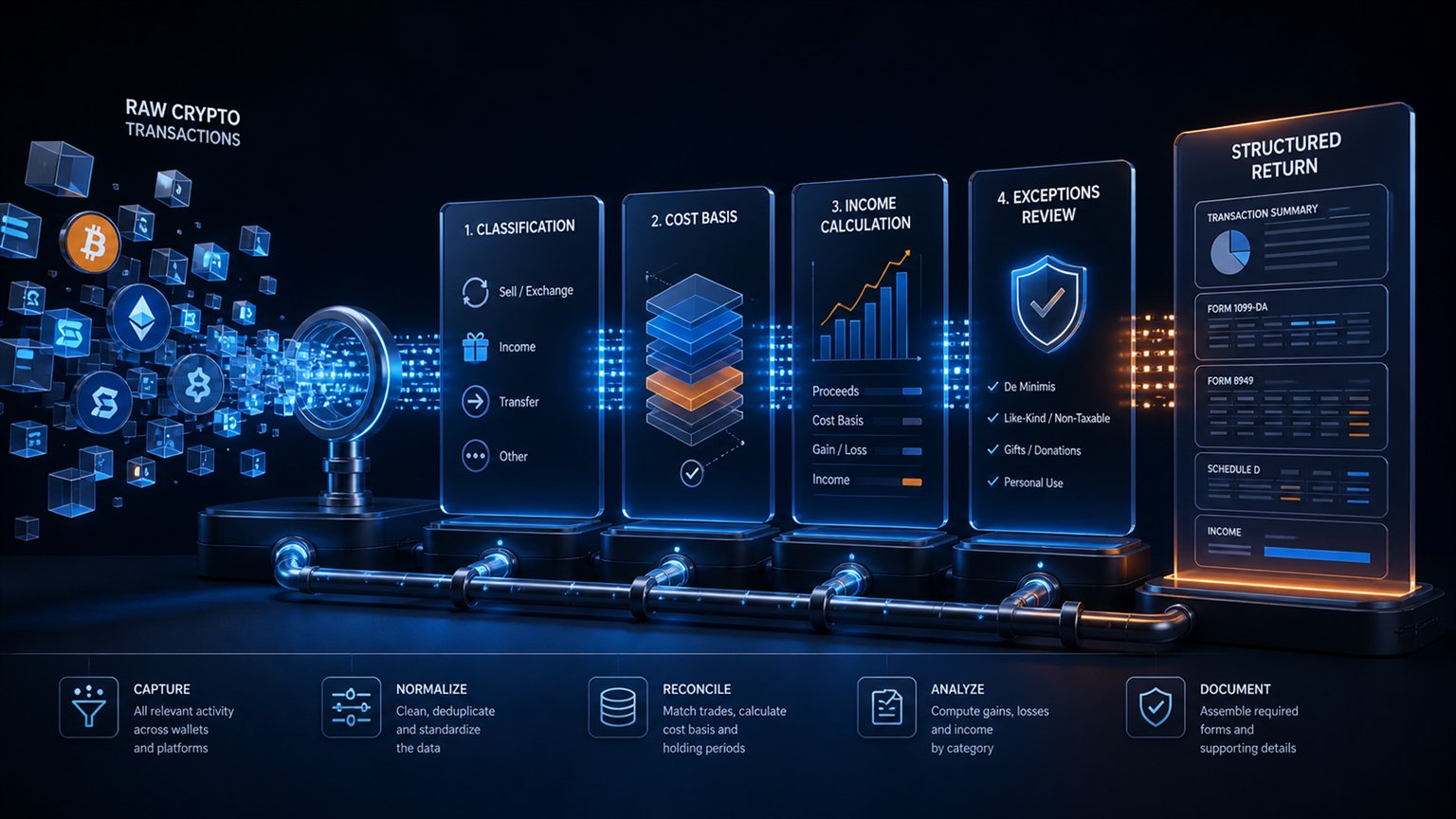
Complete IRS crypto-reporting workflow
- Collect every exchange, broker and wallet source.
- Reconcile deposits, withdrawals and opening balances.
- Classify sales, swaps, spending, income, gifts and own transfers.
- Value each taxable event in US dollars.
- Apply documented tax-lot identification and adjusted basis.
- Separate capital, ordinary, business and derivative results.
- Match Forms 1099-DA without duplicating transactions.
- Answer the Form 1040 question from actual activity.
- Prepare Form 8949, Schedule D and income schedules.
- Mark missing basis not computable and resolve it before filing.
- Retain source exports, wallet proof and calculation workpapers.
Read the IRS reporting overview, Form 1099-DA guide, capital-gains guide and records checklist for the linked workpapers.
Frequently asked questions
Must I report crypto if I did not receive Form 1099-DA?
Yes, if a taxable transaction occurred. The form does not create or limit the reporting obligation.
Do I report crypto that I only bought and held?
Buying with US dollars and holding generally does not create a tax entry and by itself generally supports “No” on the digital-asset question.
Is moving crypto to my hardware wallet taxable?
The principal transfer between wallets you own generally is not, but preserve basis and review crypto used to pay the network fee.
Do crypto-to-crypto trades count?
Yes. Disposing of one digital asset for another generally requires a USD gain-or-loss calculation.
Is there a minimum crypto gain below which I report nothing?
No universal federal minimum exempts an otherwise taxable digital-asset transaction.
Official IRS sources
- IRS: digital assets and the tax-return question
- IRS: digital-asset transaction FAQ
- IRS: understanding Form 1099-DA
- IRS: final 2026 Form 1099-DA instructions
- IRS: Form 8949 instructions
Official-source review completed 1 September 2026. Always use the forms and instructions for the return year being filed.
Related Resources
Generate Your Crypto Tax Report
Import your transactions, review the results and generate a detailed PDF report with a transaction-level audit trail.
Start for free →Disclaimer: This article is for general informational purposes only and does not constitute tax advice. For individual tax advice, consult a licensed tax professional.