Liquidity Pool Taxes in the US: What Is Known and What Remains Open
The IRS recognizes liquidity-provider transactions in its digital-asset reporting rules, but it has not issued a blanket income-tax rule saying every pool deposit is taxable or tax-free. Notice 2024-57 temporarily removes specified LP transactions from broker information reporting until further guidance; that relief does not determine whether the underlying transaction creates gain, loss, basis, or income. A defensible 2026 report must preserve the pool contract, assets transferred, LP token or NFT received, fees, rewards, and redemption data before choosing a tax treatment.
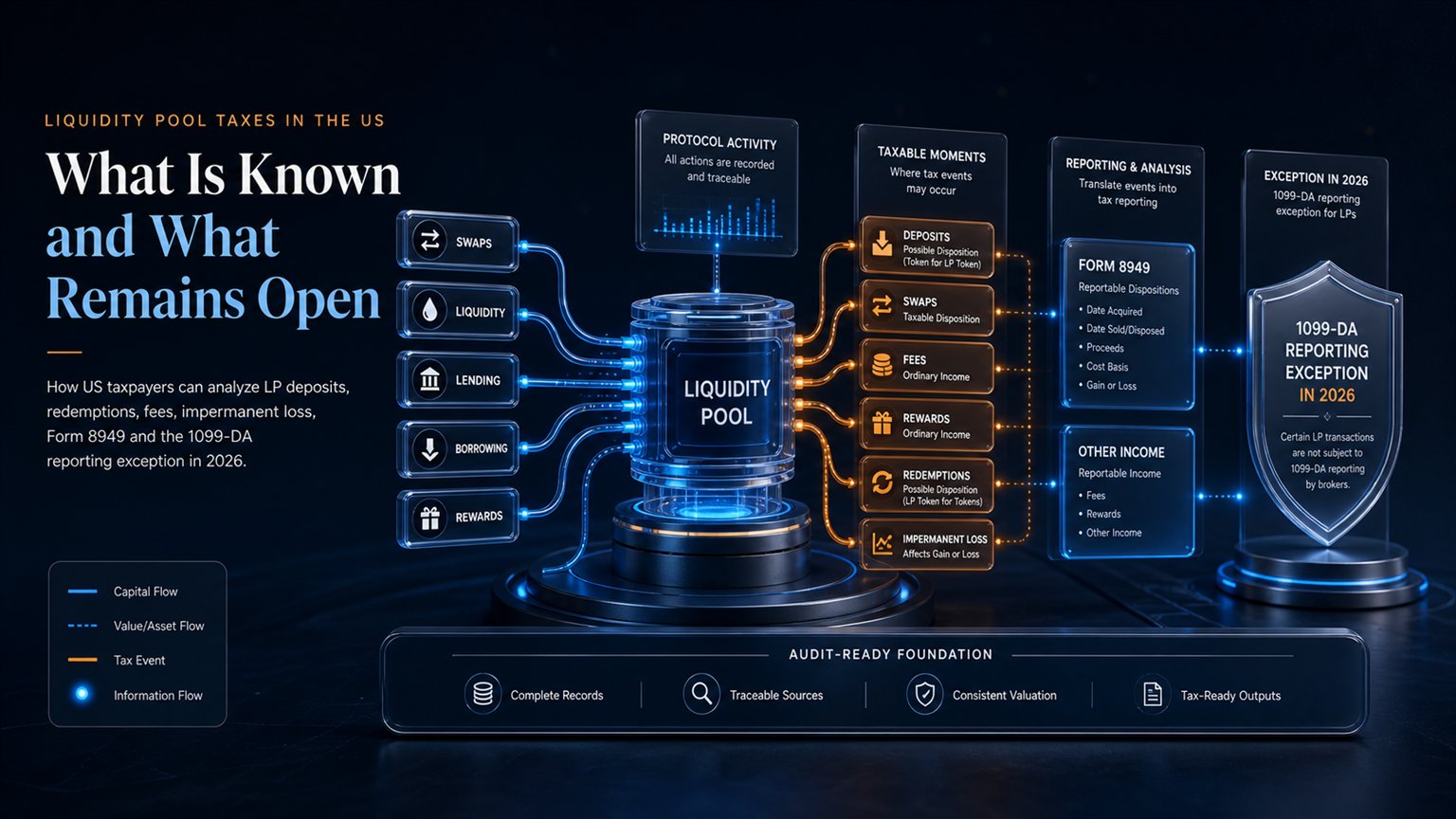
Short answer: information-reporting relief is not tax guidance
Prepare Your Crypto Tax Workpapers
Import your transactions, review the results and generate detailed tax workpapers without building the entire calculation manually in spreadsheets.
Start for free →The IRS treats digital assets as property and applies general property principles to sales and exchanges. The current digital-asset FAQs state that exchanging property for a digital asset that differs materially in kind or extent generally recognizes gain or loss. That general rule is relevant to liquidity pools, but the IRS has not published a universal ruling on whether a particular LP token merely evidences continuing ownership or represents materially different property.
Notice 2024-57 specifically identifies liquidity-provider transactions for temporary exceptions from broker reporting. It describes a transfer of one or more digital assets to an automatically executing contract in exchange for a different digital asset representing an interest in the pool, followed by redemption for a proportional pool share. The notice postpones Forms 1099-DA for those specified transactions until further guidance. It also says the exception does not decide whether compensation credited during the transaction is reportable under another income-reporting rule.
| LP event | Federal tax issue | Required evidence |
|---|---|---|
| Deposit without a separate token | ownership and control may continue; facts matter | contract rights, withdrawal claim, pool accounting |
| Deposit for transferable LP token | possible exchange for materially different property | FMV, basis, token rights, timestamp |
| Uniswap V3 position NFT | unique position right; NFT label alone does not decide tax | position ID, range, assets and value |
| Claimed incentive token | possible ordinary income when dominion and control exist | claim time, quantity, USD FMV |
| Redeem LP interest | possible disposition of LP right and acquisition of returned assets | LP basis, returned assets, USD values, fees |
Entering a pool: conservative exchange treatment is an inference
A common conservative position treats the deposited tokens as disposed of when the taxpayer receives a transferable LP token or NFT that represents a different bundle of contractual rights. Gain or loss would equal the fair market value of the received LP interest minus the adjusted basis of the assets transferred, with transaction costs allocated under the applicable basis rules. The LP interest would take a new basis based on the exchange value.
That position follows general property-exchange principles, not an LP-specific IRS holding. A different analysis may be possible when the protocol structure leaves the taxpayer with an undivided beneficial interest and the token functions only as a nontransferable receipt. The label “deposit” or “mint” in a blockchain explorer is not evidence by itself. Tax software should either apply a documented taxpayer policy to a defined protocol structure or flag the transaction for review.
Uniswap V2 typically issues a fungible pool token, while Uniswap V3 represents a concentrated-liquidity position through an NFT. This technical difference affects valuation and recordkeeping, but neither ERC-20 nor ERC-721 status automatically determines realization. The rights, economic exposure, transferability, and assets returned upon redemption remain central.
Trading fees, incentive tokens, and compounding
LP economics can produce several types of return. A protocol may credit claimable fees, issue new incentive tokens, increase the quantity of an interest, or embed earnings in the redemption value. The IRS has not published one timing rule covering every LP design. The report must determine when the taxpayer obtains dominion and control over an identifiable asset rather than assuming income accrues continuously from an on-screen estimate.
Separately claimable reward tokens can support ordinary-income treatment at their USD fair market value when the taxpayer can transfer, sell, or otherwise control them. That amount generally becomes basis for a later disposition. Fees that remain locked inside an LP interest may instead be reflected in the value realized when the interest is redeemed, depending on the legal structure and accounting method. Auto-compounding cannot be classified correctly from a change in position value alone.
- Store the block timestamp and the time zone used for every claimed reward.
- Record token quantity and a supportable USD market value.
- Do not treat a protocol dashboard estimate as cash already received.
- Keep gas and protocol fees linked to the related deposit, claim, or redemption.
- Separate business LP activity from an investor-held capital position.
Redemption and impermanent loss
Under an exchange approach, redeeming or burning an LP token disposes of the LP interest. The amount realized is based on the USD fair market value of the assets received, reduced or adjusted for qualifying transaction costs. The returned assets begin with their own basis and acquisition date. The result on the LP interest is short- or long-term if it is a capital asset, subject to the taxpayer’s holding period and activity.
Impermanent loss is not a stand-alone federal deduction. It measures how the value of an LP position compares with simply holding the deposited assets. It can exist while the position is open without a closed transaction. A tax gain can even coexist with economic underperformance if the redeemed assets are worth more than the LP basis but less than the hypothetical hold portfolio.
If the pool is hacked, frozen, abandoned, or insolvent, do not create a zero-proceeds capital sale automatically. Worthlessness, theft, abandonment, bad-debt, and casualty rules have distinct requirements and may not create an allowable capital loss for an individual. The reviewed US crypto-loss guide explains those boundaries.
Form 8949, Schedule D, and wallet-level basis
If the taxpayer concludes that an LP deposit or redemption is a capital-asset exchange, the disposal generally belongs on Form 8949 and Schedule D even when no Form 1099-DA arrives. Current Form 8949 separates digital-asset transactions by whether gross proceeds and basis were reported. Notice 2024-57 makes missing broker reporting expected for identified LP transactions; it does not remove the taxpayer’s reporting duty.
Since January 1, 2025, digital-asset basis identification and broker-account rules require particular attention to wallet or account provenance. An LP report should not silently pool unrelated basis from every wallet. It should preserve the units deposited, the wallet they came from, their acquisition lots, the new LP position, and every transfer that connects entry to exit.
- Reconcile beginning and ending units for each wallet and pool position.
- Identify the legal and technical pool model before assigning tax treatment.
- Value each asset transferred and received in USD at the event time.
- Preserve separate acquisition dates and basis for the LP interest and rewards.
- Classify fees once and avoid deducting the same gas cost twice.
- Report capital dispositions on Form 8949 even without Form 1099-DA.
- Disclose uncertain material positions to a qualified adviser.
Use the Form 8949 and Schedule D guide for filing mechanics and the records checklist for evidence. Broader lending, staking, bridges, and wrapped-token issues appear in our US DeFi tax guide.
Frequently asked questions
Is depositing into every liquidity pool taxable?
The IRS has not issued that blanket rule. A taxable-exchange position can follow from general property principles when materially different rights are received, but the protocol facts matter.
Does Notice 2024-57 make LP transactions tax-free?
No. It provides temporary broker information-reporting relief for specified transactions and does not determine income-tax treatment.
Is impermanent loss immediately deductible?
No. It is an economic comparison, not a separate federal deduction. Tax consequences depend on an actual realization or another recognized loss event.
Are Uniswap V3 positions automatically taxed as collectibles?
No. The ERC-721 form does not itself establish collectible treatment. The rights and federal tax character must be analyzed.
Must I report an LP exchange without a 1099-DA?
Yes, if the applied tax treatment produces a reportable disposition or income. A missing information return does not eliminate taxpayer reporting.
Official sources
- IRS: digital assets, taxpayer reporting, and identified LP transactions
- IRS Notice 2024-57: temporary reporting exceptions for liquidity-provider transactions
- IRS digital-asset FAQs: exchanges, basis, fees, and fair market value
- IRS Publication 544: sales and exchanges of property
- IRS Instructions for Form 8949: digital-asset reporting categories
Substantively reviewed September 1, 2026. General information, not individualized federal, state, business, partnership, or DeFi protocol advice.
Related Resources
Generate Your Crypto Tax Report
Import your transactions, review the results and generate a detailed PDF report with a transaction-level audit trail.
Start for free →Disclaimer: This article is for general informational purposes only and does not constitute tax advice. For individual tax advice, consult a licensed tax professional.