Polygon MATIC and POL taxes in 2026: migration, staking and DeFi
Polygon now uses POL as its native gas and staking token, but historical MATIC lots still matter. U.S. taxpayers must separate an automatic network relabeling from an active token migration, then reconcile staking rewards, swaps, bridges, liquidity positions and gas across Polygon PoS and Ethereum.
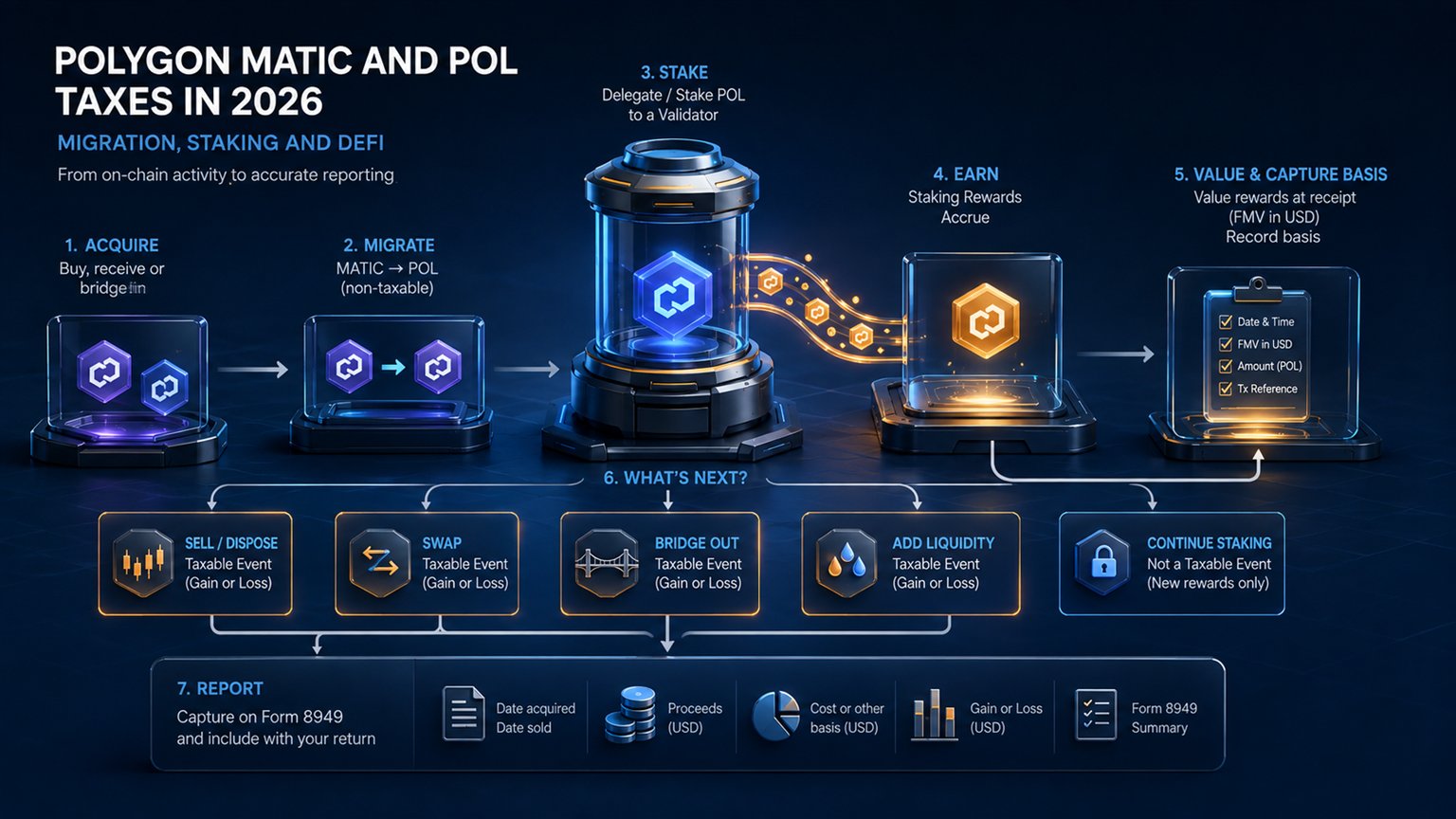
Federal starting point: the IRS treats digital assets as property. Selling investment MATIC or POL, swapping it for another token or using it to pay for goods can create capital gain or loss. Staking rewards can create ordinary income when the taxpayer gains dominion and control, followed by a separate gain or loss when those reward units are later disposed of.
What changed from MATIC to POL?
Prepare Your Crypto Tax Workpapers
Import your transactions, review the results and generate detailed tax workpapers without building the entire calculation manually in spreadsheets.
Start for free →Polygon's official documentation says POL replaced MATIC as the native gas and staking token on Polygon PoS. The migration uses a 1:1 mechanism. For MATIC already on Polygon PoS, the network transition required no holder action; for MATIC on Ethereum and some other locations, a holder can use a migration contract or an exchange process.
Those technical paths are not identical for tax records. An automatic symbol and protocol update with the same units and economic position may support continuity. An active transfer of MATIC into a migration contract in exchange for separately represented POL is an exchange event that must be analyzed under the federal property rules. Polygon's 1:1 ratio does not itself create an IRS nonrecognition rule.
Do not label every MATIC-to-POL event tax-free or taxable
The IRS has not published a Polygon-specific migration ruling. The relevant question is whether the taxpayer received property materially different in kind or extent, not whether the market value happened to remain 1:1. Record chain, contract, token addresses, units before and after, transaction hash, rights and any exchange statement.
| Migration path | Tax-report treatment | Evidence |
|---|---|---|
| Automatic Polygon PoS network update | Continuity candidate; retain original lot | Same address, units and network history |
| Ethereum migration contract | Property-exchange review | Contract in/out and token rights |
| Centralized exchange conversion | Review broker statement and lot mapping | Account ledger and conversion entry |
| Market swap through a DEX | Generally a disposition | USD value, fees and received token |
The focused MATIC-to-POL migration guide explains how to preserve wallet-specific basis without silently resetting acquisition dates.
Sales and swaps of MATIC or POL
For a U.S. investor, gain or loss generally equals amount realized minus adjusted basis. More than one year can produce long-term capital treatment; one year or less is short-term. A swap of POL for USDC, ETH or another token is not ignored because it stayed on-chain.
Each disposal needs date and time, units, USD proceeds, basis, transaction costs and holding period. Wallet- and account-specific basis rules matter when old MATIC lots were held on an exchange, Ethereum and Polygon PoS. A migration record must not create a second acquisition if the tax analysis concludes the property continued unchanged.
Polygon staking rewards
Polygon documentation explains that staking transactions for Polygon PoS take place on Ethereum and rewards are now distributed in POL. Revenue Ruling 2023-14 requires a cash-method taxpayer to include staking validation rewards in gross income when the taxpayer gains dominion and control over the units, measured at fair market value at that time.
Delegating principal is not reward income. A reward becoming withdrawable, being credited to a controlled address or being distributed under a custodial arrangement can provide the relevant evidence. Restaking does not erase income if control already arose. The USD income value becomes basis in the rewarded POL for its later sale.
QuickSwap, Aave and other Polygon DeFi
A protocol name does not determine tax character. A token swap can be a taxable exchange; supplying an asset can create a loan, a transfer for a receipt token or another arrangement; liquidity provision can exchange two assets for an LP position. Rewards, interest-like payments and return of principal must remain separate.
- record every token delivered and received;
- track aToken, LP, receipt and wrapped-token balances;
- separate incentive rewards from withdrawals of contributed assets;
- capture protocol fees, gas and liquidation events;
- mark unsupported valuations as missing rather than zero.
The U.S. DeFi tax guide provides the transaction-level classification workflow.
Bridging between Ethereum and Polygon PoS
Polygon describes its official PoS bridge as locking tokens on Ethereum and minting or releasing corresponding units on Polygon, with the reverse path burning the Polygon representation and unlocking Ethereum units. This supports a transfer analysis when the same taxpayer retains the same economic property, but it does not make every cross-chain interaction tax-free.
A third-party bridge may deliver a materially different wrapped asset, charge value-changing fees or introduce a claim against another protocol. Record both chain transactions and the intermediate status. A report should pair a genuine own transfer rather than count the outgoing leg as a sale and the incoming leg as new income.
Gas paid in POL is part of the tax data
Paying gas disposes of POL units. Current IRS digital-asset FAQs provide transaction-cost allocation rules based on the transaction facilitated. A fee to acquire property may affect basis, while a fee to dispose of property may affect amount realized; a failed transaction or personal activity may require different treatment.
Do not add the same gas twice: once from the wallet balance change and again from an aggregator's calculated fee. Store gas quantity, POL lot, USD value and the related transaction identifier.
Polygon NFTs and gaming assets
Buying an NFT with POL can create two records: disposal of POL and acquisition of the NFT. Selling the NFT is another disposition. Creator mint proceeds, royalties and inventory can be ordinary business income rather than investor capital gain.
NFT collectible treatment is not determined by the Polygon network. IRS Notice 2023-27 uses a look-through analysis to the associated right or asset while final guidance is developed. Gaming rewards and promotional tokens likewise need facts about services, control and market value.
Forms 8949, Schedule D and information statements
Investor sales and exchanges generally appear on Form 8949 and Schedule D, subject to the current instructions. Staking and other income use the line or schedule appropriate to the activity; a trade or business can require Schedule C and self-employment analysis.
A U.S. broker may furnish Form 1099-DA for dispositions, but foreign and decentralized platforms may not. Basis may be missing, particularly for transferred-in assets. Taxpayers must report taxable activity whether or not a form arrives. The Form 8949 workflow shows how to reconcile broker proceeds to wallet events.
Polygon tax-report checklist
- Import all Polygon, Ethereum and exchange accounts.
- Preserve pre-migration MATIC acquisition dates and basis.
- Classify each migration by its actual technical path.
- Pair bridges and own transfers across both chains.
- Separate staking income, DeFi rewards and returned principal.
- Decode LP, receipt, wrapped and NFT positions.
- Reconcile gas, missing prices, duplicates and year-end balances.
Frequently asked questions
Is every MATIC-to-POL migration tax-free?
No blanket IRS rule says that. An automatic Polygon PoS update and an active contract exchange should be documented separately and analyzed under property principles.
Does the 1:1 ratio guarantee no gain?
No. Equal value can limit economic gain, but it does not decide whether an exchange occurred or how basis and holding period continue.
Are POL staking rewards taxable?
They can be ordinary income when the taxpayer gains dominion and control, with fair market value becoming basis in the reward units.
Is bridging to Polygon taxable?
A bridge can be an own transfer when the same property and ownership continue, but wrapped assets and third-party contracts require a facts-based review.
Is a QuickSwap trade reportable?
Yes, an exchange of one investment token for another can create capital gain or loss even without dollars.
Do I report Polygon activity without Form 1099-DA?
Yes. Federal reporting applies to taxable income, gains and losses regardless of whether a broker form is furnished.
Official sources
- IRS: current digital-asset transaction and cost-basis FAQs
- IRS Revenue Ruling 2023-14: staking rewards
- IRS: Form 1099-DA, foreign brokers and basis
- Polygon: POL token, 1:1 migration and bridge behavior
- Polygon: official POL delegation and reward mechanics
- Polygon: official PoS bridge mechanics
Reviewed 2 September 2026 against current IRS and Polygon documentation. Migration and DeFi contracts require transaction-specific analysis.
Related Resources
Generate Your Crypto Tax Report
Import your transactions, review the results and generate a detailed PDF report with a transaction-level audit trail.
Start for free →Disclaimer: This article is for general informational purposes only and does not constitute tax advice. For individual tax advice, consult a licensed tax professional.