Shiba Inu Taxes 2026: SHIB, ShibaSwap and Shibarium
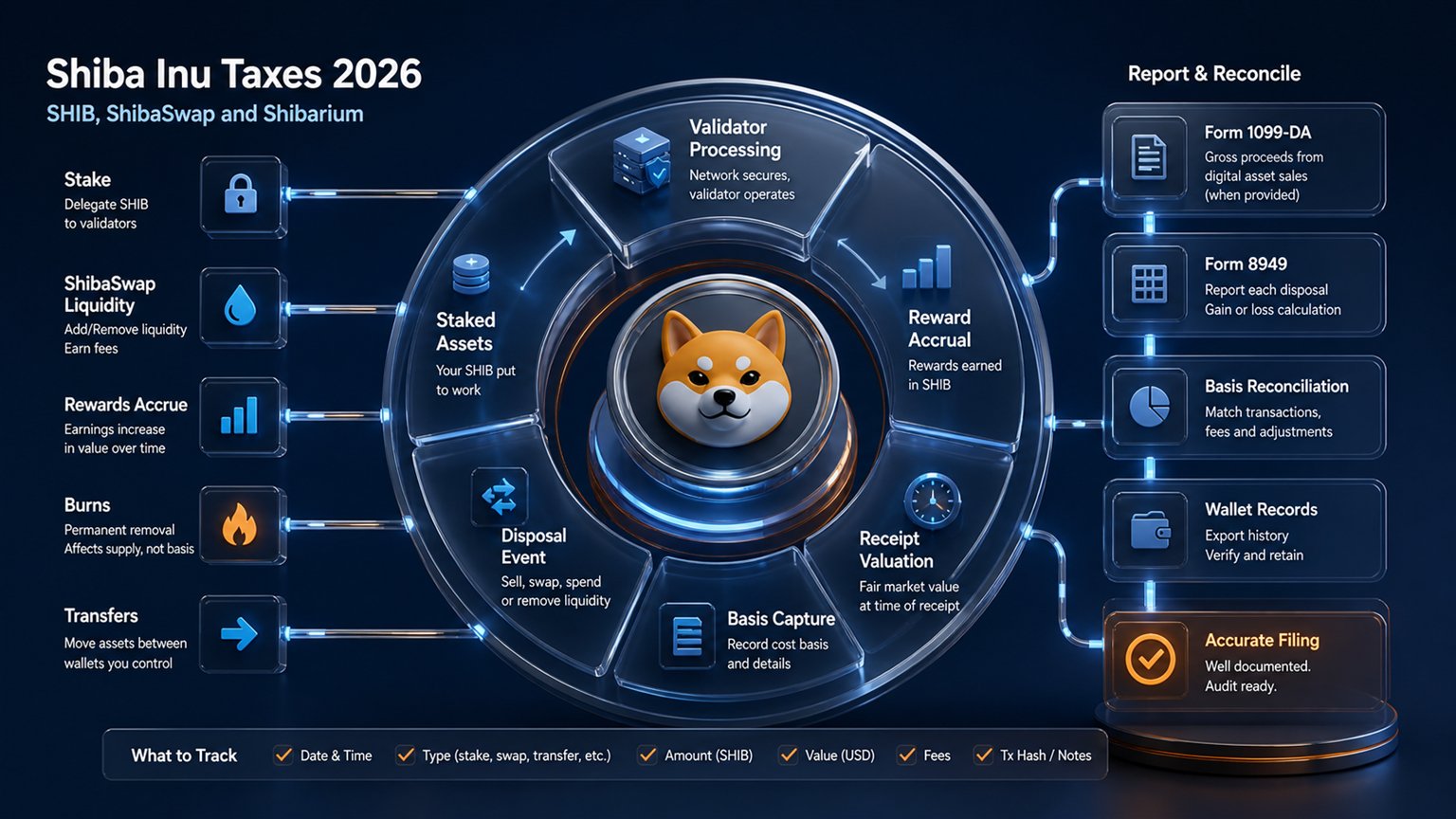
SHIB has no special meme-coin exemption under U.S. federal tax rules. Buying and holding generally is not taxable, but selling, swapping, spending, earning rewards and many ShibaSwap interactions can create reportable events. The hard part is not the token price; it is preserving exact units, wallet-level basis, gas costs and the relationship between SHIB, BONE, LEASH, TREAT, LP positions and staking receipts.
Short answer: how is Shiba Inu taxed in the United States?
Prepare Your Crypto Tax Workpapers
Import your transactions, review the results and generate detailed tax workpapers without building the entire calculation manually in spreadsheets.
Start for free →The IRS treats digital assets as property under general federal tax principles. SHIB held for investment is normally a capital asset. A sale for U.S. dollars, a swap for another token, or spending SHIB on property or services can realize a capital gain or loss equal to value received minus adjusted basis. Merely buying SHIB with cash and continuing to hold it generally does not realize income or gain.
Receiving tokens for services, mining, staking or another reward activity can create ordinary income when the taxpayer obtains dominion and control. A later sale is a second event: the amount previously included in income generally becomes basis. No information-form threshold makes an otherwise taxable event tax-free.
| SHIB activity | Typical federal treatment | Record needed |
|---|---|---|
| Buy SHIB with USD | Acquisition, generally no immediate gain | Units, price, fees, wallet/account |
| Sell SHIB for USD | Capital gain or loss for an investor | Proceeds, basis, holding period |
| Swap SHIB for BONE or another token | Disposition of SHIB and acquisition of received token | Fair market values and gas |
| Transfer between owned wallets | Generally non-taxable, except digital assets used for fees | Both addresses and transaction hash |
| Receive available reward tokens | Potential ordinary income, followed by new basis | Time of control, units and USD value |
| Provide ShibaSwap liquidity | Fact-specific token exchange and continuing fee/reward events | Tokens surrendered, position NFT/receipt and withdrawals |
SHIB transactions that require tax review
The token label does not decide the result. Start with the economic transaction. The IRS states that a disposition can include selling a digital asset for currency, exchanging it for a different digital asset, paying for property or services, or using digital assets for transaction costs. Common SHIB events include:
- selling SHIB on a centralized exchange;
- swapping SHIB for ETH, BONE, LEASH, TREAT, a stablecoin or another token;
- using SHIB to pay for goods, services or fees;
- receiving SHIB or ecosystem tokens for work, promotion or services;
- claiming rewards when the tokens are transferable and under the taxpayer's control;
- depositing assets into or withdrawing assets from a DeFi contract when the legal and economic rights change;
- selling or transferring an LP position, receipt token or concentrated-liquidity NFT.
A move from one address you own to another address you own is generally not a sale. IRS digital-asset FAQ 81 confirms this, while separating any digital assets used or withheld as transaction fees. Therefore, an exchange withdrawal to a hardware wallet should be linked as an own-wallet transfer, not counted as both a sale and a new purchase.
SHIB cost basis, exact units and wallet-level records
SHIB's low unit price makes rounding dangerous. A report should retain the native token quantity rather than abbreviating millions or billions of units. Basis normally starts with purchase price plus properly allocable acquisition costs. When SHIB was previously included in income, that included fair market value generally becomes basis for the later disposition.
Beginning in 2025, U.S. basis identification for digital assets must be handled by wallet or account under the applicable transition and identification guidance. Moving SHIB between owned wallets does not reset basis or holding period. A year-end choice of whichever lot produces the smallest gain is not automatically valid; identification must satisfy the timing and record requirements.
- Record every acquisition lot with timestamp, source, units, USD basis and fees.
- Assign each lot to the wallet or custodial account where it is held.
- Link own-wallet transfers without creating proceeds or a new purchase.
- Identify disposed units under the valid specific-identification or default rule.
- Keep enough decimal precision to reproduce exchange and blockchain balances.
- Preserve price-source evidence for thin or volatile trading periods.
If an exchange receives SHIB from another wallet, it may not know the original basis or acquisition date. A zero or blank broker basis is a data limitation, not proof that the taxpayer acquired the tokens for free. Reconstruct the lot from the sending exchange, wallet history and prior income records before filing.
ShibaSwap, Bury staking and liquidity positions
ShibaSwap interactions must be decoded one step at a time. The official Shiba Inu documentation describes swaps, liquidity pools, staking and rewards as distinct products. ShibaSwap v2 concentrated-liquidity positions can be represented by NFTs, while legacy Bury staking can involve receipt tokens. Those mechanics matter because a contract deposit may transfer economic rights rather than merely move the same asset between two addresses.
Do not apply a blanket rule that every staking deposit is taxable or tax-free. Ask whether the taxpayer surrendered SHIB for a materially different token or enforceable position, whether beneficial ownership changed, and what can be transferred or redeemed. Then record rewards separately from return of principal.
- Swap: Calculate the SHIB disposition at the USD value of property received, then establish basis in the received token.
- Bury or token lock: Review the contract and any receipt or voting token; do not infer treatment from the word “stake.”
- Reward claim: Determine when the reward became transferable and subject to dominion and control.
- Liquidity deposit: Preserve the basis and value of every token contributed and identify any position NFT or LP token received.
- Trading fees: Record collected fees or fee growth separately from the value of assets returned.
- Early-withdrawal penalty: Record the actual units returned, penalty terms and transaction value; do not silently treat missing units as market loss.
The official Bury 2.0 guide in September 2026 describes locked SHIB, TREAT, LEASH or BONE used for governance voting power and says rewards are planned for the future. A tax article should therefore not promise that every current Bury 2.0 deposit earns BONE income. Use the actual contract version and transaction records.
For a broader event-by-event method, see the U.S. DeFi tax guide and the DeFi audit-trail checklist.
Shibarium bridges, gas and wrapped assets
A bridge transaction is not classified solely by the user interface. Trace the asset deposited, asset received, redeemability and ownership on both chains. A simple technical representation of the same beneficial interest may support nonrecognition, while an exchange for a materially different asset can be a taxable disposition. This remains a facts-and-circumstances analysis.
Gas paid in ETH, BONE or another digital asset is itself a disposition of that fee asset. The tax treatment of the fee amount also depends on the underlying transaction. Keep the transaction hash and allocate the cost consistently instead of deleting the fee line or adding it twice.
Token symbols can collide across chains. Verify the network and official contract address before combining lots. A fake SHIB token or an unrelated bridged representation should not be pooled with genuine SHIB merely because its ticker looks identical.
SHIB burns, unsolicited tokens, gifts and donations
Sending SHIB to a burn address is not the same as donating property to a qualified charitable organization. A voluntary burn generally does not create a charitable deduction. Whether any separate loss is allowable is fact-specific and should not be assumed merely because the tokens became inaccessible.
Unsolicited tokens also are not automatically income at the moment they appear in an address. The federal analysis considers whether the taxpayer has dominion and control. Spam tokens that cannot be sold or transferred require different evidence from an intentional reward that is immediately marketable.
A bona fide gift to another person is generally not a sale by the donor, but gift reporting and the recipient's carryover-basis rules may apply. A donation to a qualified charity is different: IRS guidance says digital assets are noncash property, and deductions above $5,000 generally require a qualified appraisal. Burning SHIB, gifting it to an individual and donating it to a qualified charity are three separate categories.
Form 1099-DA, Form 8949 and Schedule D
For broker dispositions beginning in 2025, U.S. brokers generally use Form 1099-DA to report digital-asset proceeds. For 2025, basis often was not reported to the IRS. For sales after 2025, mandatory basis reporting applies to covered digital assets under the phased rules, while noncovered assets can still show blank basis. Whether or not a form arrives, the IRS requires taxpayers to report taxable digital-asset income, gains and losses.
An investor normally reports SHIB capital-asset dispositions on Form 8949 and Schedule D. Short-term treatment generally applies when the asset was held one year or less; long-term treatment applies when held more than one year. Ordinary income from services or a trade or business belongs on the form appropriate to that activity, not automatically on Form 8949.
- Import centralized-exchange files and all SHIB-related wallet addresses.
- Reconcile Form 1099-DA proceeds to the detailed transactions.
- Restore basis and holding period for inbound transfers.
- Decode ShibaSwap swaps, receipt positions, rewards and liquidity changes.
- Separate own-wallet transfers from taxable exchanges.
- Report disposals on Form 8949/Schedule D and income on the appropriate schedule.
- Answer the Form 1040 digital-asset question under the current instructions.
- Retain hashes, statements, price evidence and the final reconciliation.
A CoinTaxReporting U.S. report can prepare Form 8949 and Schedule D working papers while leaving missing basis visible. Compare the result with the Form 1099-DA guide and the complete U.S. filing workflow.
Frequently asked questions
Do I owe tax just for holding SHIB?
Generally no. Buying SHIB with cash and holding it does not by itself realize income or gain. A later sale, swap, spend or reward can create a reportable event.
Is swapping SHIB for BONE taxable?
Generally it is a disposition of SHIB for another digital asset. Calculate SHIB gain or loss and establish basis in the BONE received.
Is every ShibaSwap staking deposit taxable?
No blanket answer is reliable. Review the contract, any receipt or voting token, transferability, beneficial ownership and redemption rights.
Can I deduct SHIB sent to a burn address?
Do not treat a burn as a charitable contribution. Any possible loss treatment is fact-specific and should be reviewed before filing.
Why does my exchange show zero SHIB basis?
Blockchain transfers do not automatically carry purchase records to the receiving broker. Reconstruct the original lot; a blank broker field does not establish a true zero basis.
Does a 1099-DA include my ShibaSwap wallet?
Do not assume it does. Self-custody DEX and Shibarium activity must be imported and reconciled separately from custodial broker forms.
Official sources
- IRS: Understanding your Form 1099-DA
- IRS: Frequently asked questions on digital asset transactions
- IRS: Digital assets filing guidance
- Official Shiba Inu documentation: Bury 2.0 staking
- Official Shiba Inu documentation: ShibaSwap v2 liquidity
Sources reviewed September 2, 2026. This article covers common U.S. federal issues and does not replace individualized tax advice.
Related Resources
Generate Your Crypto Tax Report
Import your transactions, review the results and generate a detailed PDF report with a transaction-level audit trail.
Start for free →Disclaimer: This article is for general informational purposes only and does not constitute tax advice. For individual tax advice, consult a licensed tax professional.