XRP Taxes in the United States: Sales, Basis, Income, and Forms
The IRS treats digital assets as property. For an XRP investor, the key questions are what was disposed of, the adjusted basis of the units, the dollar value at the transaction time, and whether the units were held for more than one year. A regulatory label or lawsuit headline does not replace the federal income-tax transaction analysis.
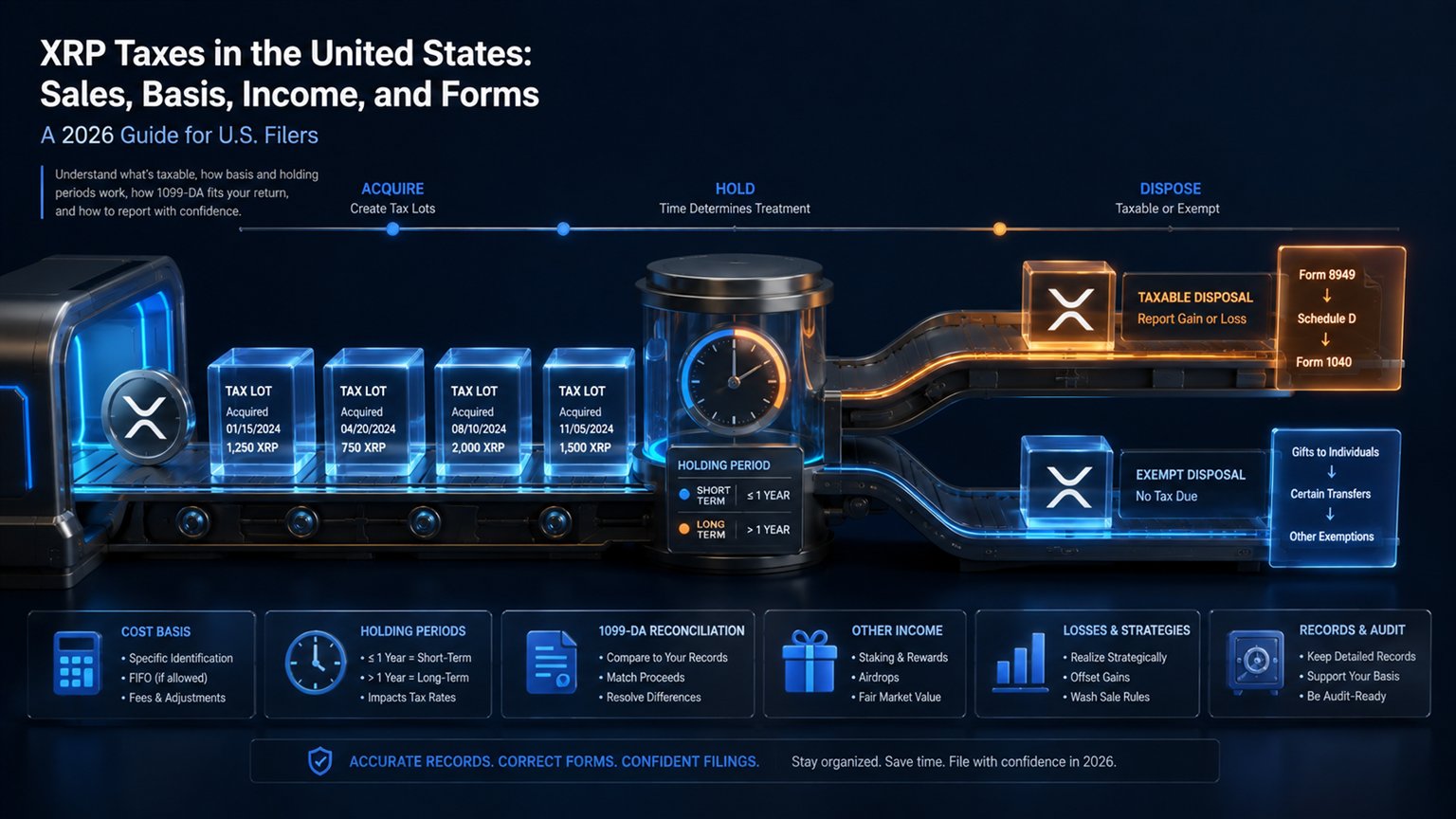
XRP is a digital asset treated as property for federal tax
Prepare Your Crypto Tax Workpapers
Import your transactions, review the results and generate detailed tax workpapers without building the entire calculation manually in spreadsheets.
Start for free →The IRS rule is transaction-based: digital assets are property, and general property principles apply. XRP held for investment is generally a capital asset. A business holding XRP as inventory or receiving it for services can have different character and forms.
Do not derive the income-tax result solely from a securities-law headline. The asset's use in the taxpayer's hands, the transaction, and the Internal Revenue Code determine whether an item is capital gain, ordinary income, or business income.
When XRP creates a taxable event
| Activity | Federal starting point | Amount to measure |
|---|---|---|
| Sell XRP for USD | capital-asset disposition for an investor | proceeds minus adjusted basis |
| Trade XRP for BTC or USDC | disposition of XRP | USD value of property received |
| Spend XRP | disposition before payment | USD value of goods or services |
| Transfer between own wallets | generally no change of beneficial ownership | retain transfer trail and fees |
| Receive XRP for services | ordinary compensation income | fair market value when received |
Buying XRP with dollars generally establishes basis without recognizing gain. Merely holding XRP while its value changes is not a realization event. Our U.S. beginner guide explains the same distinction across digital assets.
Cost basis, fees, and holding period
Adjusted basis generally starts with the dollars paid for XRP plus qualifying transaction costs allocable to the purchase. A sale's amount realized may be reduced by qualifying selling costs. When XRP was received as taxable income, the dollar value included in income generally becomes basis for a later disposition.
Gain is long-term only when the specific units were held for more than one year. Otherwise it is short-term. The method for identifying units matters. The IRS digital-asset FAQs provide specific-identification requirements and default identification rules for hosted wallets and accounts. Starting in 2026, broker basis reporting applies to covered digital assets under the transition rules, but self-custody and transferred units can still require taxpayer records.
- Identify the wallet or account holding the XRP.
- Trace acquisition date, quantity, USD cost, and transaction costs.
- Apply a valid specific identification or the applicable default rule.
- Calculate proceeds and selling costs in USD.
- Assign short- or long-term character to the actual units sold.
Reconciling Form 1099-DA, Form 8949, and Schedule D
Brokers began gross-proceeds reporting on Form 1099-DA for 2025 sales, with covered-basis reporting expanding for assets acquired after 2025 under the regulations. A form can therefore show proceeds without basis. Never treat a blank basis box as proof that the true basis is zero.
For the 2025 Form 8949, digital-asset categories are G/H/I for short-term and J/K/L for long-term. The correct category depends on whether a Form 1099-DA was received and whether basis was reported to the IRS. See the 1099-DA reconciliation guide and Form 8949 instructions.
- reconcile sales by transaction ID, date, quantity, and proceeds;
- do not import both broker rows and the same consolidated ledger rows;
- supply supported basis for transfers into the broker;
- use Form 8949 adjustments only with a documented reason;
- tie Form 8949 totals to Schedule D and the detailed XRP ledger.
XRP rewards, lending, and service payments
The XRP Ledger is not a conventional proof-of-stake chain. Products marketed as “XRP staking” may actually be lending, a centralized earn program, liquidity provision, or a derivative. Classify the contract instead of relying on the product label.
XRP received for services is ordinary income at fair market value when received. Lending or DeFi rewards can also create income depending on dominion, control, and the transaction's legal form. A later sale is a separate disposition. Preserve the value included as income so it is not omitted from basis.
How XRP capital losses work
Capital losses first offset capital gains. If losses exceed gains, an individual may generally deduct up to $3,000 of net capital loss per year, or $1,500 if married filing separately, with the remainder carried forward under the statutory rules. A price decline without a sale or other closed transaction is not a realized capital loss.
Section 1091 is written for stock or securities, not every item of property. Whether it applies to a particular digital asset depends on legal classification; tokenized securities can be covered. Avoid blanket claims that every XRP repurchase is either always permitted or always a wash sale. The U.S. capital gains guide covers loss limitations and holding periods.
XRP recordkeeping checklist
- exchange exports, broker statements, and Forms 1099-DA;
- every XRP address and transaction hash;
- acquisition and disposition timestamps with USD values;
- purchase, sale, and network fees;
- lot-identification instructions and confirmations;
- self-transfer matches and transferred basis;
- reward, lending, and service-income classification;
- final Form 8949 and Schedule D reconciliation.
Frequently asked questions
Is trading XRP for USDC taxable?
Yes. Exchanging one digital asset for another is generally a disposition measured in U.S. dollars.
Does moving XRP between my wallets create gain?
A genuine self-transfer generally does not, but ownership, transaction fees, and both sides of the transfer must be documented.
What if my Form 1099-DA has no basis?
Reconstruct supported basis from the complete account and wallet history; a blank form field does not establish zero tax basis.
Are XRP gains long-term after exactly one year?
The units must be held for more than one year to receive long-term capital-gain treatment.
Does the XRP Ledger pay staking rewards?
It is not conventional proof of stake. Verify whether the product is lending, liquidity provision, a centralized reward, or another contract.
Primary sources
- IRS digital asset transaction FAQs
- IRS digital assets filing page
- IRS Instructions for Form 8949
- IRS Instructions for Form 1099-DA
- IRS Revenue Procedure 2024-28
Reviewed September 2, 2026 for U.S. federal individual income-tax reporting. State and business rules require a separate analysis.
Related Resources
Generate Your Crypto Tax Report
Import your transactions, review the results and generate a detailed PDF report with a transaction-level audit trail.
Start for free →Disclaimer: This article is for general informational purposes only and does not constitute tax advice. For individual tax advice, consult a licensed tax professional.