Dogecoin Taxes in the US for 2026: How to Report DOGE Correctly
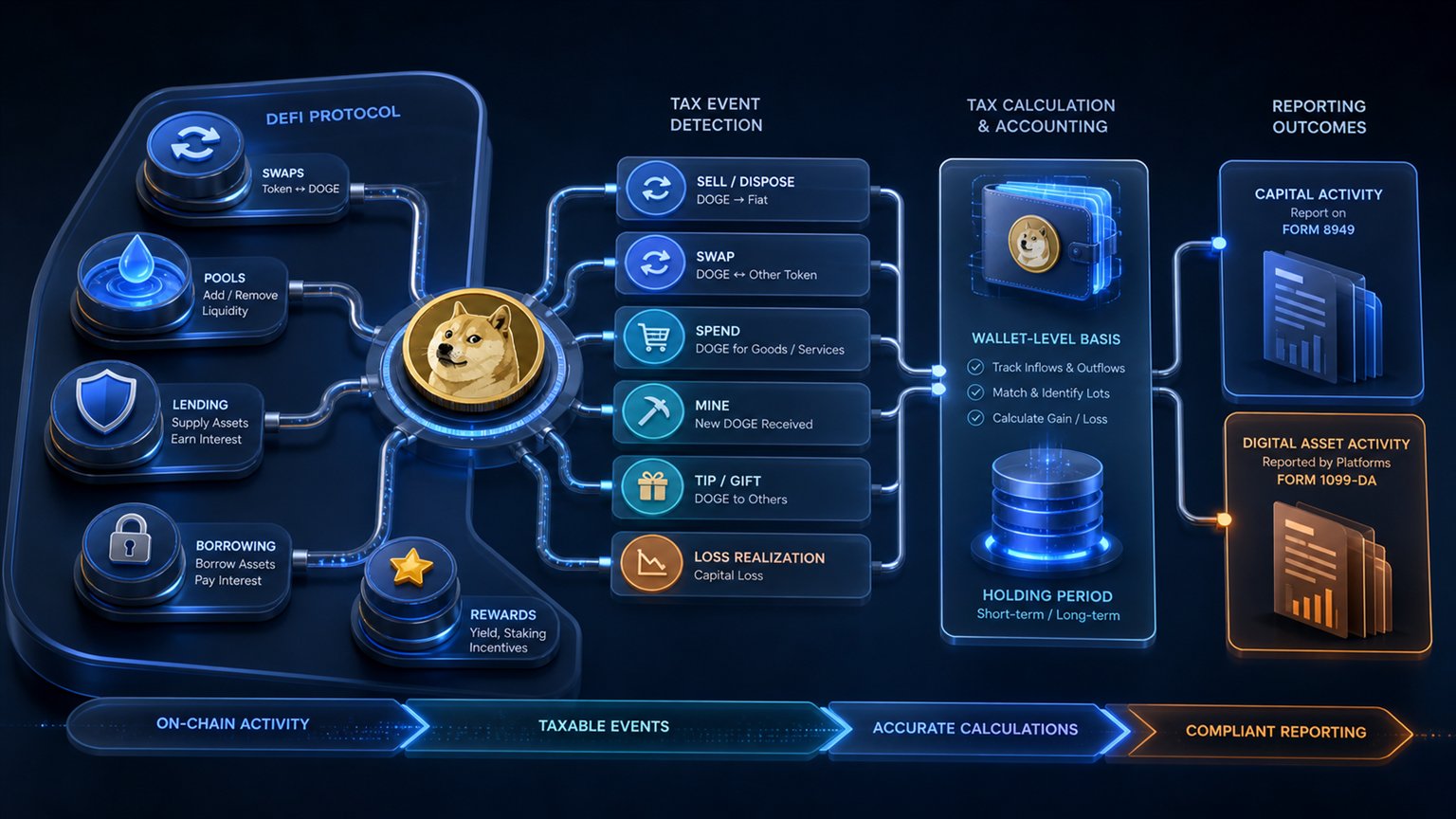
Dogecoin does not have a meme-coin exception in federal tax law. DOGE is a digital asset treated as property, so selling, swapping or spending it can create gain or loss, while mining and service payments can create ordinary income. The difficult parts are usually not the token name but missing wallet basis, tips that may be gifts or compensation, transferred-in broker lots and the difference between a price decline and a realized loss.
Is Dogecoin taxable in the United States?
Prepare Your Crypto Tax Workpapers
Import your transactions, review the results and generate detailed tax workpapers without building the entire calculation manually in spreadsheets.
Start for free →Yes. The IRS treats digital assets as property rather than currency for federal income tax purposes. The same core framework applies to DOGE, Bitcoin, Ether, stablecoins and other digital assets. The tax result depends on what the taxpayer did with the DOGE and why it was held.
| DOGE activity | Typical federal result | Record required |
|---|---|---|
| Buy DOGE with US dollars | Acquisition, not taxable by itself | Date, time, units, USD cost and transaction cost |
| Hold DOGE without another transaction | No realized gain or loss | Wallet and lot history |
| Sell DOGE for dollars | Property disposition; capital gain or loss if held as a capital asset | Gross proceeds, adjusted basis and holding period |
| Swap DOGE for another digital asset | Disposition of DOGE and acquisition of the other asset | USD fair market value of both legs and fees |
| Spend DOGE on goods or services | Disposition of DOGE plus purchase of the item or service | USD value, basis and merchant evidence |
| Transfer DOGE between owned wallets | Not taxable by itself, except DOGE used to pay transaction services | Proof both wallets are owned and basis carried forward |
| Receive DOGE from mining or for services | Ordinary income at fair market value when received or controlled | Units, control time, USD value and activity status |
| Receive a genuine DOGE gift | Generally no income merely upon receipt | Donor basis, value, date and gift documentation |
DOGE sales, swaps and purchases with Dogecoin
A sale produces gain or loss equal to amount realized minus adjusted basis. If DOGE was held for investment, a holding period of one year or less generally produces short-term capital gain or loss; more than one year generally produces long-term treatment. Short-term net gain is generally taxed at ordinary income rates, while net long-term capital gain can qualify for preferential rates depending on taxable income and filing status. The 3.8% net investment income tax can also apply to higher-income taxpayers.
Example: partial DOGE sale
- Taxpayer buys 10,000 DOGE for $800 plus a $10 qualifying acquisition cost.
- Total lot basis is $810, or $0.081 per DOGE before later adjustments.
- Taxpayer sells 4,000 DOGE for $600 and pays a $6 qualifying sale cost.
- Amount realized is $594; basis of the units sold is $324.
- Recognized gain is $270.
- The remaining 6,000 DOGE retain $486 of basis.
The character depends on the holding period of the actual units sold. A price quoted in the Dogecoin app is not enough; the report needs the acquisition lot and wallet or account.
DOGE-to-crypto exchanges
Swapping DOGE for BTC, ETH, USDT or another token is not deferred merely because no dollars reach a bank account. The outgoing DOGE is valued in US dollars, its basis is removed and the incoming asset starts a new basis record. The IRS digital-asset question also treats exchanging one digital asset for another as an activity generally requiring a “Yes” answer.
Transaction fees need specific treatment. Qualifying digital-asset transaction costs can increase acquisition basis or reduce amount realized under the final regulations. In a crypto-to-crypto exchange, applicable costs are allocated to the transferred-asset disposition. If DOGE or another token is used to pay the fee, that fee token is itself disposed of and can create gain or loss.
DOGE mining, tips, rewards and service payments
Mining
Notice 2014-21 states that when a taxpayer successfully mines virtual currency, the fair market value at receipt is gross income. If mining constitutes a trade or business and is not performed as an employee, net earnings can be subject to self-employment tax. Later sale of the mined DOGE creates a separate property result, using the amount included in income as basis.
Record each payout or supportable aggregation with units, date and time, pool, wallet, USD fair market value, restrictions and basis. Hashrate or estimated pending rewards are not the same as DOGE actually or constructively received.
Tips are not all the same
The old article stated that every DOGE tip is ordinary income. That is too broad:
- Payment or reward for content, services or promotion: ordinary income at fair market value. Schedule C may apply when received in a trade or business.
- Genuine detached gift: generally not gross income to the recipient solely because it was received. The recipient may take a carryover or dual basis under gift-basis rules, so donor records matter.
- Employer tip or compensation: wage and employment-tax rules can apply.
- Platform reward: examine terms, required activity and when the DOGE became transferable.
Calling a transfer “tip” in a memo does not determine its federal character. Preserve the relationship, message, platform terms and reason for payment.
Gifts made with DOGE
A donor generally does not recognize gain merely by making a completed gift, but federal gift-tax reporting can apply based on value, recipient and the annual exclusion rules. A transfer to a charity has separate substantiation and appraisal requirements. Do not report every outgoing gift as a zero-proceeds DOGE sale on Form 8949.
Dogecoin cost basis after 2024: track by wallet or account
The final digital-asset regulations apply basis identification by wallet or account beginning January 1, 2025. A taxpayer cannot treat DOGE spread over Robinhood, Coinbase and three self-hosted wallets as one universal lot pool. Own-wallet transfers preserve basis, but the lot record must move to the receiving wallet.
Specific identification and the default order
Adequate specific identification can select particular units when the regulatory requirements and contemporaneous records are satisfied. “HIFO” is not a separate statutory safe harbor; it is an ordering objective that only works when each selected high-basis lot is validly and timely identified. If identification is inadequate, default ordering rules apply within the wallet or account.
- Keep DOGE acquisition date and time, units and USD basis for each lot.
- Identify the wallet or custodial account holding the units.
- Carry the lot through documented owned-wallet transfers.
- Make and retain any specific identification before or at the required time.
- Apply transaction costs and partial-lot calculations consistently.
- Do not retrospectively choose HIFO after seeing the year’s prices without adequate records.
Robinhood and Form 1099-DA in 2026
A US custodial broker can issue Form 1099-DA for DOGE dispositions. But “Robinhood tracks your basis automatically” is not universally correct. The 2026 basis-reporting phase-in only requires basis for covered digital assets acquired after 2025 and held continuously in the same custodial broker account. DOGE acquired before 2026, transferred in from another broker or wallet, or otherwise noncovered may lack reported basis.
| DOGE lot | Likely Form 1099-DA status for a 2026 sale |
|---|---|
| Bought in the same custodial broker account in 2026 and held there | Potentially covered; required basis reporting if all conditions are met |
| Bought in that account in 2024 | Acquired before 2026; generally noncovered for digital-asset basis reporting |
| Transferred from self-custody in 2026 | Generally noncovered; broker does not possess complete historical basis |
| Sold through a noncustodial DEX | No current noncustodial-broker Form 1099-DA requirement |
Match the form to transactions already imported. Do not add Form 1099-DA as a second set of DOGE sales. Reconcile gross proceeds, covered status, basis and any difference with the taxpayer’s records. The Form 1099-DA guide explains the boxes and 2026 phase-in.
DOGE losses: a falling chart is not enough
Buying DOGE near a peak and watching its value fall does not by itself create a deductible capital loss. The loss normally must be realized in a taxable sale or exchange. A token that merely declined substantially but still has value is not automatically worthless for section 165 purposes.
Recognized capital losses first offset capital gains. If net capital losses remain, an individual can generally deduct up to $3,000 against other income for the year, or $1,500 if married filing separately, with the unused amount carried forward subject to the capital-loss rules.
Wash sales and Dogecoin
The statutory wash-sale rule applies to stock or securities. Ordinary spot DOGE is generally treated as property rather than stock or a security for this federal tax provision, so the conventional 30-day wash-sale rule is not automatically applied in the same way. That is not permission to create sham losses. Related-party rules, economic-substance principles and the actual status of an instrument still matter, and legislation can change. Tokenized securities or derivatives require separate analysis.
A loss-harvesting sale followed by a repurchase creates a real new lot with a new basis and holding period. Price movement between sale and repurchase can outweigh the tax benefit. See the US crypto year-end planning guide before acting.
How to report DOGE on the federal return
| DOGE result | Common federal reporting |
|---|---|
| Sale, swap or spending of DOGE held as a capital asset | Form 8949 and Schedule D, subject to current aggregation and exception rules |
| Nonbusiness mining or reward income | Schedule 1 under current IRS digital-asset guidance |
| DOGE received for sole-proprietor services or business mining | Schedule C and potentially Schedule SE |
| Employee compensation in DOGE | Wage reporting and employment-tax rules |
| Gift of DOGE | Potential Form 709 for the donor; not automatically Form 8949 |
Every taxpayer must answer the digital asset question. Selling, exchanging, receiving rewards or paying transaction fees with DOGE generally points to “Yes.” Merely holding, buying with US dollars or transferring between owned wallets can fit the IRS “No” examples if no other digital-asset transaction occurred.
For capital sales, use the Form 8949 and Schedule D guide. The report needs description, acquisition date, disposal date, proceeds, basis, adjustment if applicable and short- or long-term classification.
DOGE recordkeeping checklist
- Export every exchange and broker account, including closed accounts.
- List all self-hosted Dogecoin addresses and prove ownership.
- Keep acquisition date, time, units, USD value, fee and wallet for every lot.
- Link owned-wallet transfers without generating sales.
- Separate mining, service income, genuine gifts and capital acquisitions.
- Record fair market value when income is received and create the related basis lot.
- Reconcile Form 1099-DA proceeds once and investigate missing basis.
- Document specific identification or apply the default order within each wallet.
- Mark missing acquisition history as unresolved rather than confirmed zero basis.
- Archive the final report, source files, settings and corrections.
IRS records must be sufficient to establish positions taken on the return. A current balance screenshot does not prove historical cost. For the broader return workflow, use the US crypto reporting guide.
Common Dogecoin reporting errors
- Reporting only dollar withdrawals and omitting DOGE-to-crypto swaps.
- Calling an unrealized price decline a deductible loss.
- Using one global FIFO or HIFO pool across unrelated wallets and accounts.
- Assuming a broker knows transferred-in or pre-2026 DOGE basis.
- Taxing a reward as income and then selling it with zero basis.
- Treating every social-media tip as compensation without checking whether it was a genuine gift.
- Ignoring DOGE spent as a transaction fee.
- Adding Form 1099-DA sales on top of the same imported transactions.
- Claiming a fixed “automatic” penalty percentage unsupported by the actual failure and statute.
Frequently asked questions
Do I owe tax just for holding Dogecoin?
No federal gain or loss is realized merely from holding DOGE as its price changes. Tax can arise from a sale, swap, spending, income receipt or another disposition.
Is swapping DOGE for USDT taxable?
Yes, the outgoing DOGE is disposed of and must be valued in US dollars. The received USDT starts a new basis record.
Are Dogecoin tips taxable?
A tip paid for content, promotion or services is generally income. A genuine detached gift can be excluded from the recipient’s income, but donor basis and gift documentation are important.
Is mined DOGE taxable before sale?
Notice 2014-21 treats successfully mined virtual currency as income at fair market value when received. That amount generally becomes basis for the later sale.
Can I deduct DOGE that fell 80%?
Not merely because the market price fell. A capital loss generally requires a recognized sale or exchange and is proceeds minus adjusted basis.
Can I use HIFO for DOGE?
A high-basis selection can work only through adequate, timely specific identification under the applicable rules. “HIFO” does not excuse missing lot and wallet records.
Will Robinhood report my DOGE basis in 2026?
Basis reporting is phased in for covered assets acquired after 2025 and continuously held with the same custodial broker. Older or transferred-in DOGE can be noncovered and require taxpayer reconstruction.
How much capital loss can offset other income?
An individual can generally deduct up to $3,000 of net capital loss against other income, or $1,500 if married filing separately, and carry forward the remaining capital loss.
Official IRS sources
- IRS Digital Assets: property treatment, records, forms and digital asset question
- Notice 2014-21: virtual currency, mining and service payments
- IRS Digital Asset FAQs: basis, transfers, fees and records after 2024
- 2026 Instructions for Form 1099-DA
- IRS: Understanding Form 1099-DA
- IRS Publication 544: sales and other dispositions of assets
- IRS Instructions for Form 8949
- IRS Topic 409: capital gains, losses and the $3,000 limitation
- IRS: Gift tax frequently asked questions
Reviewed against official federal sources through September 2, 2026. This article covers general US federal treatment for individuals. State tax, entities, trader or dealer status, derivatives, charitable transfers and international reporting require separate analysis.
Related Resources
Generate Your Crypto Tax Report
Import your transactions, review the results and generate a detailed PDF report with a transaction-level audit trail.
Start for free →Disclaimer: This article is for general informational purposes only and does not constitute tax advice. For individual tax advice, consult a licensed tax professional.