NFT Taxes in 2026: U.S. investor and reporting guide
For U.S. federal tax purposes, NFTs are digital assets and property. Investors must calculate every taxable disposal, while the right linked to the NFT can also affect collectible treatment.
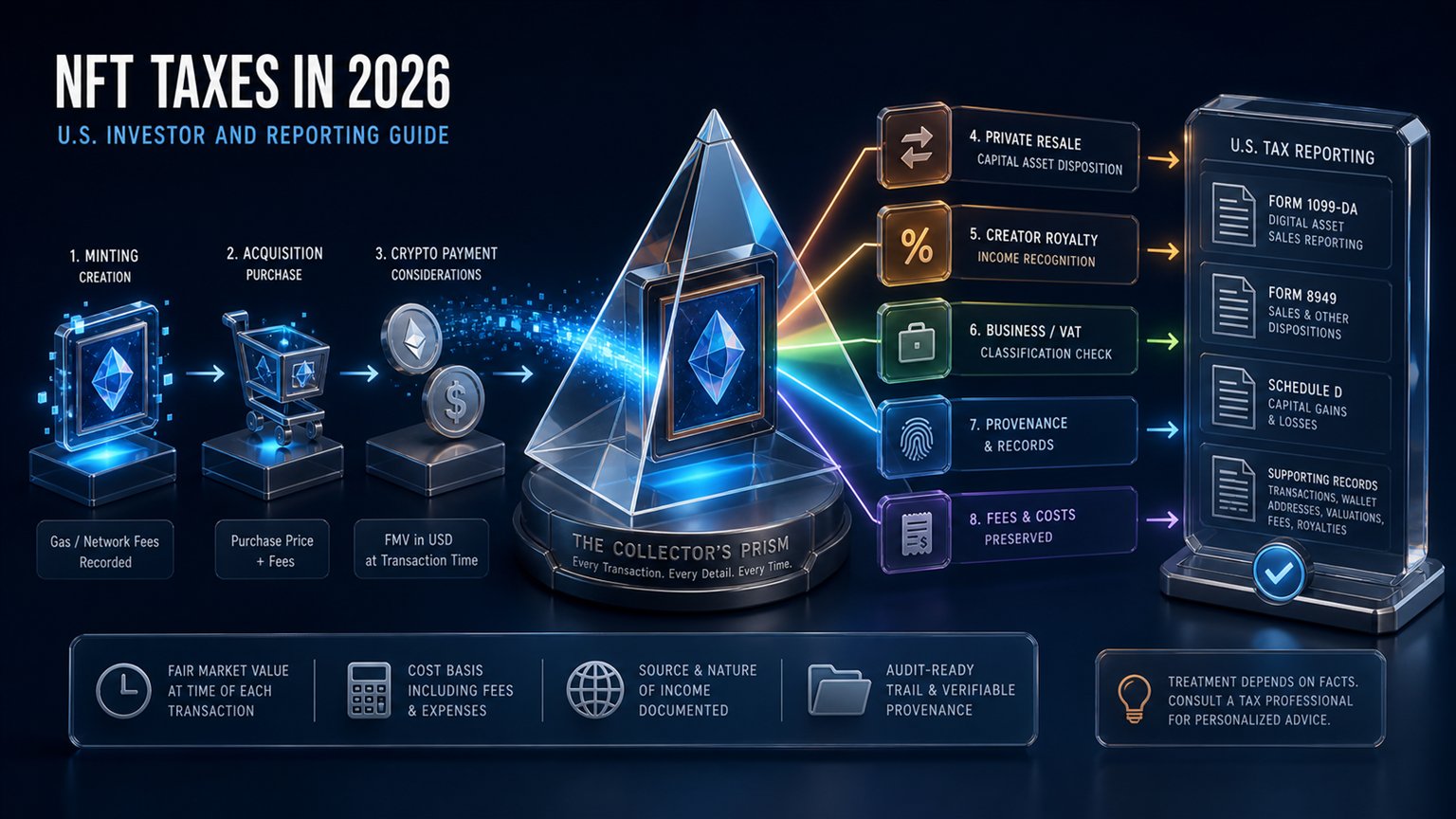
Bottom line: the IRS lists nonfungible tokens as digital assets and treats digital assets as property, not currency. Buying an NFT with dollars is generally an acquisition. Selling, exchanging, spending or gifting it can require tax reporting. The tax character depends on whether it is a capital asset, inventory, business property or a collectible under the IRS look-through approach.
NFTs are property, but not all property is taxed alike
Prepare Your Crypto Tax Workpapers
Import your transactions, review the results and generate detailed tax workpapers without building the entire calculation manually in spreadsheets.
Start for free →An NFT may represent digital art, a licence, event access, a game item, a physical object or another right. The token standard does not determine federal tax treatment. Investors usually hold NFTs as capital assets, while dealers and creators can have ordinary business income and inventory or other business property.
This article focuses on investor disposals and federal reporting. Creators, minters and recurring royalty recipients should use the separate U.S. NFT creator tax guide so that ordinary income is not mixed with Schedule D gains.
How an investor calculates gain or loss
A taxable NFT disposal generally produces gain or loss equal to amount realized minus adjusted basis. Basis begins with purchase cost and can include properly allocable acquisition costs. Proceeds include cash or the U.S.-dollar fair market value of property or services received. Selling costs may reduce proceeds under the applicable basis rules.
An NFT held for one year or less produces short-term capital gain or loss. More than one year generally produces long-term treatment. The normal preferential long-term rates can apply, but a collectible classification may change the maximum rate. Losses on personal-use property are generally not deductible, while investment capital losses follow capital-loss limits and carryover rules.
Example: an investor buys an NFT for $4,000 and pays $120 of eligible acquisition costs. It is sold 14 months later for $10,000 with $250 of selling costs. The preliminary long-term gain is $5,630. The final rate depends on the taxpayer’s income and whether the NFT is a collectible.
IRS look-through analysis for collectibles
Notice 2023-27 states that, pending further guidance, the IRS intends to use a look-through analysis. An NFT is treated as a Section 408(m) collectible when its associated right or asset is a collectible. An NFT certifying ownership of a gem is the IRS example of a collectible; a right to develop virtual land is the example of a non-collectible.
The notice leaves an important question open for digital files that may be works of art. A report should therefore store the underlying right and flag the collectible conclusion rather than assume that every profile picture is, or is not, a collectible. Long-term collectible gain can be subject to the special maximum 28% rate framework, not a flat 28% on every sale.
Buying an NFT with ETH creates a crypto disposal
Paying for an NFT with ETH, SOL or another digital asset is a taxable exchange of the payment asset. You calculate gain or loss on the crypto given up and establish basis in the NFT from the supported dollar value. No fiat deposit is required for a taxable event.
- Determine fair market value in U.S. dollars at the transaction time.
- Calculate the gain or loss on the crypto disposed of.
- Record the NFT acquisition date and supported initial basis.
- Allocate gas, marketplace fees and creator fees consistently.
- Retain the hash, wallets, contract, token ID and marketplace statement.
Paying a fee in a separate token may create another disposal. A tax engine must not collapse the NFT acquisition, payment-token sale and fee-token sale into one unexplained row.
Form 8949, Schedule D and the digital-asset question
Capital NFT sales and exchanges are generally reported on Form 8949 and summarized on Schedule D, unless an applicable Form 8949 exception applies. Description, acquisition date, disposal date, proceeds, basis and adjustment codes must match the evidence. Short- and long-term transactions are separated.
Taxpayers must also answer the digital-asset question on the relevant federal return. The answer depends on actual receipt, sale, exchange or other disposition during the year. Merely holding an NFT without a transaction is different from selling it. The IRS requires taxable income, gain or loss to be reported even when no information form arrives.
What Form 1099-DA does and does not prove
For sales after 2025, digital-asset broker reporting expands. The 2026 Form 1099-DA instructions include an optional aggregate method for specified NFTs. A broker using that method may report aggregate proceeds, and basis may not be required for those specified NFT sales. First sales by a creator or minter can be reported separately under the method.
A Form 1099-DA is an information return, not a complete NFT ledger. It may omit self-custody basis, acquisitions elsewhere, gas and unbrokered sales. Reconcile it to your records rather than replacing calculated basis with zero. For broader rules, see the U.S. capital-gains guide.
Gifts, worthless NFTs and losses
Gifting an NFT generally is not a sale by the donor, but gift-tax reporting and carryover-basis rules may apply. A transfer to a wallet you control is not a gift or disposition. A marketplace transfer to another person for no consideration needs recipient and donative-intent evidence.
A floor price of zero does not automatically establish a deductible loss. Abandonment, worthlessness, personal-use status and a sale for nominal consideration have different rules. Keep the token in review until a legally relevant event and amount can be supported. Our crypto-loss guide explains the capital-loss framework.
NFT tax-record checklist
- chain, contract address, token ID and transaction hash;
- date, time, wallets and marketplace;
- underlying asset, licence and collection terms;
- gross proceeds and dollar valuation source;
- gas, marketplace fee and creator fee separately;
- capital, personal-use, business and collectible classifications;
- 1099-DA reconciliation and missing-basis explanation.
If a price cannot be supported, mark the row “not calculable,” not zero. Follow the tax-data quality checklist before filing.
Frequently asked questions
Are all NFT gains taxed at 28%?
No. The 28% concept concerns the maximum rate framework for long-term collectible gain. Classification, holding period and taxable income matter.
Is every art NFT a collectible?
The IRS look-through notice leaves questions for digital files. Store the associated right and flag uncertain cases for review.
Is buying an NFT with ETH tax-free?
No. Giving up ETH is generally a taxable digital-asset disposal, even though no dollars are received.
Does Form 1099-DA include correct basis?
Not always. Specified NFT optional reporting may omit basis, and brokers may not know self-custody history.
Can I deduct an NFT that fell to zero?
A market decline alone is not enough. Capital, personal-use, abandonment and worthlessness rules must be applied to an identifiable event.
Where do investor NFT sales go?
Capital transactions generally go to Form 8949 and Schedule D, subject to the form instructions and reporting exceptions.
Official sources
- IRS: Digital assets and how to report them
- IRS Notice 2023-27: NFTs and collectibles
- IRS: Instructions for Form 8949
- IRS: 2026 Instructions for Form 1099-DA
Reviewed 2 September 2026 against current official IRS guidance. This guide is educational and not individual tax advice.
Related Resources
Generate Your Crypto Tax Report
Import your transactions, review the results and generate a detailed PDF report with a transaction-level audit trail.
Start for free →Disclaimer: This article is for general informational purposes only and does not constitute tax advice. For individual tax advice, consult a licensed tax professional.