Filecoin Taxes in the US for 2026: FIL Sales, Provider Rewards and Collateral
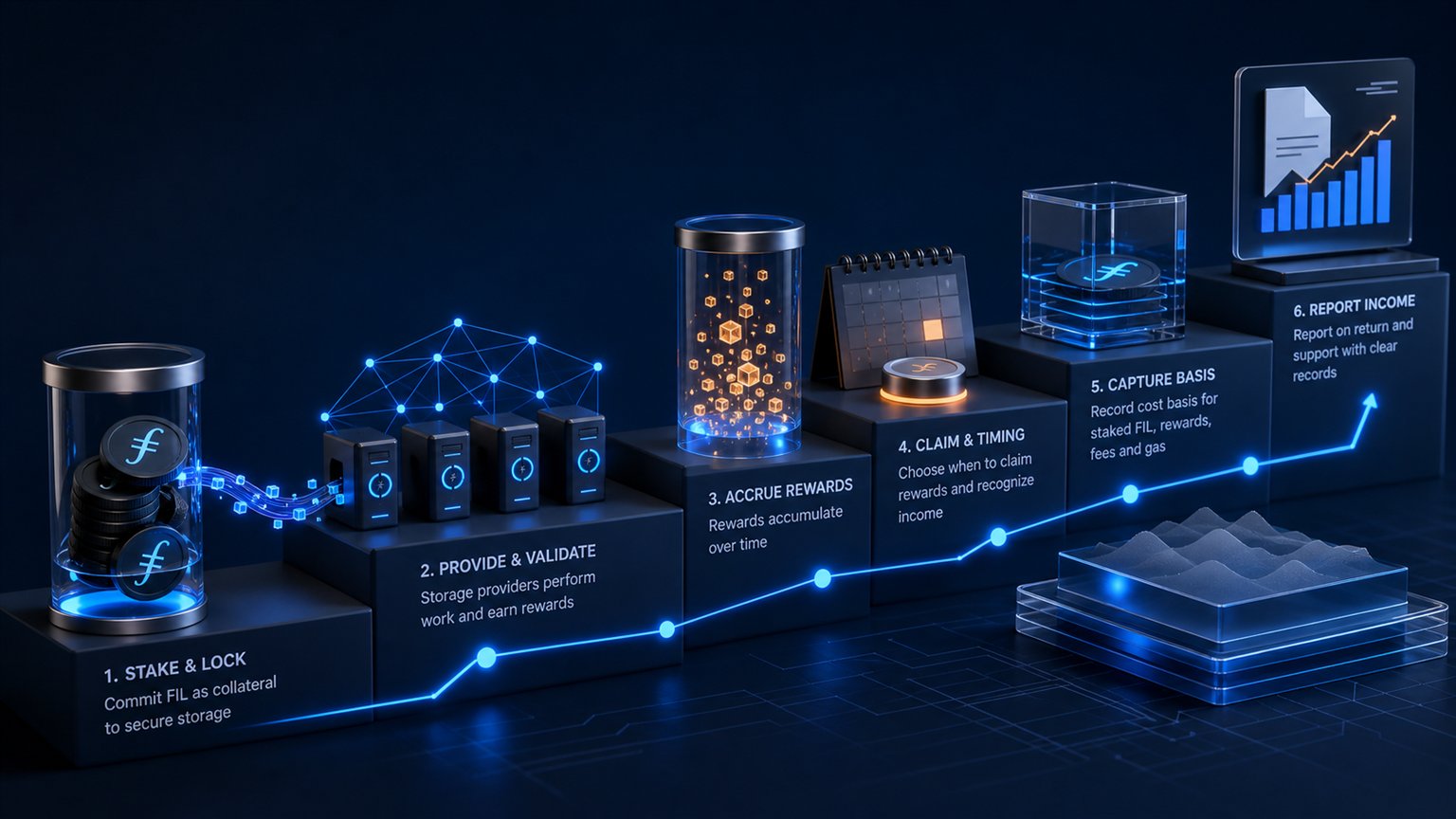
Filecoin is a storage network, not a simple proof-of-stake product. A storage provider can receive block rewards, storage payments and retrieval fees while locking FIL as pledge or deal collateral and facing protocol penalties. This guide separates those flows, explains the IRS rules that can apply and identifies where Filecoin-specific judgment is still required.
How is Filecoin taxed in the United States?
Prepare Your Crypto Tax Workpapers
Import your transactions, review the results and generate detailed tax workpapers without building the entire calculation manually in spreadsheets.
Start for free →For federal tax purposes, FIL is a digital asset treated as property. Buying FIL with US dollars is generally an acquisition, while selling, swapping or spending FIL can create gain or loss. Receiving FIL as compensation for storage, retrieval, validation or other services can create ordinary income before any later disposition.
Filecoin protocol vocabulary does not determine the tax result. A line called “reward” may be newly earned property, a locked claim, a release of previously recognized income or a transfer between provider subaccounts. A line called “collateral return” may be the return of the provider's own FIL rather than income. The ledger needs economic classification before tax forms are generated.
| FIL flow | Typical federal starting point | Key evidence |
|---|---|---|
| Buy FIL with dollars | Acquisition, not income by itself | Date, units, USD cost, fee and account |
| Sell or swap investment FIL | Capital gain or loss if FIL is a capital asset | Proceeds, basis, costs and holding period |
| Earn FIL from storage or retrieval service | Ordinary service/business income when received under the applicable accounting rule | Deal, invoice, units, USD value and control date |
| Earn consensus or block reward | Potential ordinary provider income; timing depends on receipt and restrictions | Reward event, vesting table, lock and slashing rights |
| Lock owned FIL as pledge collateral | Not automatically income or a sale if beneficial ownership is retained | Source lot, actor, sector, lock and release |
| Receive owned collateral back | Return of principal is not itself new income | Original pledge matched to returned units |
| FIL slashed or burned | Separate loss/expense analysis; not automatically a capital loss | Protocol cause, amount, business purpose and basis |
| Move FIL between owned addresses | Nontaxable transfer except FIL used for transaction services | Ownership proof, message CID and carried lot basis |
FIL sales, swaps and payments
An investor generally computes gain or loss as amount realized minus adjusted basis. FIL held for one year or less generally produces short-term character; FIL held for more than one year generally produces long-term character. Inventory or FIL held mainly for sale to customers is not a capital asset, and a storage provider's business facts can require different treatment.
Swapping FIL for USDC, BTC or another digital asset is a disposition even if no dollars reach a bank account. The outgoing FIL must be valued in US dollars and the received asset starts a separate basis record. Spending FIL for hosting, hardware or a network service also disposes of FIL; the acquired cost may then be deductible or capitalized under the rules for the underlying business item.
Example: partial FIL sale
- A taxpayer buys 1,000 FIL for $4,000 plus a $20 qualifying acquisition cost.
- The lot basis is $4,020, or $4.02 per FIL in this simplified example.
- The taxpayer later sells 300 FIL for $1,800 and incurs a $12 qualifying sale cost.
- Amount realized is $1,788 and the sold units have $1,206 of basis.
- The recognized gain is $582; its character depends on the actual holding period.
- The remaining 700 FIL retain $2,814 of basis.
Storage-provider rewards are not ordinary proof-of-stake rewards
The Filecoin protocol describes storage providers that commit storage, prove continued storage and can participate in Storage Power Consensus. Providers may earn block rewards and fees and may separately be paid under storage or retrieval arrangements. This is operational activity, not merely delegating a token to someone else's validator.
Notice 2014-21 states that successfully mined convertible virtual currency is gross income at fair market value upon receipt. It also states that if mining is a trade or business conducted by an individual other than as an employee, net earnings from that business can be self-employment income. A Filecoin provider should apply those general principles to its actual services and consensus activity; the IRS has not published a Filecoin-specific ruling that labels every protocol flow “mining.”
Business status and self-employment tax
A serious storage-provider operation commonly has business indicators: substantial hardware, power and bandwidth, repeated deals, service commitments, profit motive and continuing operational work. But the old article's statement to “add 15.3%” to every reward was inaccurate. Self-employment tax applies to qualifying net earnings and is subject to statutory calculation, Social Security wage-base interaction and additional Medicare-tax rules. It is not a flat surcharge on every gross FIL credit.
- Gross receipts: block rewards, storage compensation, retrieval fees and other provider consideration must be separately identified.
- Ordinary expenses: power, bandwidth, hosting, software and repairs may be deductible if ordinary, necessary and properly substantiated.
- Capital assets: servers, storage equipment and infrastructure may require capitalization and depreciation rather than immediate deduction.
- FIL paid as an expense: the payment can also create gain or loss on the spent FIL.
- Inventory or customer sales: provider facts can affect whether later FIL dispositions are capital or ordinary.
A nonbusiness recipient of an isolated reward or service payment may have ordinary income without Schedule C treatment. Classification should be supported by the scale, continuity and purpose of the activity rather than selected solely to obtain deductions.
Storage payments, retrieval fees and deal economics
The Filecoin specification distinguishes block rewards from storage-market payments and collateral. A client and provider negotiate storage terms, and the provider can be paid for storing data. Retrieval services may also generate compensation. For a cash-method provider, FIL received or made available as service compensation is generally measured in US dollars when actually or constructively received, subject to restrictions and the actual contractual flow.
Record the deal identifier, client, service period, agreed price, payment schedule, address, message CID and USD fair market value. If a payment covers a future service period, accounting timing can require more analysis. An accrual-method entity should not apply a cash-method shortcut without reviewing its method of accounting.
| Provider receipt | Tax data needed |
|---|---|
| Storage deal payment | Service terms, earned period, payment release and USD value |
| Retrieval fee | Request, service completion, payer and units received |
| Block/consensus reward | Award event, locked and immediately available portions, vesting and slashing |
| Subsidy or grant | Program agreement, required activity and restrictions |
| Reimbursement | Underlying cost and accountable-plan or business treatment |
When are locked or vesting FIL rewards income?
The Filecoin specification says block rewards can be locked in a provider's vesting table and released over future epochs. Locked rewards also function as collateral and can be exposed to slashing. The protocol can change through network upgrades, so a tax report should read the applicable actor state rather than assume one permanent “180-day” schedule for every year and provider.
There is no IRS ruling that specifically says every Filecoin reward is taxed at each daily vest or entirely at the initial award. General federal questions include whether property was received, whether the taxpayer had dominion and control, whether a substantial risk of forfeiture remained and whether section 83 applies to property transferred in connection with services. Revenue Ruling 2023-14, although written for native staking rewards, illustrates that inability to sell or otherwise dispose of reward units can delay income until dominion and control exists. Its facts do not automatically resolve Filecoin's provider and collateral structure.
Three timing records, not one timestamp
- Award: when the network attributed the reward to the provider.
- Vesting/unlock: when units ceased to be locked or slashable under the relevant rule.
- Withdrawal/control: when the provider could transfer, sell or otherwise dispose of the FIL.
A report should preserve all three and document the adopted tax position. If income was recognized at an earlier legally supportable time, later release of the same principal is not income again. The recognized USD amount generally creates basis in the reward units for the later sale. If the units are later forfeited, the prior income inclusion and the character of the resulting loss require reconciliation.
Initial pledge, deal collateral, penalties and slashing
Filecoin requires several collateral mechanisms. Initial pledge supports sector commitments; provider deal collateral supports storage deals; unvested block rewards can also secure performance. Locking FIL that the provider already owns does not automatically transfer it in a taxable sale if the provider retains beneficial ownership and receives the same property back. The ledger must not book a pledge as an expense and its release as income merely because units moved between protocol actors.
Slashing and burned amounts are different. A protocol penalty may reduce owned FIL, pledged principal or unvested rewards. Tax treatment depends on what was lost, whether it had basis or had already been included in income, and whether the loss arose in a trade or business. A business penalty is not automatically deductible: capitalization rules, section 162, section 165 and public-policy limitations can be relevant. A capital-asset loss generally needs a sale, exchange or other recognized event and cannot be assumed from the word “burn.”
- Match every collateral lock to its original FIL lot.
- Keep pledged principal separate from newly earned rewards.
- Track unlocks as return of principal unless facts show a new receipt.
- Identify whether slashing consumed basis-bearing principal or unrecognized locked reward.
- Record the fault, sector, protocol calculation and business reason.
- Do not combine pledge, deal collateral, gas burn and termination penalties into one “fee” total.
Filecoin gas, burned fees and transaction costs
FIL used to pay network transaction services is disposed of. Its USD value and adjusted basis must be tracked even when the related message is a provider operation. The tax treatment of the cost follows its purpose: it may adjust basis or amount realized in an asset transaction, be an ordinary and necessary business expense, or require capitalization. A failed message or burned amount is not automatically a capital loss.
For provider accounting, separate BaseFee burn, miner tip, overestimation burn, penalty and collateral movement where the chain data permits. Economically different charges can have different timing and deductibility. Deducting a USD fee in Schedule C while also subtracting the same FIL disposition cost from a capital sale can double count the expenditure.
Wallet-by-wallet FIL basis and Form 1099-DA in 2026
Digital-asset basis identification became wallet- or account-specific beginning January 1, 2025. FIL held at a US broker, in a Lotus owner address, worker address, beneficiary address and a separate self-custody wallet cannot be treated as one unrestricted universal lot pool. Internal provider movements can be nontaxable, but lot basis and holding period must follow the units.
Custodial brokers began gross-proceeds reporting on Form 1099-DA for reportable transactions effected on or after January 1, 2025. Basis reporting phases in for certain transactions effected on or after January 1, 2026. Pre-2026 FIL, transferred-in units and FIL generated by a storage provider can be noncovered even if a later custodial sale produces a Form 1099-DA.
| FIL sold in 2026 | Likely reporting issue |
|---|---|
| Bought in 2026 and continuously held by the same custodial broker | May qualify as covered with broker-reported basis |
| Bought before 2026 in that account | Generally acquired before the digital-asset basis phase-in |
| Transferred from a provider or self-custody address | Broker may know proceeds but not historical basis or income date |
| Earned as provider reward | Income basis must come from provider records; not created by the later broker sale form |
| Sold on a noncustodial venue | Current noncustodial transactions are outside the same broker reporting duty |
Reconcile Form 1099-DA once; do not add it as a duplicate transaction source. Compare proceeds, covered status, basis and short/long classification with the provider and wallet ledger. See the Form 1099-DA guide for the 2026 phase-in.
Which federal forms can apply to FIL?
| FIL item | Common federal path |
|---|---|
| Investor sale, swap or spending of capital-asset FIL | Form 8949 and Schedule D |
| Storage-provider sole proprietorship gross receipts and expenses | Schedule C and potentially Schedule SE |
| Depreciable provider hardware | Form 4562 and business depreciation records |
| Nonbusiness ordinary FIL income | Schedule 1 or other applicable income line based on the source |
| FIL paid to employees or contractors | Employment or information-reporting rules based on the relationship |
The digital-asset question must also be answered. Receiving provider rewards, selling, swapping or paying fees with FIL generally points to “Yes.” Merely holding FIL or moving principal between owned addresses can fit the IRS “No” examples if no other digital-asset transaction occurred, except that FIL used for the network fee remains a digital-asset transaction.
The Form 8949 and Schedule D guide covers investor dispositions. Provider businesses should use a business reporting workflow that preserves books, actor state and operating costs rather than treating every line as a retail trade.
Filecoin provider and investor recordkeeping checklist
- Export every custodial exchange and FIL wallet or address used during the year.
- Map owner, worker, control, beneficiary and payout addresses to the same provider where appropriate.
- Retain message CID, height/epoch, UTC timestamp, method, value, fee and counterparty actor.
- Separate purchased FIL, earned rewards, service payments and returned collateral.
- Capture reward award, lock, vest, withdrawal and slashing states.
- Measure USD fair market value at the tax position's documented receipt time.
- Create basis for FIL included in income and prevent a second income inclusion on unlock.
- Carry basis through owned-address and actor movements.
- Reconcile pledge principal, deal collateral, locked funds, available balance and burned funds.
- Separate capital equipment, operating expenses and FIL dispositions used to pay them.
- Reconcile Forms 1099-DA or other information returns without duplicating chain data.
- Archive raw node/actor exports, pricing source, tax settings, corrections and final return workpapers.
Explorer data can prove that a message occurred, but it may not prove ownership, accounting method, business purpose or when a locked reward became taxable. A complete report combines chain state, provider books, contracts and US-dollar pricing. The broader US crypto reporting guide explains the return-level reconciliation.
Common Filecoin tax errors
- Calling Filecoin storage provision ordinary proof-of-stake delegation.
- Applying a permanent 180-day tax schedule without checking current actor state.
- Recognizing reward income at award and again at every unlock.
- Treating returned pledge collateral as new income.
- Deducting all slashed or burned FIL as an automatic capital loss.
- Applying 15.3% self-employment tax directly to gross FIL rewards.
- Ignoring basis created by prior reward-income inclusion.
- Using one global FIFO/HIFO pool across broker, provider and self-custody addresses.
- Assuming a broker knows the basis of transferred-in provider rewards.
- Adding Form 1099-DA sales on top of the same imported FIL transactions.
Frequently asked questions
Is buying FIL with dollars taxable?
The purchase is an acquisition and does not itself create gain or income. Keep units, USD cost, transaction cost, date and account for the later disposition.
Are Filecoin storage-provider rewards taxable?
Rewards and service compensation can be ordinary income. The exact category and timing depend on the provider activity, receipt, restrictions and accounting method; the IRS has not issued a Filecoin-specific ruling.
Are all locked FIL rewards taxed only when they vest?
Not automatically. Preserve award, lock, vest and control dates and analyze dominion and control, forfeiture risk and any section 83 issue. Do not assume one timing rule for every provider.
Is returned Filecoin collateral income?
The return of the provider's own pledged principal is not new income by itself. It must be matched to the original lock so that rewards are not mixed with collateral.
Can a Filecoin provider deduct slashing?
Possibly, but not automatically. Treatment depends on whether principal or unrecognized rewards were lost, the business purpose, basis and applicable expense or loss provisions.
Does a storage provider always owe 15.3% self-employment tax?
No. Self-employment tax is computed on qualifying net earnings under the statutory rules, not as a flat charge on every gross FIL receipt.
Will Form 1099-DA show basis for provider-earned FIL?
Usually not merely because the FIL was later transferred to a broker. Transferred-in or provider-earned units can be noncovered, so income and basis records must come from the taxpayer.
Is moving FIL between my own addresses taxable?
The principal movement is generally nontaxable when ownership does not change, but FIL used for transaction services is disposed of and must be recorded.
Official and primary sources
- IRS Digital Assets: property, income, records and forms
- IRS Notice 2014-21: mining, services and self-employment principles
- Revenue Ruling 2023-14: reward dominion-and-control timing on its stated facts
- 2026 Instructions for Form 1099-DA
- IRS Instructions for Schedule C
- Filecoin specification: storage provider operations and locked funds
- Filecoin specification: pledge, block-reward and deal collateral
- Filecoin specification: storage-market deals and payments
- Filecoin documentation: crypto-economics, rewards and slashing
Reviewed against official federal and Filecoin protocol sources available through September 2, 2026. This article provides general US information. Storage-provider entities, accounting methods, section 83 elections, international operations and protocol-specific contracts require professional review.
Related Resources
Generate Your Crypto Tax Report
Import your transactions, review the results and generate a detailed PDF report with a transaction-level audit trail.
Start for free →Disclaimer: This article is for general informational purposes only and does not constitute tax advice. For individual tax advice, consult a licensed tax professional.