Hedera HBAR Taxes in the US: Staking, Transactions and 2026 Filing
HBAR follows the federal property rules for digital assets, but Hedera creates a distinctive recordkeeping issue: native staking rewards may accrue for eligible 24-hour periods and remain pending until a qualifying account event pays them. That is not the same as every account receiving a separate taxable payment every day. A defensible US filing connects Hedera payout records, fair market value, cost basis and later dispositions without counting the same HBAR twice.
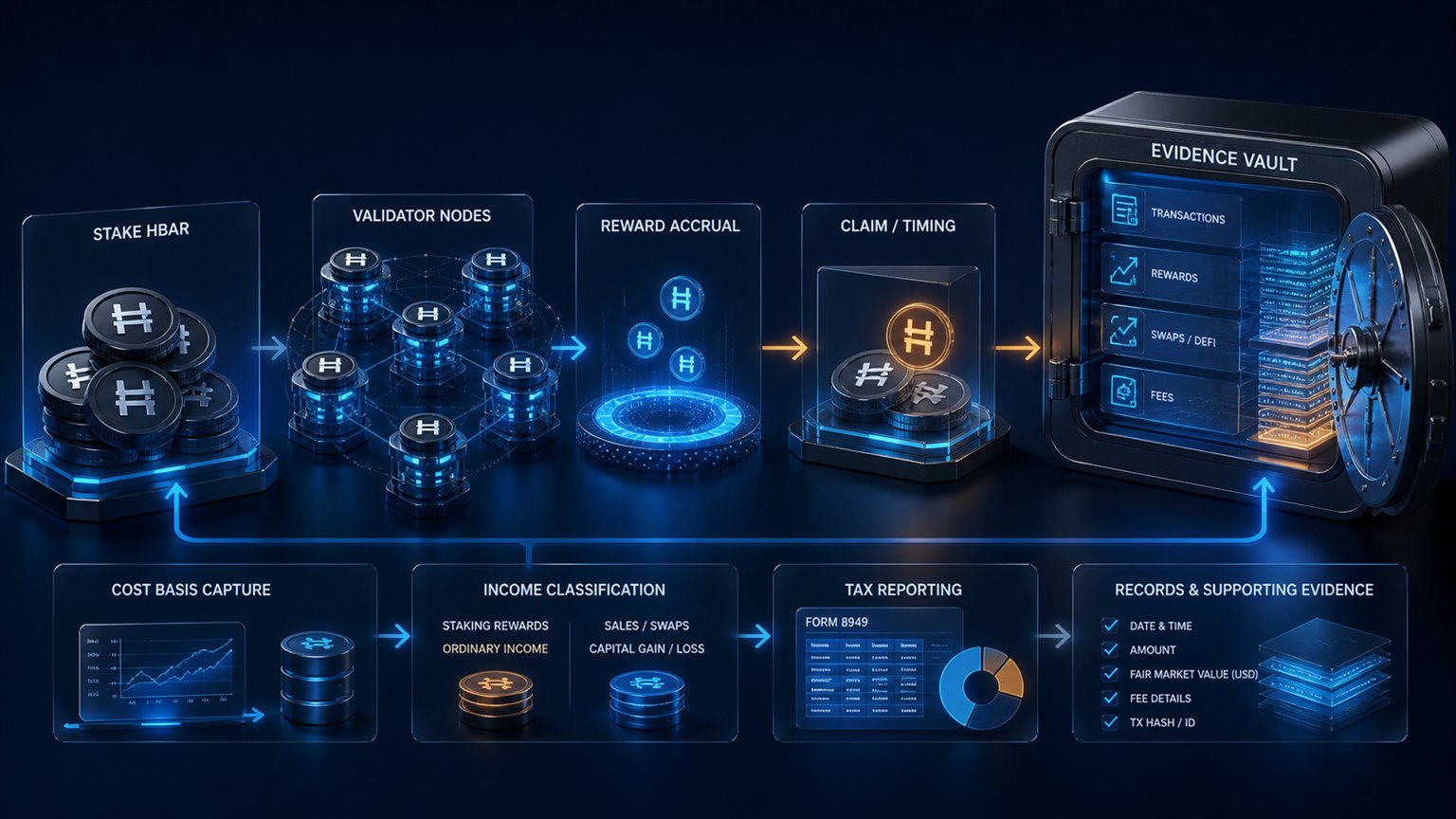
Short answer: how is HBAR taxed in the United States?
Prepare Your Crypto Tax Workpapers
Import your transactions, review the results and generate detailed tax workpapers without building the entire calculation manually in spreadsheets.
Start for free →The IRS treats a digital asset as property. HBAR has no separate federal exemption. Buying HBAR with US dollars and holding it generally does not create gain or loss. Selling HBAR, exchanging it for another token, spending it, or using it to pay a transaction cost can be a disposition. For an investment asset, the difference between proceeds and adjusted basis is generally reported as capital gain or loss.
HBAR received as staking rewards, compensation or payment for services can create ordinary income measured in US dollars when the taxpayer obtains dominion and control. The same units then receive basis. A later sale creates a second calculation only for the change in value after receipt.
| HBAR activity | Likely federal treatment | Record needed |
|---|---|---|
| Buy HBAR with USD | Generally an acquisition, not a disposition | Units, date, USD cost and acquisition fee |
| Move HBAR between owned accounts | Generally not a sale | Linked withdrawal, deposit, account IDs and fee |
| Sell HBAR for USD | Capital disposition if held for investment | Proceeds, basis, dates and units |
| Swap HBAR for another token | Disposition of HBAR and acquisition of the received asset | USD fair market values and transaction ID |
| Receive native staking reward | Income when dominion and control is obtained | Actual payout, timestamp, units and USD value |
| Pay a fee in HBAR | Fee treatment plus possible HBAR disposition | Fee units, purpose, value and basis |
HBAR sales, swaps, spending and self-transfers
A sale for dollars, a swap for an Hedera Token Service asset, a purchase of goods or services and a transfer of ownership are all capable of producing a taxable disposition. Proceeds are the US-dollar value received, reduced or adjusted for transaction costs under the applicable current-year instructions. Gain or loss equals proceeds minus adjusted basis.
A transfer between two wallets or accounts belonging to the same taxpayer generally does not change beneficial ownership. It should not be turned into a sale merely because one export labels the withdrawal as “send” and another labels the deposit as “receive.” The original acquisition date and basis continue with the transferred units. Network fees consumed during the transfer must be tracked separately.
HBAR used for a network fee
Hedera fees are denominated in US dollars but charged in HBAR. When an investor uses appreciated HBAR to pay a personal transaction cost, the consumed units can themselves have a gain or loss. The fee may also affect the basis or proceeds of the related acquisition or disposition. Do not record the gross wallet balance change, the transaction fee and the reward payout embedded in the same transaction as three unexplained trades.
The IRS says a digital-asset disposition can include using an asset to pay broker transaction costs. The exact reporting of other network fees depends on what the transaction accomplished. Preserve enough detail to apply the current Form 8949 instructions consistently.
HBAR native staking: accrual, payout and taxable timing
Hedera native staking differs from a simple daily interest credit. Hedera describes 24-hour reward periods, but rewards earned for eligible periods can remain pending. Its current staking explanation says rewards are paid when the account balance changes because HBAR is sent or received, when staking settings are updated, or when the account auto-renews. Hedera also states that rewards can be collected only for a limited historical period, currently up to 365 days back.
The IRS rule is expressed differently. Revenue Ruling 2023-14 says a cash-method taxpayer includes the fair market value of staking rewards when the taxpayer gains dominion and control, meaning the taxpayer can sell, exchange or otherwise dispose of the rewarded units. It does not create an HBAR-specific rule and expressly does not resolve every possible staking fact pattern.
Practical HBAR timing rule
- Identify each on-ledger staking reward payout, not merely an estimated annual percentage rate.
- Record the consensus timestamp, HBAR units and account receiving the payout.
- Determine when the taxpayer could actually transfer or dispose of those units.
- Measure US-dollar fair market value at that date and time using a documented pricing policy.
- Create a matching basis lot for the rewarded HBAR.
- When that lot is later sold or swapped, calculate only the post-receipt gain or loss.
An actual Hedera payout record is strong operational evidence of receipt. A displayed “pending reward” should not automatically be converted into 365 income entries. At the same time, a taxpayer who can freely trigger or claim pending rewards may need advice about constructive receipt and dominion and control before assuming deferral until a voluntary payout. The facts, wallet terms and taxpayer control matter.
Native staking is not exchange staking
For HBAR held through an exchange or custodian, the platform agreement determines when rewards are credited and available. Revenue Ruling 2023-14 applies its dominion-and-control principle to rewards received through a crypto exchange too. Use the custodian’s reward ledger and withdrawal availability, not the Hedera account-payout mechanics, if the customer never controls the underlying Hedera account.
How to find Hedera staking reward records
The Hedera Mirror Node REST API exposes account information, transactions and a dedicated account rewards endpoint. The account response can also show a pending_reward amount, while /api/v1/accounts/{id}/rewards returns past staking reward payouts. These are different data concepts and should remain separate in a tax import.
- Store the Hedera account ID or EVM alias for every controlled account.
- Export or query the complete transaction period, including the opening-balance history.
- Retrieve past staking reward payouts for each account.
- Capture consensus timestamps and transaction IDs.
- Separate HBAR transfers, token transfers, smart-contract calls and assessed fees.
- Reconcile the opening balance plus inflows, rewards and outflows to the closing balance.
- Archive the raw response or export used to prepare the return.
A wallet interface or explorer view is useful for inspection, but it is not by itself a complete tax workpaper. Pagination, aliases, token associations, internal contract transfers and reward payouts can cause a visible transaction list to differ from the economic ledger.
Hedera Token Service assets, DeFi, NFTs and airdrops
An HBAR-to-token swap is not ignored merely because both assets remain on Hedera. The HBAR disposition and the basis of the acquired token need consistent US-dollar values. A later token sale, redemption or swap then uses the token’s own basis.
DeFi deposits and withdrawals require a contract-by-contract analysis. If a user transfers assets and receives a materially different token or enforceable right, the transaction may be an exchange; if the protocol relationship is closer to an agency or custody arrangement, the analysis may differ. The IRS has not issued a universal “all liquidity deposits are taxable” or “all wrappers are tax-free” rule. A tax engine should preserve the actual transfers and flag uncertain transformations instead of silently forcing one answer.
Liquidity incentives, farming rewards and other token distributions can be income when the recipient obtains dominion and control. The subsequent disposition is a separate basis calculation. An unsolicited or still-unclaimable token should not be assigned income solely because a block explorer displays it; control and the surrounding facts remain important.
Buying an NFT with HBAR can dispose of the HBAR used for the purchase and establish basis in the NFT. Selling the NFT is another transaction. Collectible-rate rules may become relevant to certain NFTs based on the rights or asset represented, so the token label alone is not enough.
HBAR cost basis and lot identification
Adjusted basis generally begins with the acquisition cost and applicable transaction costs. HBAR received as taxable reward income generally starts with basis equal to the amount included in income. HBAR moved between owned accounts retains its historical basis; it does not receive a new zero basis or market-value basis on arrival.
Specific identification requires adequate, timely records. A software package should not retroactively select whichever HBAR lots produce the lowest tax unless the taxpayer satisfied the applicable identification requirements. If identification fails, the federal default ordering rules can apply. The US crypto capital-gains guide explains holding periods, capital-loss netting and lot controls.
Worked example: reward income and later sale
A Hedera account receives an on-ledger payout of 100 HBAR when the taxpayer can transfer it. If 100 HBAR is worth $8 at that time, the taxpayer generally records $8 of ordinary income and an $8 basis lot. If those same 100 HBAR are later sold for $11, the later capital gain is $3 before relevant disposition costs. Reporting $11 of gain with zero basis would count the original $8 economic value again.
Worked example: swap and network fee
An investor swaps HBAR worth $500 for an HTS token and pays 2 HBAR of transaction fees. The report must identify the disposed HBAR lots, the USD value of received tokens, and the purpose and basis of the fee units. It should not use the received token quantity as if it were US-dollar proceeds.
Form 8949, Schedule D, income and Form 1099-DA
Investment sales and exchanges generally flow through Form 8949 and Schedule D. For 2025 returns, the IRS introduced digital-asset categories G, H and I for short-term transactions and J, K and L for long-term transactions. The correct category depends on whether Form 1099-DA reported the transaction and whether basis was reported to the IRS. See the Form 8949 crypto instructions before aggregating rows.
Form 1099-DA reports broker proceeds and, in some cases, basis. A self-custodied Hedera account or decentralized exchange activity may not generate a form. The IRS explicitly says taxpayers must report digital-asset income, gains and losses whether or not they receive Form 1099-DA. Gross proceeds are not taxable profit, and a broker’s missing basis is not automatically zero basis.
Staking and service income belongs on the form and schedule appropriate to the taxpayer’s activity. Occasional investment rewards, a trade or business, employee compensation and independent-contractor services are not interchangeable classifications. A Form 1099-MISC or another information return is a reconciliation input, not the legal classification itself.
Answer the digital-asset question on Form 1040 using the current instructions. Do not assume that checking the question replaces Form 8949 or income reporting. State tax treatment also depends on residence and state conformity and is outside a single federal HBAR calculation.
HBAR tax-report workflow and controls
- List every Hedera account ID, alias, exchange account and wallet controlled during the year.
- Load complete ledger history and independently retrieve staking reward payouts.
- Link self-transfers and carry historical acquisition dates and basis.
- Classify purchases, sales, swaps, spending, fees, rewards and contract interactions.
- Price taxable events in US dollars at consistent timestamps.
- Create basis lots for purchased and income-received HBAR.
- Reconcile wallet balances and investigate unexplained HBAR or token changes.
- Reconcile broker forms without treating missing forms as tax exemptions.
- Separate income reporting from later Form 8949 dispositions.
- Retain raw exports, API responses, price evidence and classification notes.
The crypto tax records checklist provides a broader multi-wallet control list. For reward-specific questions, use the US staking tax guide.
Common HBAR tax errors
- Creating one income record for every day without checking actual Hedera payouts.
- Ignoring freely claimable rewards without considering constructive receipt.
- Recording reward income and later selling the reward with zero basis.
- Treating every outbound transfer as a sale.
- Ignoring HBAR consumed as transaction fees.
- Assuming an explorer’s visible rows equal the complete account ledger.
- Missing HTS token transfers or smart-contract effects.
- Calling every liquidity transaction automatically tax-free or taxable.
- Using gross Form 1099-DA proceeds as net gain.
- Applying retroactive HIFO without adequate identification.
Frequently asked questions
Is buying HBAR with dollars taxable?
Buying and holding HBAR generally is not a disposition. Keep the date, units, USD cost and acquisition fees because they establish basis.
Does Hedera pay every staking account once per day?
No. Eligible rewards may accrue across 24-hour periods, but Hedera says pending rewards are paid when specified account events occur, such as an HBAR balance change, staking update or auto-renewal.
When is an HBAR staking reward taxable?
Revenue Ruling 2023-14 uses dominion and control: income is measured when the taxpayer can sell, exchange or otherwise dispose of the received units. Hedera payout records are important evidence, while freely claimable pending rewards may require a constructive-receipt analysis.
Is moving HBAR between my own wallets taxable?
A transfer that does not change beneficial ownership generally is not a sale. Carry the original basis and acquisition date and account separately for any HBAR fee.
Is swapping HBAR for another Hedera token taxable?
Generally yes when investment HBAR is exchanged for different property. Calculate proceeds in USD and establish basis in the received token.
Will HashScan or a wallet create my complete tax return?
An explorer or wallet can supply important ledger data, but a complete return also needs linked transfers, USD pricing, adjusted basis, income classification and reconciliation across all accounts.
Do I still report HBAR activity without Form 1099-DA?
Yes. The IRS states that all taxable digital-asset income, gains and losses must be reported whether or not a Form 1099-DA is received.
Are all Hedera DeFi deposits taxable swaps?
No single IRS rule resolves every protocol. Analyze the assets and legal or economic rights exchanged, preserve the transfers and flag uncertain transactions for review.
Official and primary sources
- Hedera: native staking phases, reward periods and payout triggers
- Hedera Mirror Node REST API: accounts, transactions and reward payouts
- Hedera API reference: account data and pending rewards
- IRS Revenue Ruling 2023-14: staking rewards and dominion and control
- IRS: digital asset transaction FAQs
- IRS: 2025 Instructions for Form 8949
- IRS: Understanding Form 1099-DA
- IRS: digital asset filing overview
Legal and network status: September 2, 2026. Hedera staking parameters, broker reporting and IRS forms can change. Use the rules and forms for the actual tax year and preserve the source data used for each conclusion.
Related Resources
Generate Your Crypto Tax Report
Import your transactions, review the results and generate a detailed PDF report with a transaction-level audit trail.
Start for free →Disclaimer: This article is for general informational purposes only and does not constitute tax advice. For individual tax advice, consult a licensed tax professional.