MiCA Crypto Regulation in 2026: What EU Investors Should Check
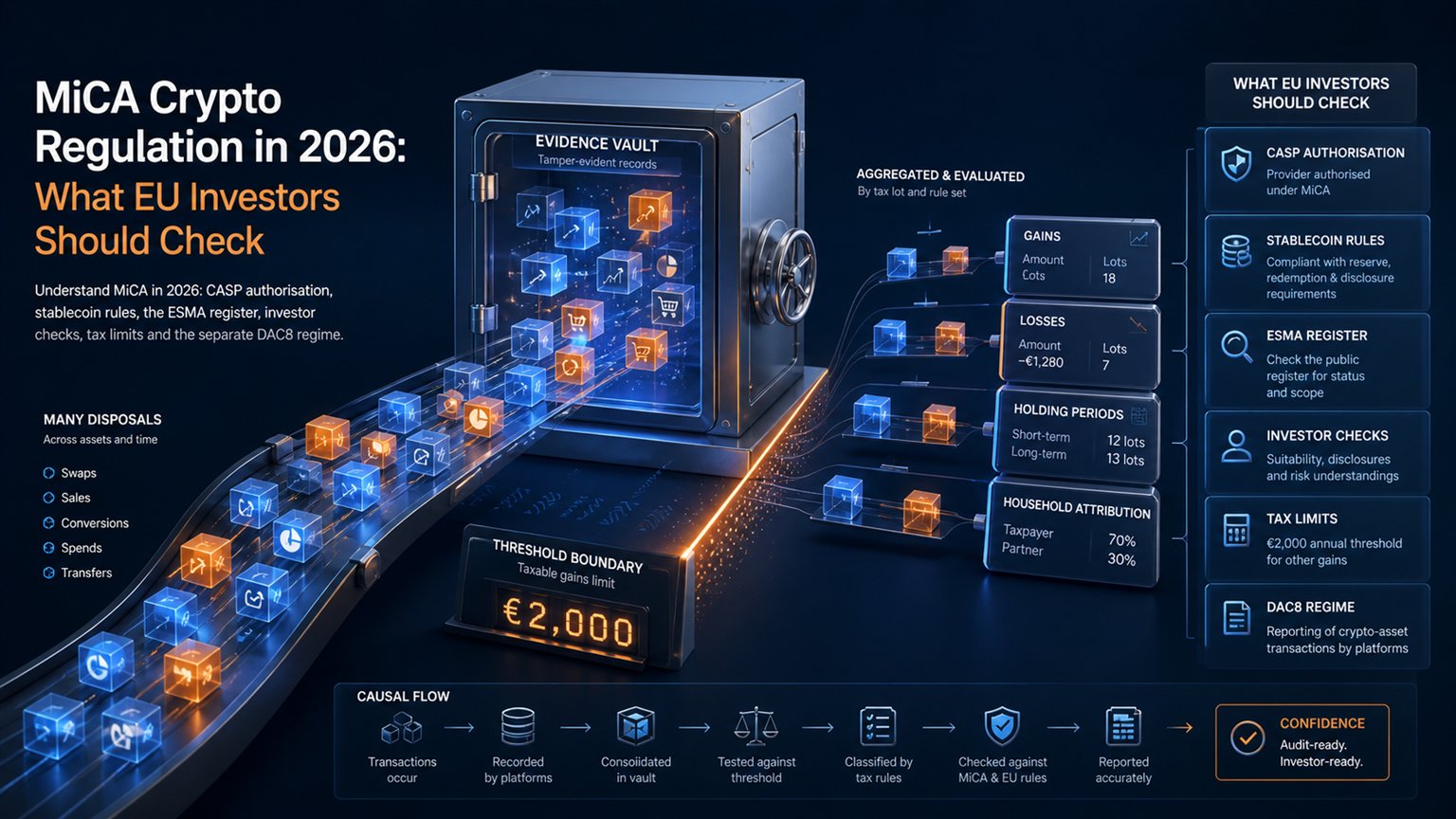
MiCA is now the core EU rulebook for many crypto-asset issuers and service providers, but it is often credited with protections it does not provide. The final grandfathering deadline passed on 1 July 2026. An investor should therefore verify the exact legal entity and authorised services in the ESMA register, understand the separate rules for stablecoins and keep MiCA compliance distinct from national tax law and DAC8 reporting.
MiCA status in September 2026
Prepare Your Crypto Tax Workpapers
Import your transactions, review the results and generate detailed tax workpapers without building the entire calculation manually in spreadsheets.
Start for free →Regulation (EU) 2023/1114 on markets in crypto-assets is directly applicable across the EU. Its Titles III and IV, covering asset-referenced tokens and e-money tokens, applied from 30 June 2024. Most remaining provisions, including the authorisation regime for crypto-asset service providers, applied from 30 December 2024.
Article 143 allowed Member States to grant existing national providers a temporary grandfathering period. That permission could end earlier under national law and could never continue beyond 1 July 2026. ESMA warned clients before the deadline that not every provider would be authorised afterwards. As of September 2026, an old national registration alone should not be presented as a current MiCA authorisation.
What MiCA regulates
MiCA fills parts of the EU regulatory gap for crypto-assets that were not already governed as financial instruments under existing financial-services law. It establishes rules for public offers and admission to trading, issuers of certain crypto-assets, and firms providing listed crypto-asset services.
| Area | What MiCA generally adds | What an investor should verify |
|---|---|---|
| Issuers and offers | White-paper, disclosure and communications requirements | Token category, responsible offeror and warnings |
| Crypto-asset service providers | Authorisation, governance, conduct and prudential requirements | Authorised entity and the specific services listed |
| Custody | Safeguarding, records and liability-related duties | Who holds the keys, client-asset terms and complaint route |
| Trading platforms | Operating, transparency and market-integrity duties | Execution entity, venue and conflicts |
| Market abuse | Rules against insider dealing, unlawful disclosure and manipulation | Whether conduct should be reported to the authority |
The label "MiCA compliant" is too broad on its own. A firm can be authorised for some services but not others. A non-EU affiliate of an authorised group does not inherit the EU entity's status. Investors should compare the contract, website footer, account terms and ESMA entry.
ARTs, EMTs and the MiCA stablecoin rules
MiCA distinguishes asset-referenced tokens (ARTs) from e-money tokens (EMTs). An EMT purports to maintain a stable value by referencing one official currency. An ART references another value or right, or a combination of them, which can include one or more official currencies. The classification affects authorisation, reserve, redemption and supervisory requirements.
A marketing term such as "stablecoin" does not decide the legal category. Investors should identify the issuer, token terms and redemption right. MiCA requirements reduce some issuer and disclosure risks, but they do not guarantee a permanent peg, eliminate smart-contract risk or turn the token into an insured bank deposit.
Tokens offered as EMTs or ARTs can face trading or service restrictions when the issuer or offering does not meet the applicable requirements. The result can differ by token, service, legal entity and jurisdiction; a blanket statement that every exchange must delist every non-EU stablecoin is inaccurate.
How to check a crypto provider after 1 July 2026
- Find the legal entity named in the customer agreement, not only the app or brand.
- Open ESMA's MiCA register and search the authorised CASP list.
- Compare the company name, national competent authority and listed services.
- Check the non-compliant-entities file as well as the authorised list.
- Confirm that deposits and trades are contracted with the authorised EU entity.
- Read custody, complaint, conflicts, execution and wind-down disclosures.
- Repeat the check after a migration, new terms or a change of account entity.
The ESMA register also contains white papers and issuer information. ESMA states that inclusion of a crypto-asset white paper does not mean a competent authority reviewed or approved its contents. A register entry is evidence to examine, not an investment recommendation.
What MiCA does not guarantee
- It does not guarantee token value, yield, liquidity or recovery after failure.
- It does not make every crypto asset equivalent to a regulated security.
- It does not automatically cover a service delivered by an unauthorised non-EU entity.
- It does not approve every white paper listed in the ESMA register.
- It does not create a universal EU crypto deposit-guarantee scheme.
- It does not classify gains, staking rewards or DeFi income for personal tax.
MiCA's scope has boundaries. Crypto-assets already qualifying as financial instruments fall under other EU legislation. Genuinely unique NFTs may be outside MiCA, but a large series, fractional interests or fungible characteristics can point in the opposite direction. Services provided in a fully decentralised manner without an intermediary require a careful factual analysis; using the word "DeFi" does not by itself remove a service from regulation.
MiCA, national crypto tax and DAC8 are separate
MiCA is a regulatory regime. It does not harmonise the income-tax treatment of a Bitcoin sale, token swap, staking reward or DeFi position. The taxpayer still applies the law of the relevant country, tax residence and activity profile. The same transaction can be regulated under MiCA but taxed differently in Germany, France, Italy or another Member State.
DAC8 is the separate tax-transparency directive. It applies from 1 January 2026 and requires reporting crypto-asset service providers to collect information on reportable transactions. The European Commission states that the first reporting year is 2026 and information is reported and exchanged in 2027, with the first exchanges due by 30 September 2027. DAC8 is neither a new tax rate nor proof that the reported cost basis is complete.
Users should reconcile exchange statements with wallets before the first DAC8 exchange. See the DAC8 reporting guide and the crypto tax data-quality checklist. Software selection criteria are covered in our crypto tax software comparison.
Investor and tax-record checklist
- Save the legal name and country of every exchange or custodian used.
- Retain the relevant ESMA register extract and terms for the period used.
- Export complete trades, deposits, withdrawals, income and fee records.
- Connect transfers between owned wallets instead of recording false disposals.
- Preserve acquisition dates and cost basis when moving assets.
- Separate regulatory status, DAC8 reporting and national tax classification.
- Review missing basis, unexplained deposits and duplicate imports before filing.
Frequently asked questions
Is MiCA fully applicable in 2026?
Yes. The main regime applied from 30 December 2024, stablecoin titles from 30 June 2024, and the last possible Article 143 grandfathering period ended on 1 July 2026.
Does a national registration still equal MiCA authorisation?
No. Transitional national operation was not the same as MiCA authorisation, and the final EU grandfathering deadline has passed. Check the current ESMA entry.
Does MiCA make crypto investing safe?
No. It adds authorisation, disclosure, conduct and safeguarding requirements, but market, issuer, custody, technology and fraud risks remain.
Are all stablecoins banned if the issuer is outside the EU?
No blanket conclusion follows from the issuer's location alone. Classification, issuer status, offering, service and legal entity must be checked under the applicable MiCA provisions.
Does MiCA decide my crypto tax?
No. Taxable events, rates, exemptions and filing forms remain questions of national tax law and the taxpayer's facts.
Are MiCA and DAC8 the same?
No. MiCA regulates markets and service providers. DAC8 governs tax-information collection and exchange for reportable crypto transactions from 2026.
Does a white paper in the ESMA register mean it was approved?
No. ESMA expressly warns that listed white papers have not necessarily been reviewed or approved by a competent authority.
Official sources
- EUR-Lex: Regulation (EU) 2023/1114 (MiCA)
- ESMA: MiCA register, implementation and transitional measures
- ESMA: statement on the end of MiCA transitional periods
- European Commission: DAC8 tax transparency for crypto-assets
Sources reviewed 2 September 2026. This article explains the EU framework and is not legal, tax or investment advice.
Related Resources
Generate Your Crypto Tax Report
Import your transactions, review the results and generate a detailed PDF report with a transaction-level audit trail.
Start for free →Disclaimer: This article is for general informational purposes only and does not constitute tax advice. For individual tax advice, consult a licensed tax professional.