Polkadot DOT taxes in 2026: staking, swaps and U.S. reporting
DOT is property for U.S. federal tax purposes. Sales and swaps can create capital gain or loss, while staking rewards can create income when the taxpayer gains dominion and control. Polkadot payout mechanics, nomination pools and legacy crowdloan records make the timing and basis work more important than a simple annual reward total.
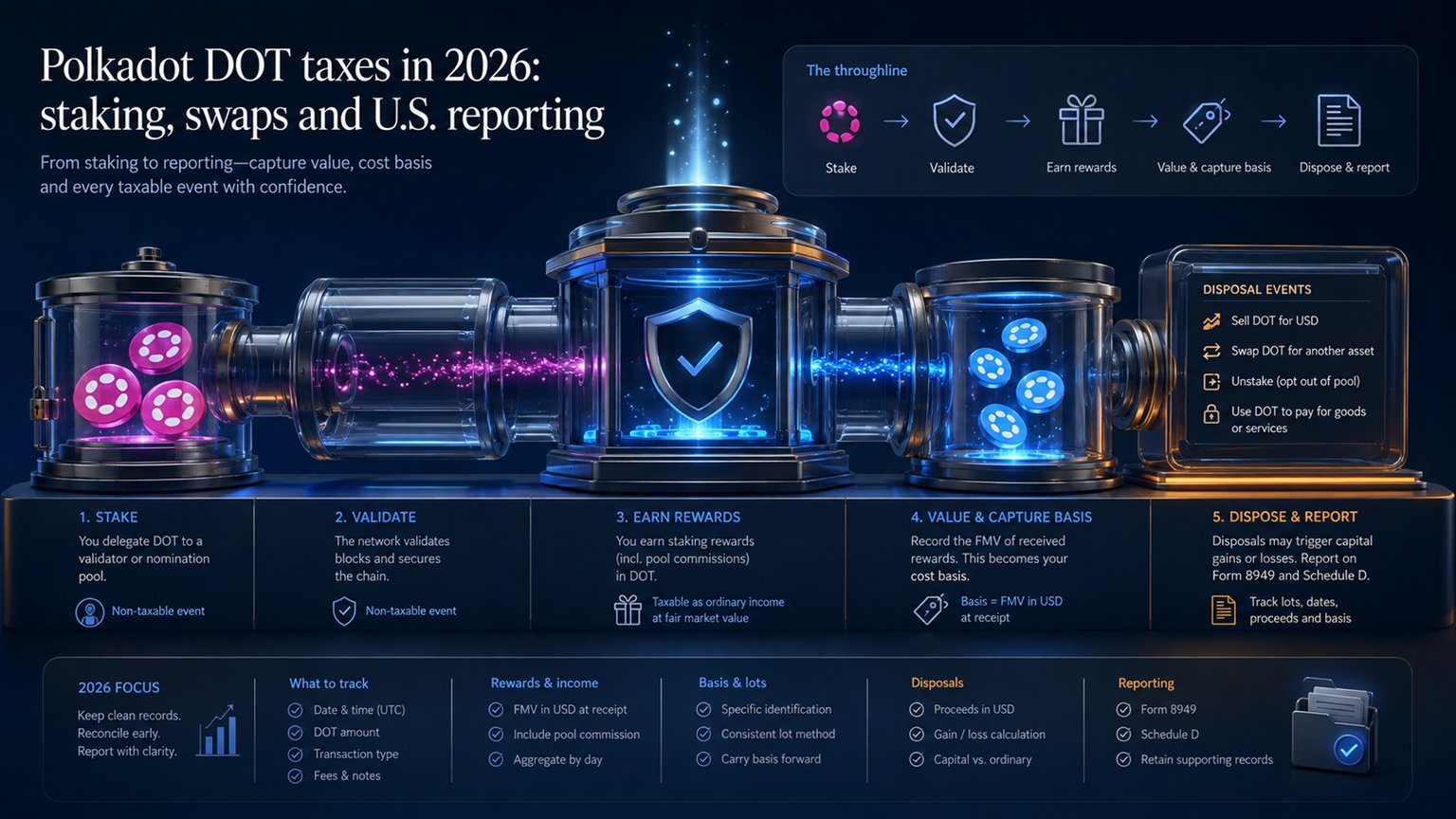
Federal baseline: the IRS treats digital assets as property. Buying DOT with U.S. dollars and holding it generally does not create gain. Selling DOT, exchanging it for another digital asset or using it for property can create a disposition. Staking rewards are analyzed separately from the later sale of the reward units.
Which DOT transactions are taxable?
Prepare Your Crypto Tax Workpapers
Import your transactions, review the results and generate detailed tax workpapers without building the entire calculation manually in spreadsheets.
Start for free →| DOT activity | General federal treatment | Primary record |
|---|---|---|
| Buy DOT with dollars | No gain at purchase | Cost and acquisition date |
| Sell DOT for dollars | Capital disposition for an investor | Proceeds, basis and fees |
| Swap DOT for another token | Property-for-property exchange | USD fair market value |
| Transfer between owned accounts | Generally not a sale by itself | Linked hashes and ownership |
| Receive staking reward | Potential ordinary income | Control date, units and USD value |
| Dispose of rewarded DOT | Separate gain or loss | Reward basis and sale proceeds |
The character depends on how the taxpayer holds the asset. Investment DOT is generally a capital asset; DOT held as inventory or in a trade or business can follow ordinary rules. Token labels do not decide the result.
DOT sales, swaps and holding period
For investment DOT, gain or loss generally equals amount realized minus adjusted basis. A holding period of more than one year can produce long-term capital treatment; one year or less is short-term. A DOT-to-stablecoin trade is not ignored merely because no cash reached a bank account.
Transaction costs must follow the current IRS rules for the transaction they facilitate. Wallet- and account-specific basis rules and adequate identification matter when the taxpayer owns DOT in several locations. The U.S. capital-gains guide explains lot identification without creating a global pool that the records cannot support.
Staking rewards: income when dominion and control exists
Revenue Ruling 2023-14 states that a cash-method taxpayer includes staking validation rewards in gross income when the taxpayer gains dominion and control over the reward units. The amount is their fair market value at that time. That USD value becomes basis in the rewarded DOT, so a later sale creates a separate capital result.
Polkadot calculates rewards by era, but an era calculation is not automatically the same as a taxpayer receiving controllable units. Official Polkadot materials explain that payouts must be triggered and that rewards are minted and distributed through the payout process. The tax record should therefore capture the actual on-chain credit or claim event and the point at which the taxpayer can transfer, sell or otherwise control the units.
This corrects a common shortcut: “one era equals one taxable event” is not a complete tax rule. The actual payout mechanics, custody arrangement and control over the reward must be documented.
Valuing DOT staking income and building basis
Record the date and time control arose, DOT quantity, wallet, transaction or extrinsic identifier, and a consistently applied USD market price. If a payout covers several eras, do not invent separate receipt dates unless the taxpayer actually obtained control on those dates. Validator or pool fees should be shown separately rather than netted invisibly.
Example: a taxpayer receives control of 8 DOT worth $6 each. The income item is $48 and the aggregate basis of those units is $48. If the units are later sold for $64, the later capital gain is $16 before relevant adjustments. Reporting the $64 as both new income and capital proceeds without the $48 basis would double count economic income.
Nomination pools and custodial staking
A nomination pool can change how and when a member claims rewards. An exchange can also credit rewards off-chain before or after a network payout. Use the event that gives the taxpayer actual control under the relevant arrangement; do not assume the validator's era record is identical to the customer statement.
- reconcile network payouts to pool or exchange credits;
- separate gross rewards from validator and platform fees;
- record reward destination accounts and automatic compounding;
- track slashing or forfeiture separately from ordinary selling;
- avoid duplicating the same reward from explorer and broker imports.
Automatic compounding does not eliminate the need to identify when the taxpayer received controllable value. It can instead make basis tracking more granular.
Bonding, unbonding and liquid staking
Moving DOT into a native staking arrangement while retaining the same beneficial ownership is not automatically a sale. The report should retain the original acquisition date and basis unless the legal or economic rights actually change. Network bonding and unbonding records are position documentation, not reward income by themselves.
Receiving a separate liquid-staking or receipt token can present a different question. If DOT is exchanged for property materially different in kind or extent, the IRS property-exchange rules can recognize gain or loss. The token's redemption rights, transferability and contract terms must be reviewed; a user-interface button labeled “stake” does not provide a federal nonrecognition rule.
Legacy parachain crowdloans require transaction-level review
Polkadot's official wiki now describes parachain slot auctions and crowdloans as deprecated after the move to Agile Coretime. Historical crowdloan activity still appears in tax years and basis histories. Do not present crowdloan rewards as a current universal Polkadot feature.
If DOT was merely locked and the same property was later released to the same owner, there may be no sale at the lock or return. A transferable receipt token, disposal of rights, or materially different property can change the analysis. Project tokens or other rewards become a separate asset; their income timing depends on when the taxpayer has dominion and control and whether the receipt represents compensation, a distribution or another arrangement. The IRS has not issued a DOT-specific crowdloan safe harbor, so automatic tax-free treatment is not supportable.
Polkadot ecosystem swaps, bridges and DeFi
DOT can move through system chains, bridges, decentralized exchanges and smart contracts. A cross-chain movement can be a transfer if the same taxpayer retains the same asset and rights, but a wrapped token, LP token or receipt can be different property. Each leg needs asset in, asset out, quantity, USD value, fees and identifiers.
Do not treat every outgoing DOT amount as a sale and do not treat every bridge as tax-free. The protocol contract and what the wallet received are decisive. Missing market values remain flagged as not determinable rather than silently recorded as zero.
Where DOT appears on a U.S. return
Investment sales and exchanges generally flow to Form 8949 and Schedule D, subject to the form instructions and any permitted aggregation. Staking reward income is reported in the location applicable to the taxpayer's facts; operating a validator or staking activity as a trade or business can involve Schedule C and self-employment analysis, while a non-business receipt follows the applicable individual income reporting line.
A broker may issue Form 1099-DA for dispositions or Form 1099-MISC for certain rewards. The absence of a form does not remove the reporting duty. For 2025 dispositions reported on forms furnished in 2026, basis is commonly absent, so the taxpayer must reconcile it. See the Form 8949 filing workflow.
The Form 1099-DA guide explains covered and noncovered reporting. A broker form must be reconciled to wallet activity; it must not be added on top of the same on-chain dispositions as if they were new sales.
DOT tax record checklist
- Import every exchange, wallet and Polkadot account used during the year.
- Match own transfers before calculating dispositions.
- Identify staking payouts by actual control date and destination.
- Assign USD value and basis to every reward lot.
- Review pool, liquid-staking and legacy crowdloan contracts separately.
- Reconcile Form 1099-DA or 1099-MISC without duplicating on-chain rows.
- Retain hashes, extrinsics, price source and method decisions.
Frequently asked questions
Is buying DOT taxable?
Buying DOT with U.S. dollars generally establishes basis but does not create gain at purchase.
Is swapping DOT for USDC taxable?
It can be. Exchanging investment property for materially different digital property generally recognizes gain or loss.
Are Polkadot staking rewards taxable every era?
Not merely because an era ended. Revenue Ruling 2023-14 focuses on when the taxpayer gains dominion and control over reward units; actual payout mechanics matter.
Does restaking a reward avoid income?
No. Automatic compounding does not by itself prevent income if the taxpayer already gained dominion and control.
Are crowdloan rewards tax-free?
There is no IRS DOT-specific exemption. The locked DOT, any receipt token and each reward require separate analysis.
Do I report DOT without a tax form?
Yes. The IRS requires income, gains and losses to be reported even when no Form 1099 is furnished.
Official sources
- IRS Notice 2014-21: digital assets as property
- IRS Revenue Ruling 2023-14: staking rewards and dominion and control
- IRS: current digital-asset transaction FAQs
- IRS: understanding Form 1099-DA and missing basis
- Polkadot Wiki: staking eras, payouts and reward claims
- Polkadot Wiki: Agile Coretime and deprecated crowdloans
Reviewed 2 September 2026 against current IRS and Polkadot materials. This is general federal information; state rules and business facts can differ.
Related Resources
Generate Your Crypto Tax Report
Import your transactions, review the results and generate a detailed PDF report with a transaction-level audit trail.
Start for free →Disclaimer: This article is for general informational purposes only and does not constitute tax advice. For individual tax advice, consult a licensed tax professional.