Stablecoin Taxes in 2026: USDT, USDC and IRS Reporting
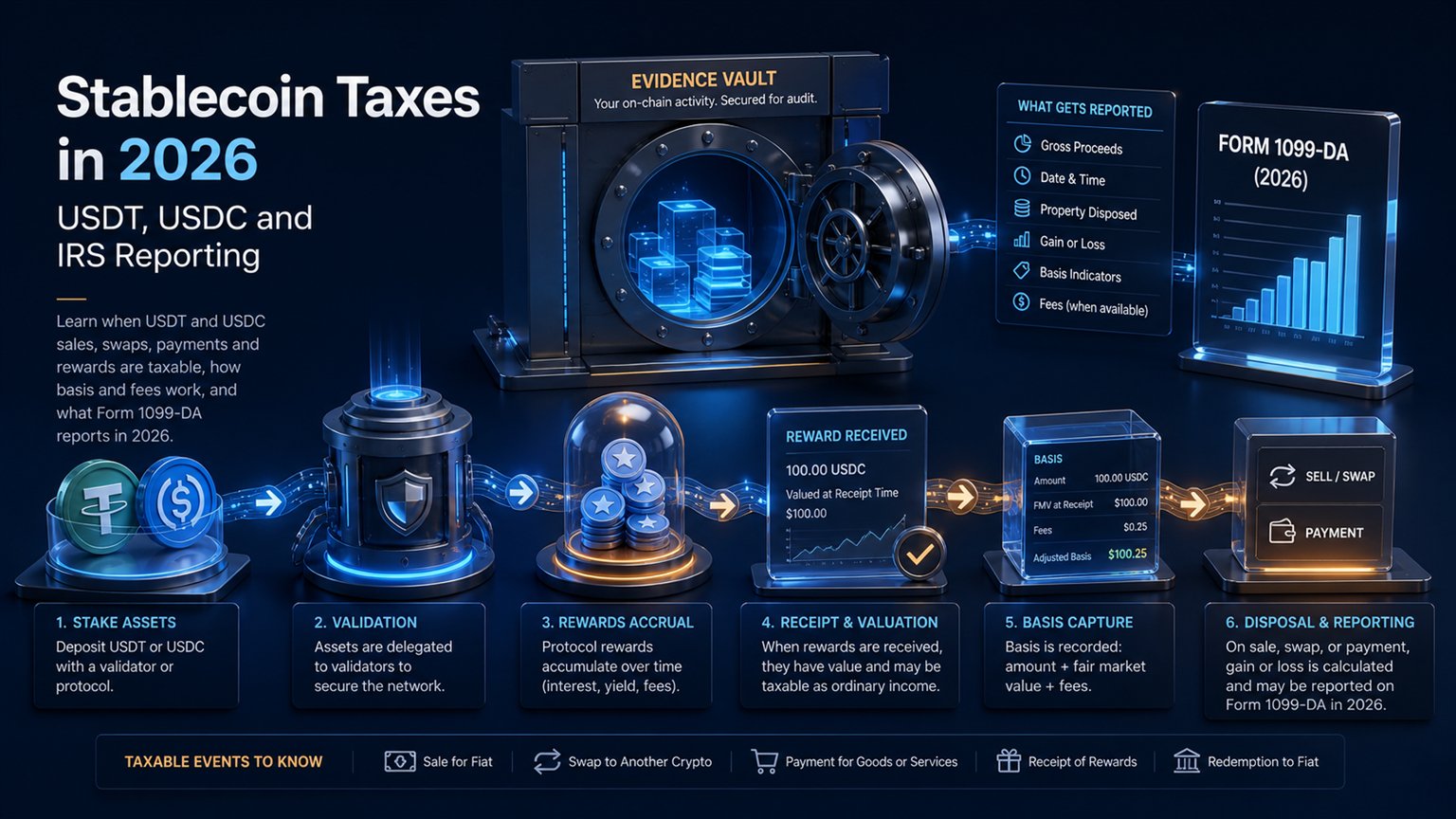
A token designed to stay near one dollar is still a digital asset for U.S. federal tax purposes. Selling, swapping or spending USDT, USDC or another stablecoin can create a reportable disposition even when the economic gain is tiny. Beginning with 2026 sales, Form 1099-DA includes special optional broker rules for qualifying stablecoins, but its 10,000-dollar threshold is not a taxpayer exemption.
Are stablecoins taxable in the United States?
Prepare Your Crypto Tax Workpapers
Import your transactions, review the results and generate detailed tax workpapers without building the entire calculation manually in spreadsheets.
Start for free →Yes, stablecoins fall within the IRS definition of digital assets and are treated as property for federal income-tax purposes. The word "stable" describes a design objective, not a tax exemption. If an investor disposes of a stablecoin, gain or loss is generally the amount realised minus adjusted basis. If the taxpayer receives stablecoins as compensation or rewards, the receipt can be income.
A one-dollar purchase followed by a one-dollar redemption can produce no material gain, but it is still necessary to substantiate the units, basis and proceeds. Fees, foreign-currency acquisition, discounts, premiums and depegs can make the result non-zero. Rounding every stablecoin transaction to zero before calculation can conceal real gains or losses.
Stablecoin transactions and their typical treatment
| Transaction | Typical U.S. federal treatment | Data to retain |
|---|---|---|
| Buy USDC with USD | Acquisition, generally no gain at purchase | Units, dollars paid and acquisition costs |
| Redeem USDC for USD | Disposition; calculate gain or loss | Proceeds, basis and redemption fee |
| Swap USDT for BTC | Disposition of USDT and acquisition of BTC | Both assets, USD value and transaction costs |
| Swap USDT for USDC | Do not assume tax-free; compare materially different assets | Contract/mint, units, value and fee |
| Pay for goods with a stablecoin | Disposition plus purchase/payment transaction | Stablecoin basis and value of goods |
| Transfer between owned wallets | Generally not a taxable disposal; fee may be | Ownership of both wallets and carried basis |
| Receive stablecoin interest or reward | Potential ordinary income and new basis | Receipt time, units, USD value and activity |
| Sell during a depeg | Actual capital gain or loss for an investor | Timestamped market value and lot basis |
Section 1031 like-kind exchange treatment has been limited to real property since 2018. A crypto-to-crypto exchange therefore does not become tax-deferred merely because both assets track the dollar. The IRS's updated digital-asset FAQs expressly address stablecoin exchanges and state that a capital-asset holder recognises gain or loss even when the broker does not report the exchange on Form 1099-DA.
Cost basis, proceeds and transaction fees
Basis normally begins with the U.S.-dollar cost of acquired stablecoins plus properly allocable acquisition costs. If stablecoins are received as taxable income, the U.S.-dollar value included in income generally establishes basis in those units. Gifts, inheritances, business inventory and contributed property follow different rules.
On a sale or exchange, the amount realised is measured in U.S. dollars. The IRS digital-asset FAQs issued in December 2025 provide detailed allocation rules for digital-asset transaction costs. Depending on how the fee is paid and what assets are exchanged, transaction costs can reduce amount realised or affect basis. A tax engine should preserve the original fee asset and not deduct the same cost twice.
Example: an investor acquires 10,000 USDC for 9,980 dollars including allocable acquisition costs. Later, the investor exchanges the 10,000 USDC for property worth 10,040 dollars after the applicable disposition-cost calculation. The resulting gain is 60 dollars, not zero simply because USDC targets one dollar.
Lot identification matters when a wallet contains units acquired at different prices or through income. For 2025 and later years, the federal wallet-by-wallet or account-by-account basis rules and valid identification procedures must be considered. See our U.S. crypto capital gains guide for Form 8949 lot mechanics.
Stablecoins received as wages, services, rewards or yield
Payment in USDT or USDC does not change the character of what was earned. A freelancer paid 2,000 USDC generally measures compensation in dollars when received under the applicable cash-method rules. That amount becomes the starting basis in the USDC. A later redemption or swap is a second transaction with its own gain or loss.
- Employee compensation can be wages subject to payroll reporting and withholding.
- Independent services can create self-employment or business income.
- Referral, learn-and-earn or protocol rewards can be ordinary income when dominion and control exists.
- Lending yield or platform interest requires analysis of the legal arrangement and reporting form.
- A return of the taxpayer's own collateral is not automatically new income.
The report should not combine the initial income with later token appreciation or loss. Income, basis and disposition must remain traceable as separate entries.
DeFi deposits, liquidity pools, bridges and payments
Depositing stablecoins into DeFi can produce a receipt token, LP token, vault share or lending claim. U.S. guidance does not provide a blanket rule making every protocol deposit tax-neutral. Determine whether the user receives materially different property, whether ownership rights changed and how rewards accrue. A withdrawal returning different assets also needs transaction-level review.
Stablecoin bridges should be reconstructed across both chains. A transfer of the same beneficially owned token may be treated as an internal movement, while a burn-and-mint into a different token or protocol claim can require further analysis. Preserve source and destination hashes, token contracts, bridge receipts and fees.
Payments create two records: the expense or acquired item and the stablecoin disposition. Business taxpayers may have an expense subject to ordinary substantiation rules; personal spending generally does not create a deduction. The stablecoin gain or loss is calculated independently.
Form 1099-DA rules for qualifying stablecoins in 2026
For broker sales effected after 2025, Form 1099-DA reporting expands. The 2026 instructions define a qualifying stablecoin using three requirements: it is designed to track one official currency one-to-one, uses an effective stabilisation mechanism and is generally accepted as payment by persons other than the issuer.
A broker may use an optional method for designated sales of qualifying stablecoins. Under that method, the broker generally does not have to report designated sales when the customer's aggregate proceeds for those sales at that broker do not exceed 10,000 dollars for the year. If the threshold is exceeded, the broker can report aggregate proceeds for each type of qualifying stablecoin on a separate Form 1099-DA and may omit basis and acquisition-date fields.
This rule belongs to broker information reporting:
- It is not a 10,000-dollar tax-free allowance.
- It does not let the taxpayer omit gains or losses below the threshold.
- It does not prove that a token is always worth exactly one dollar.
- It can produce an aggregate form without the basis needed for Form 8949.
- Some exchanges for non-qualifying digital assets can be outside the optional designated-sale report even though they remain taxable.
Read the Form 1099-DA guide before reconciling broker proceeds. A blank basis box is not a zero basis instruction.
Stablecoin reporting workflow
- Import every exchange, wallet, payment account and DeFi protocol.
- Identify stablecoins by network and contract address, not ticker alone.
- Connect own-wallet transfers and bridge legs.
- Separate purchases, disposals, income, collateral and internal movements.
- Track basis and holding period by wallet or account under current rules.
- Calculate every disposal before applying rounding to totals.
- Reconcile Forms 1099-DA to transaction detail and restore missing basis.
- Transfer investment dispositions to Form 8949 and Schedule D working papers.
- Retain statements, hashes, price sources and the evidence in the crypto recordkeeping guide.
Frequently asked questions
Is converting USDC to dollars taxable?
It is a disposition. The calculated gain may be zero or small, but basis, proceeds and fees still determine the result.
Is swapping USDT for USDC tax-free?
Do not assume so. They are separate tokens with different issuers and rights; a materially different digital-asset exchange can realise gain or loss.
Is there a 10,000-dollar stablecoin tax exemption?
No. The threshold in the 2026 Form 1099-DA instructions is an optional broker reporting rule, not a taxpayer gain exclusion.
Why is basis missing on an aggregate Form 1099-DA?
The optional qualifying-stablecoin method permits the broker to omit basis and acquisition dates. The taxpayer must reconstruct them from records.
Are stablecoin rewards taxable?
They can be ordinary or business income when the taxpayer obtains dominion and control. Later sale or exchange is a separate disposition.
Is moving USDC between my wallets taxable?
Generally not if both wallets belong to the same taxpayer, but the basis must move with the units and any token used for the fee may be disposed of.
Can a stablecoin depeg create a deductible loss?
A realised sale or exchange can produce a loss for a capital-asset holder. A decline while still holding is generally unrealised, and worthless or abandoned-property rules require separate analysis.
Official sources
- IRS: digital assets, including stablecoins
- IRS: digital-asset transaction FAQs, including stablecoin FAQ 100
- IRS: 2026 Instructions for Form 1099-DA
- IRS Notice 2014-21: digital assets treated as property
- IRS: section 1031 is limited to real property
Sources reviewed 2 September 2026. This guide covers common U.S. federal rules; state, business, gift and insolvency treatment can differ.
Related Resources
Generate Your Crypto Tax Report
Import your transactions, review the results and generate a detailed PDF report with a transaction-level audit trail.
Start for free →Disclaimer: This article is for general informational purposes only and does not constitute tax advice. For individual tax advice, consult a licensed tax professional.