Stellar XLM taxes in the US: 2026 reporting guide
Stellar Lumens are digital assets for US federal tax purposes. Buying and holding XLM is generally not taxable, but selling, swapping, spending or using XLM to pay a fee can create a disposition. XLM received as compensation or a reward may be ordinary income when the taxpayer obtains dominion and control. Historical promotional distributions require their actual terms to be reviewed; the IRS hard-fork airdrop ruling does not automatically classify every giveaway.
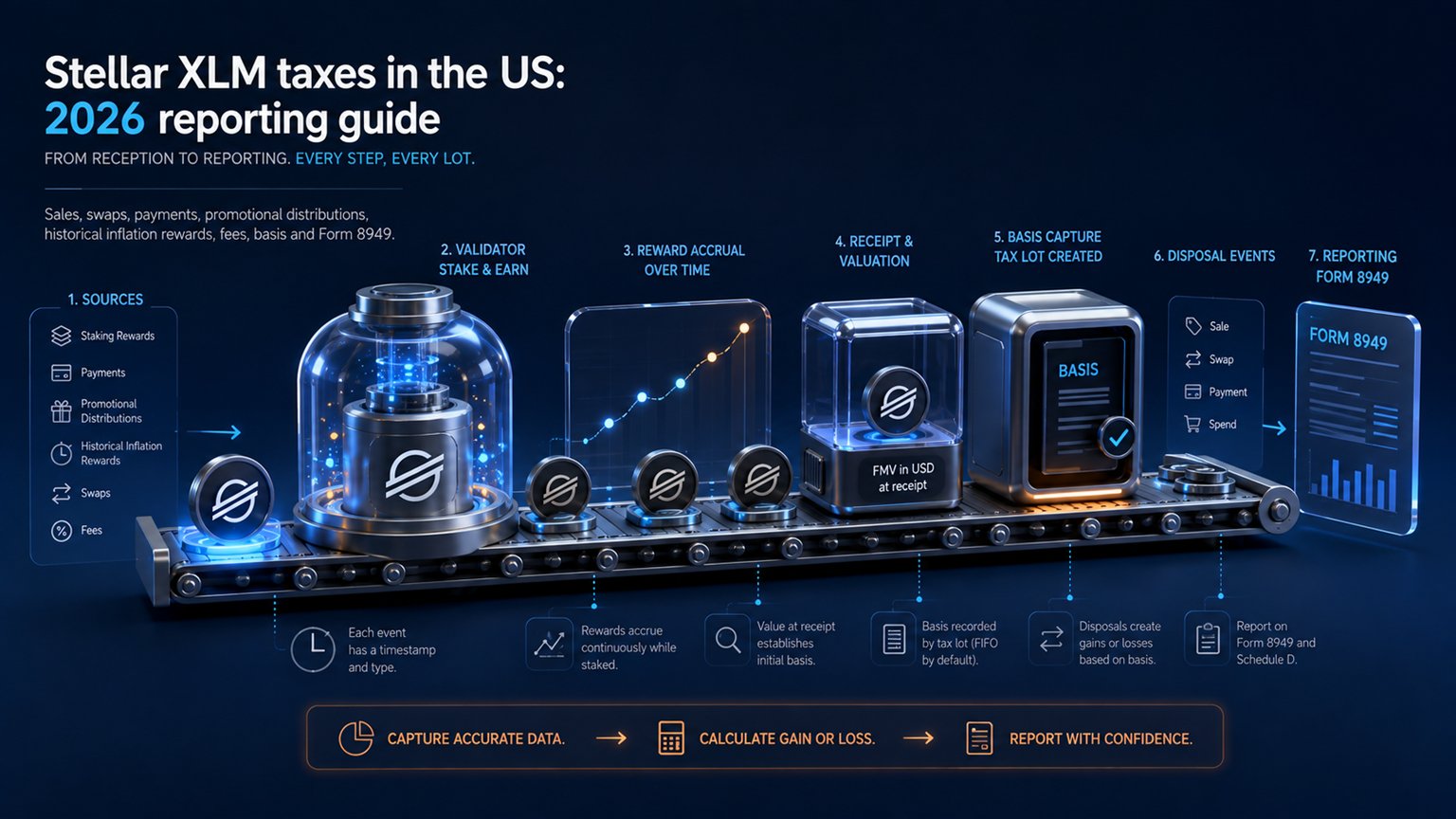
How the IRS treats Stellar XLM
Prepare Your Crypto Tax Workpapers
Import your transactions, review the results and generate detailed tax workpapers without building the entire calculation manually in spreadsheets.
Start for free →The IRS definition of a digital asset covers value recorded on a cryptographically secured distributed ledger. XLM therefore follows the federal property rules that apply to digital assets. The token name, low transaction fee and use as a bridge asset do not turn XLM into US dollars or exempt it from reporting.
For an investor, XLM will usually be a capital asset. A gain or loss arises when units are sold, exchanged or otherwise disposed of. XLM received in exchange for services, as a business receipt or as a taxable reward is ordinary income at fair market value when received. That value generally becomes basis for a later disposition, preventing the same amount from being taxed twice.
| XLM event | Typical federal treatment | Required record |
|---|---|---|
| Buy XLM with USD | No gain or loss on purchase | USD cost, fee, date and wallet |
| Hold or transfer between owned wallets | Generally not a taxable disposition | Proof both endpoints are owned |
| Sell XLM for USD | Capital gain or loss for an investor | Proceeds, basis and holding period |
| Swap XLM for USDC or another token | Disposition of XLM and acquisition of the received asset | USD fair market values for both legs |
| Receive XLM for services | Ordinary income; self-employment rules may apply | USD value when dominion and control begins |
| Receive a promotional distribution | Facts determine reward, prize, gift or another category | Campaign terms and ability to dispose |
The US crypto capital gains guide explains short-term and long-term character across all digital assets.
Selling, swapping and spending XLM
A taxable disposition is not limited to cashing out. Exchanging XLM for BTC, a stablecoin, a Stellar-issued asset or goods and services is a property exchange. The amount realized is the US-dollar fair market value of what is received, reduced or increased by transaction costs under the applicable basis and amount-realized rules. Gain or loss is compared with the adjusted basis of the XLM units disposed of.
If the units were held for one year or less, the result is short term. A holding period longer than one year generally produces long-term capital gain or loss. The period begins the day after acquisition and ends on the disposition date. A later transfer to another self-controlled Stellar account should preserve the original acquisition date rather than restart it.
- Identify the XLM units disposed of under the permitted identification method.
- Determine their adjusted USD basis and acquisition date.
- Calculate USD proceeds at the transaction time.
- Allocate network and exchange fees consistently.
- Classify the result as short term or long term.
- Reconcile the disposition to Form 8949 and Schedule D.
No Form 1099-DA is required for a transaction to be taxable. IRS FAQ 108 expressly says taxable digital-asset income, gains and losses must be reported regardless of amount or whether an information statement was received.
XLM airdrops and historical inflation rewards
Stellar has had promotional distributions through different programs and an inflation mechanism that ended in 2019. An old article may label every distribution “airdrop income,” but the IRS's express airdrop ruling addresses new cryptocurrency received after a hard fork. It should not be quoted as a universal ruling for every independent marketing giveaway.
For a promotional XLM distribution, preserve the campaign terms. XLM received as compensation for services, referrals, data, content or another required action is generally income at fair market value when the recipient can sell, exchange or transfer it. A genuine gift, a prize and an unsolicited distribution can follow different basis and income rules. The relationship between sponsor and recipient, consideration provided and dominion and control matter.
Historical Stellar inflation-pool payments were additional units distributed under a protocol mechanism. If a taxpayer received and controlled them, the conservative report position is to show the USD value as reward income while retaining the exact facts for professional review. Revenue Ruling 2023-14 directly governs proof-of-stake validation rewards, not Stellar's former inflation design, so the ruling supports the dominion-and-control timing principle but should not be misdescribed as an XLM-specific ruling.
- Record the distribution program and eligibility terms.
- Determine whether any service or action was required.
- Establish when the XLM became transferable.
- Capture USD fair market value at that time.
- Use the income amount as basis if it was included in income.
- Flag zero-value or unsolicited units instead of inventing a tax category.
See the US airdrop tax guide for the hard-fork rule and the limits of that guidance.
Stellar network fees, payments and issued assets
Stellar network fees are paid in XLM. Using a digital asset to pay a transfer fee involves disposing of units, even if the USD value is tiny. The associated fee may also adjust basis or amount realized for the related transaction. A tax engine should not simply ignore the XLM leg or deduct the same fee twice.
Spending XLM for a product or remittance creates the same basic disposition analysis as a sale. If a user acquires a tokenized asset on Stellar by paying XLM, the XLM is disposed of and the received asset obtains its own USD basis. A path payment can route through multiple assets at the protocol level; the taxpayer's actual economic trades and wallet history should be reconstructed rather than assuming every internal routing hop was a separately chosen investment.
| Technical event | Report treatment | Common error |
|---|---|---|
| Base fee paid in XLM | Link XLM disposal and transaction cost | Ignore the unit reduction or deduct twice |
| Payment to another person | Disposition at USD fair market value | Treat as a nontaxable own-wallet transfer |
| Own-account transfer | Preserve basis and holding period | Create artificial proceeds |
| Acquire Stellar-issued token | Dispose of XLM and establish new basis | Record only the received token |
Wallet-by-wallet basis and missing XLM history
Beginning in 2025, US digital-asset basis rules and the transition safe harbor require taxpayers to maintain basis by wallet or account rather than treating every venue as one invisible universal pool. A transfer from an exchange to a Stellar wallet must carry the specific units' basis. If the broker statement does not contain basis, the taxpayer still needs purchase records.
For a purchased lot, basis generally begins with the USD cost and properly allocable acquisition fees. For property included in ordinary income, basis is generally the income amount. Gift and inherited assets have special rules. A value of zero should never be inserted merely because the import lacks the earlier exchange history.
If an XLM sale has uncovered units, mark it as incomplete, trace previous transfers and recover source exports. The Form 8949 crypto instructions explain how broker categories and taxpayer adjustments work without converting a technical placeholder into confirmed basis.
Where XLM appears on the US return
- Form 8949 and Schedule D: investor sales, swaps, spending and other capital dispositions.
- Schedule 1 or applicable Form 1040 line: nonbusiness ordinary digital-asset income.
- Schedule C and Schedule SE: XLM received in a trade or business, when applicable.
- Digital asset question: answer based on the actual receipt and disposal events for the year.
- Form 1099-DA: reconcile broker-reported transactions, but also report taxable self-custody activity not on the form.
A complete ledger should retain transaction hashes, memo fields, wallet addresses, exchange IDs, USD price sources and ownership evidence. Review the 2026 US reporting guide before filing.
Frequently asked questions
Is buying XLM with dollars taxable?
Generally no. The purchase establishes basis. A later sale, swap, payment or other disposition is the event that creates gain or loss.
Is moving XLM between my own wallets taxable?
Generally no, but the ownership link and any fee paid in XLM should be documented. The transferred units retain basis and holding period.
Was every historical Stellar airdrop ordinary income?
Not automatically under the IRS hard-fork ruling. Review whether the distribution paid for services or actions, was a prize or gift, and when the recipient obtained dominion and control.
Do tiny Stellar fees need records?
Yes. They change token balances and may be part of the cost of another transaction. Materiality affects practical review, not the need for a coherent ledger.
Can I use zero basis when an exchange omitted my history?
Zero is not a confirmed basis. Reconstruct transfers and acquisitions, then show any unresolved amount as missing rather than silently overstating gain.
Official sources
- IRS: Digital assets
- IRS: Digital asset transaction FAQs
- IRS Revenue Ruling 2023-14: staking rewards
- IRS Topic 409: Capital gains and losses
Official-source review completed September 2, 2026. This guide explains federal reporting and does not replace state-tax or fact-specific advice.
Related Resources
Generate Your Crypto Tax Report
Import your transactions, review the results and generate a detailed PDF report with a transaction-level audit trail.
Start for free →Disclaimer: This article is for general informational purposes only and does not constitute tax advice. For individual tax advice, consult a licensed tax professional.