TRON TRX taxes in the US: staking and reporting for 2026
TRX is a digital asset for US federal tax purposes. Selling, swapping or spending it can create capital gain or loss, while staking validation rewards are ordinary income when a cash-method taxpayer obtains dominion and control. TRON Energy and Bandwidth require a separate technical review: staking or unstaking the same owned TRX is not automatically a sale, but rewards, delegated resources, rental payments and burned TRX must not be collapsed into one number.
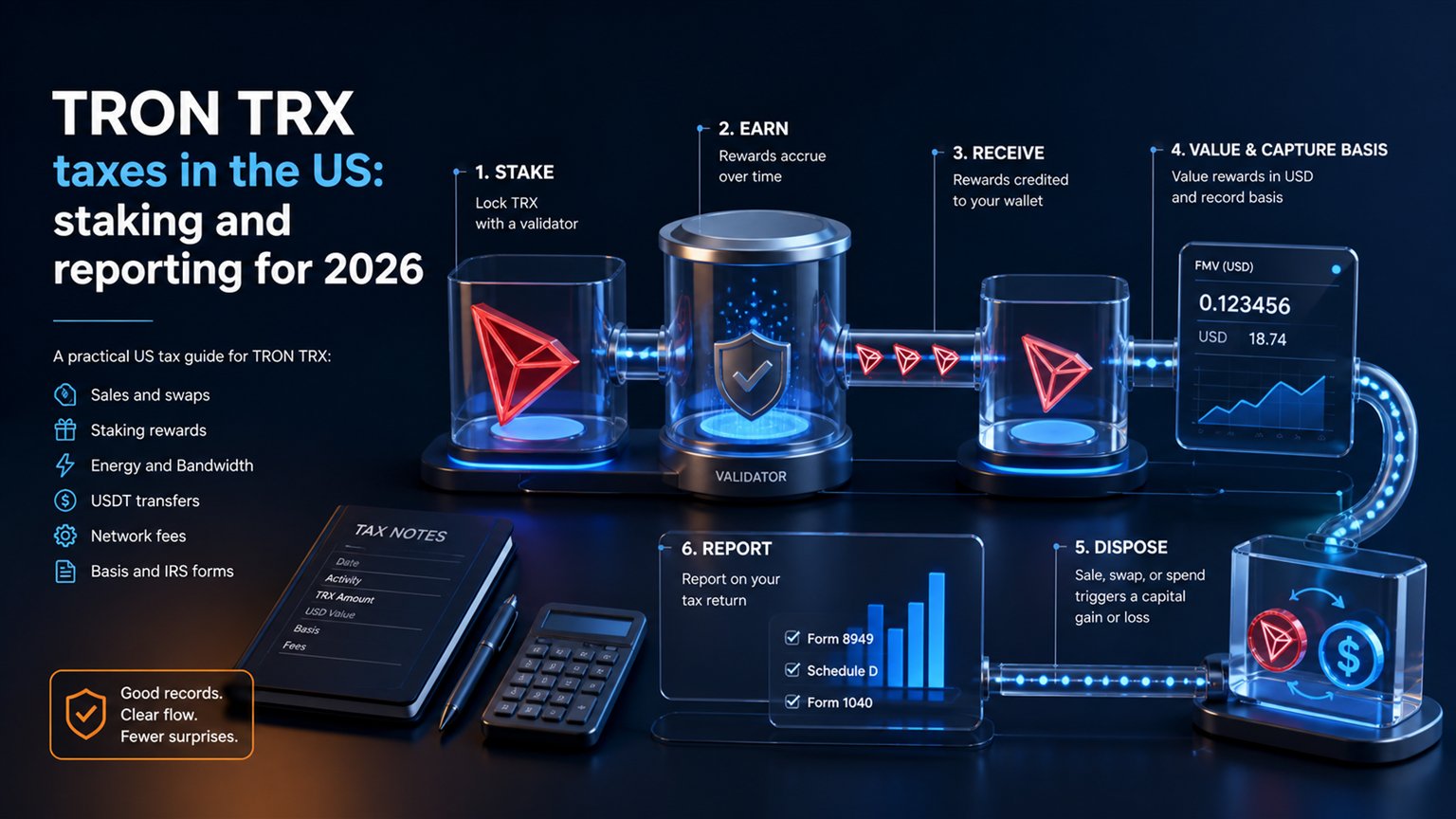
How US federal tax rules apply to TRX
Prepare Your Crypto Tax Workpapers
Import your transactions, review the results and generate detailed tax workpapers without building the entire calculation manually in spreadsheets.
Start for free →The IRS treats digital assets as property. An investor who buys TRX with US dollars generally does not recognize gain or loss on the purchase. Selling TRX, swapping it for USDT or another token, spending it, or using it to acquire a resource or service can create a disposition. Moving TRX between wallets owned by the same taxpayer generally is not a taxable transfer, but ownership and fees must be documented.
| TRON event | Typical federal treatment | Record needed |
|---|---|---|
| Buy TRX with USD | No gain or loss; establish basis | Cost, fee, date and account |
| Sell TRX | Capital gain or loss for an investor | USD proceeds and adjusted basis |
| Swap TRX for USDT | Disposition of TRX and acquisition of USDT | USD values for both legs |
| Receive validation reward | Ordinary income when dominion and control begins | TRX amount, date, time and USD value |
| Stake and later unstake the same TRX | Not automatically a sale if ownership and property remain the same | Protocol records and unit continuity |
| Pay fees by burning TRX | Disposition of TRX; related cost treatment also required | Burn amount, USD value and related transaction |
The US capital gains guide explains holding periods and gain calculations beyond TRON.
TRX staking rewards and dominion and control
Revenue Ruling 2023-14 holds that a cash-method taxpayer includes proof-of-stake validation rewards in gross income when the taxpayer obtains dominion and control, valued at the date and time that control begins. The ruling applies whether the taxpayer stakes directly or through a staking service. It does not wait until the reward is sold for dollars.
For TRON, a report should distinguish the principal TRX placed into staking from newly credited voting or validation rewards. Returning the same principal is not reward income. A reward that is merely displayed but cannot yet be sold, exchanged or transferred may not yet satisfy the ruling's control test; contract and platform restrictions must be checked.
- Identify each reward credit and the wallet or service.
- Determine when the reward became transferable.
- Capture the TRX quantity and USD fair market value at that date and time.
- Include the value in ordinary income.
- Carry that value forward as basis for a later sale.
- Separate validator business expenses from investor costs.
If a taxpayer runs an organized validator or resource-rental business, Schedule C, self-employment tax and business expense rules may apply. Passive delegation by an investor does not automatically create a trade or business. See the US staking tax guide for the full workflow.
Energy, Bandwidth and TRON resource delegation
TRON allows users to stake TRX for network resources commonly described as Energy and Bandwidth and to delegate resources to other addresses. The IRS has not issued TRON-specific tax guidance for these resource rights. A tax report should therefore model the actual property and payment flow, not assume that every resource number is a token or every staking transaction is taxable.
If the user stakes and later recovers the same TRX while retaining beneficial ownership, the lock and unlock can be treated as a nontaxable custody or protocol movement pending confirmation of the rights. If TRX is transferred in exchange for a new transferable property right, rented to another user for consideration, or permanently burned for resources, different consequences arise.
| Resource event | Report position | Question to confirm |
|---|---|---|
| Stake TRX for own resources | Track as locked principal, not income | Did beneficial ownership or property change? |
| Unstake and recover principal | Return of the tracked units | Are the recovered units the same property? |
| Delegate Energy/Bandwidth | Technical delegation record | Was any consideration received? |
| Receive rental payment | Potential ordinary income | When was payment controlled and was it a business? |
| Burn TRX for transaction resources | TRX disposal linked to the transaction cost | How should the cost adjust basis or proceeds? |
Calling the resource itself tax-free is too broad. A no-payment delegation may have no immediate income, while a commercial resource-rental arrangement can produce ordinary receipts and business reporting.
USDT transfers on TRON are still digital-asset transactions
USDT issued on TRON is a separate digital asset from TRX. Moving USDT between a taxpayer's own accounts generally does not create a sale, but exchanging TRX for USDT does. A stablecoin's target price does not eliminate gain or loss: basis, actual proceeds, fees and depegging can produce a nonzero result.
Sending USDT to another person as payment is a disposition. Receiving USDT for services is ordinary income at fair market value and may be business income. Bridging USDT between networks requires review of whether the taxpayer retains the same property interest or exchanges it for a wrapped or issued token. A bridge label alone does not settle the question.
- Use contract address and chain to identify the USDT asset.
- Preserve basis when a genuine own-wallet transfer occurs.
- Record TRX burned or paid as the transaction fee.
- Do not combine the USDT amount with TRX staking rewards.
- Reconcile bridge deposits, mints, burns and withdrawals.
The USDT and USDC tax guide covers stablecoin payments, swaps and depegs in more detail.
TRX basis, lots and network fees
Basis generally begins with the US-dollar cost of purchased TRX plus properly allocable acquisition costs. For a staking reward included in income, the included fair market value generally becomes the basis of those reward units. Gift, inheritance and business inventory rules differ.
A wallet or account must maintain its own unit history under the current digital-asset basis framework. When TRX moves from an exchange to self-custody, the original acquisition date and basis should follow the transferred units. If the source exchange is missing, the report should mark basis as unresolved rather than silently insert zero.
Network costs need both sides. The TRX used for a fee has its own basis and is disposed of. The USD value of that fee may also be an acquisition cost, selling cost, business expense or personal nondeductible amount depending on the related event. Counting it both as a separate expense and a basis adjustment overstates deductions.
| Fee use | Possible treatment | Do not do |
|---|---|---|
| Acquire an investment asset | Potentially capitalize properly allocable cost | Deduct immediately and add to basis |
| Sell an investment asset | Apply amount-realized rules | Ignore the TRX units spent |
| Own-wallet transfer | TRX fee disposition; transfer itself generally nontaxable | Treat full transferred balance as proceeds |
| Trade or business | Business expense or inventory rules may apply | Use investor treatment automatically |
IRS forms and the TRON audit trail
Investor dispositions are generally reported on Form 8949 and summarized on Schedule D. Nonbusiness staking or reward income appears on Form 1040 or Schedule 1 as applicable. Validator, service and rental activity may require Schedule C and Schedule SE. Taxable events remain reportable even without a Form 1099-DA.
- transaction hash and timestamp in a consistent timezone;
- sending and receiving TRON addresses;
- TRX, USDT and other contract identifiers;
- stake, unstake, vote, reward, delegate and burn event types;
- USD price source for income and dispositions;
- basis lot and acquisition date;
- evidence linking owned wallets and exchange accounts;
- open classifications for resource rentals and bridges.
The Form 8949 crypto guide explains how the capital-disposition rows fit the federal return.
Frequently asked questions
Is staking TRX itself taxable?
Locking and recovering the same owned TRX is not automatically a sale. Newly received rewards are ordinary income when the taxpayer obtains dominion and control.
Are TRON Energy and Bandwidth taxable assets?
The IRS has no TRON-specific ruling. The answer depends on the property rights, whether consideration is paid or received, and whether TRX is transferred or burned.
Is transferring USDT on TRON taxable?
An own-wallet transfer generally is not a sale. Paying another person, swapping assets or bridging into a different property can create taxable events.
Do TRX staking rewards get taxed again when sold?
The later gain or loss is measured from the basis established by the amount previously included in income, so the same value should not be taxed twice.
Can I ignore small burned TRX fees?
They affect balances and can affect basis or proceeds. A consistent ledger should capture them even when their dollar amount is small.
Official sources
- IRS Revenue Ruling 2023-14: staking rewards
- IRS: Digital assets
- IRS: Digital asset transaction FAQs
- IRS Topic 409: Capital gains and losses
Official-source review completed September 2, 2026. The IRS has not published TRON-specific Energy or Bandwidth guidance; those sections identify facts that require confirmation.
Related Resources
Generate Your Crypto Tax Report
Import your transactions, review the results and generate a detailed PDF report with a transaction-level audit trail.
Start for free →Disclaimer: This article is for general informational purposes only and does not constitute tax advice. For individual tax advice, consult a licensed tax professional.