Litecoin Taxes in the United States: Basis, Mining and Form 8949
Litecoin is property for U.S. federal tax purposes. Selling LTC, swapping it for another token or spending it can create a taxable disposition; moving LTC between your own wallets generally does not. Correct reporting depends on wallet-specific basis, holding period, fees and complete records rather than a year-end balance.
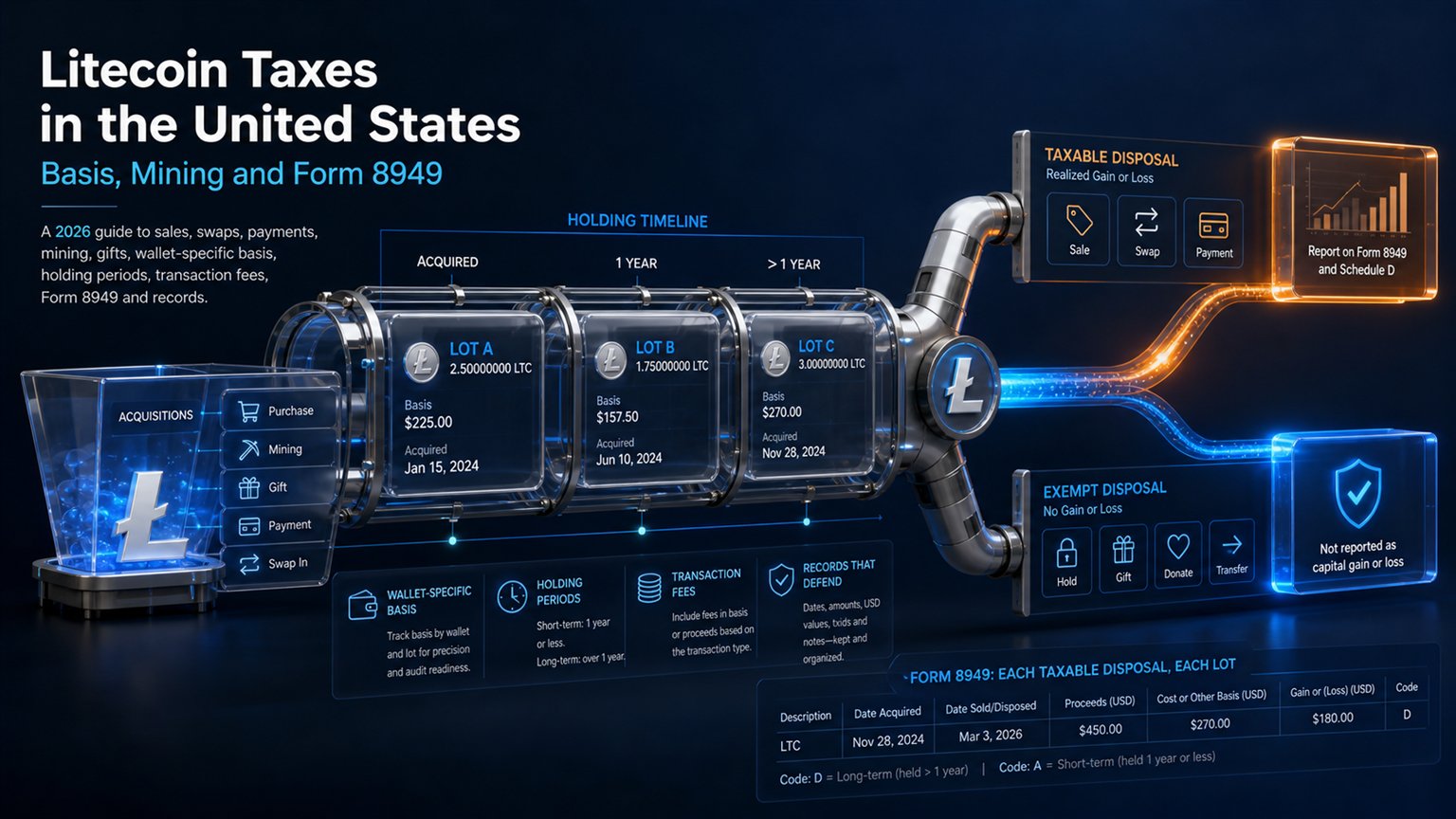
Litecoin is digital-asset property, not tax-exempt cash
Prepare Your Crypto Tax Workpapers
Import your transactions, review the results and generate detailed tax workpapers without building the entire calculation manually in spreadsheets.
Start for free →The IRS applies property principles to digital assets. LTC may function as a payment network, but spending Litecoin is not treated like spending U.S. dollars. A taxpayer generally recognizes gain or loss when disposing of LTC for cash, another digital asset, goods or services.
The result is amount realized minus adjusted basis. If an investor bought 10 LTC for $700 including acquisition costs and later sold all 10 for net proceeds of $900, the capital gain is $200. If the same LTC was used to buy a $900 item, the property payment can produce the same economic disposition even though no dollars entered the bank account.
| Transaction | Typical federal result | Required value |
|---|---|---|
| buy LTC with USD | basis acquisition, no gain yet | cost plus allocable costs |
| sell LTC for USD | capital gain/loss if investment asset | net proceeds |
| swap LTC for BTC | LTC disposition plus BTC acquisition | fair market value |
| spend LTC | LTC disposition | value of goods/services |
| own-wallet transfer | generally no sale | fee and lot continuity |
Sales, swaps, payments and donations
A crypto-to-crypto trade is not tax deferred merely because it never touches fiat. The Litecoin surrendered has an amount realized equal to the fair market value of property received, and the acquired property receives its own basis under the applicable rules. Its holding period generally begins the day after receipt.
- sale through a centralized exchange,
- LTC-to-BTC, LTC-to-stablecoin or other swap,
- merchant payment or debit-card conversion,
- gift or charitable transfer requiring special basis records,
- payment of a transaction service fee with LTC.
A bona fide gift generally does not create income to the recipient at receipt, but the later basis can depend on donor basis, date-of-gift fair market value and gift tax. A charitable donation may avoid a sale by the donor but requires substantiation and, depending on value and property, appraisal and form rules. A transfer should not be relabeled a gift without identifying the recipient and donative intent.
Wallet-specific basis and holding period after 2024
Current IRS FAQs explain that basis identification for digital-asset transactions on or after January 1, 2025 is wallet- or account-specific. A taxpayer cannot sell LTC from one account and casually assign a lot held in another account. Specific identification requires timely, adequate records; otherwise the applicable default ordering rules can control.
For each acquired lot, preserve date and time, units, adjusted basis and acquisition account. For each disposition, preserve units, date and time, proceeds, costs and the lot identified. A backup copy of private keys does not merge wallets for tax basis.
- inventory every exchange account and self-custody wallet,
- allocate pre-2025 unattached basis under any applicable safe harbor,
- record acquisitions in the wallet that actually holds the units,
- make and retain adequate specific identification if used,
- otherwise apply the supported default method consistently.
Holding longer than one year generally produces long-term capital gain or loss for an investment asset; one year or less is short-term. The rate depends on the taxpayer’s overall return. See the crypto capital-gains guide for the broader framework.
Litecoin mining rewards and later sale
LTC obtained from mining is generally income when received or when the taxpayer has control, measured at fair market value in U.S. dollars. If mining is conducted as a trade or business, net earnings may be subject to self-employment tax and ordinary-and-necessary business expenses may be relevant. Hobby or nonbusiness treatment follows different expense limitations.
The amount included in income generally becomes basis in the mined LTC. A later sale creates a second calculation. For example, $500 of LTC recognized as mining income and later sold for $650 can produce $150 of additional gain before transaction costs. It should not produce $650 of both mining income and capital gain.
| Mining record | Purpose |
|---|---|
| pool payout time and LTC | income and acquisition |
| USD price source | fair market value |
| pool fee and statement | gross/net reconciliation |
| equipment and electricity | business-expense support |
| wallet destination | basis location and later sale |
Further details are in the U.S. crypto mining tax guide.
Transaction fees and transfers between wallets
An LTC network transfer between wallets owned by the same taxpayer generally is not a disposition of the transferred principal. Basis and holding period remain with the units. The sending fee must still be recorded. Current IRS FAQ 97 says digital assets used or withheld to pay transaction-service costs are disposed of, so the fee units can themselves produce gain or loss.
The dollar value of transaction costs may also affect basis or amount realized depending on the transaction they facilitate. A report should not silently reduce units with no tax trail. For a pure transfer, it should separate principal from fee, move the selected lot to the destination wallet and record any tax consequence of the LTC used for service.
- match withdrawal and deposit by transaction ID,
- preserve gross sent, fee and net received,
- carry lot basis and acquisition date forward,
- do not create income at the destination,
- keep unmatched transfers as review items.
Form 8949, Schedule D and broker reporting
Investment-asset LTC dispositions are generally itemized on Form 8949 and summarized on Schedule D. Short- and long-term transactions are separated. Mining or service income is reported in the category that matches the taxpayer’s activity; it is not placed on Form 8949 as sale proceeds at receipt.
A Form 1099-DA or other broker statement does not replace wallet history. Broker-reported gross proceeds may lack basis for coins transferred in from self-custody, and an exchange cannot see spending or swaps from an external wallet. Reconcile reported proceeds, basis status and transaction category rather than importing each broker row twice.
The Form 8949 crypto guide explains the reporting workflow.
Litecoin year-end recordkeeping checklist
- export every exchange trade and ledger file,
- add all LTC addresses and wallet transactions,
- match transfers and preserve transaction fees,
- identify basis and holding period within each wallet/account,
- separate purchases, mining income, gifts and sales,
- reconcile Form 8949 proceeds with broker forms,
- mark missing prices or basis as unresolved rather than zero.
The chosen software should expose these records and corrections; compare tools using the crypto tax software guide.
Frequently asked questions about Litecoin taxes
Do I owe tax just for holding LTC?
Federal income tax generally is not triggered by an unrealized price increase alone. A sale, exchange, payment or income receipt can create reporting.
Is swapping LTC for BTC taxable?
Yes, it is generally a disposition of LTC and an acquisition of BTC at fair market value.
Is moving LTC to a hardware wallet taxable?
The principal transfer between your own wallets generally is not a sale, but the network fee and basis continuity must be recorded.
How are mined LTC units taxed?
Fair market value is generally income when received or controlled; that value becomes basis for a later disposition.
Can I use a lot from a different wallet?
Post-2024 federal basis identification is wallet- or account-specific under current IRS rules and transition guidance.
Does a 1099-DA contain all Litecoin activity?
No. It may omit self-custody transactions and can lack basis for transferred-in units. Reconciliation remains necessary.
Primary sources
Reviewed September 2, 2026. This article addresses common federal cases; state and business rules may differ.
Related Resources
Generate Your Crypto Tax Report
Import your transactions, review the results and generate a detailed PDF report with a transaction-level audit trail.
Start for free →Disclaimer: This article is for general informational purposes only and does not constitute tax advice. For individual tax advice, consult a licensed tax professional.