Solana Taxes 2026: SOL Staking, Wallets and DeFi
SOL is taxed under the same federal property principles as other digital assets, but Solana account mechanics create unusual reporting traps. Native stake accounts, epoch rewards, liquid-staking tokens, associated token accounts, rent refunds, compressed NFTs and DeFi instructions can produce many ledger lines without producing the same number of taxable events. A reliable report reconstructs the economic transaction rather than taxing every instruction.
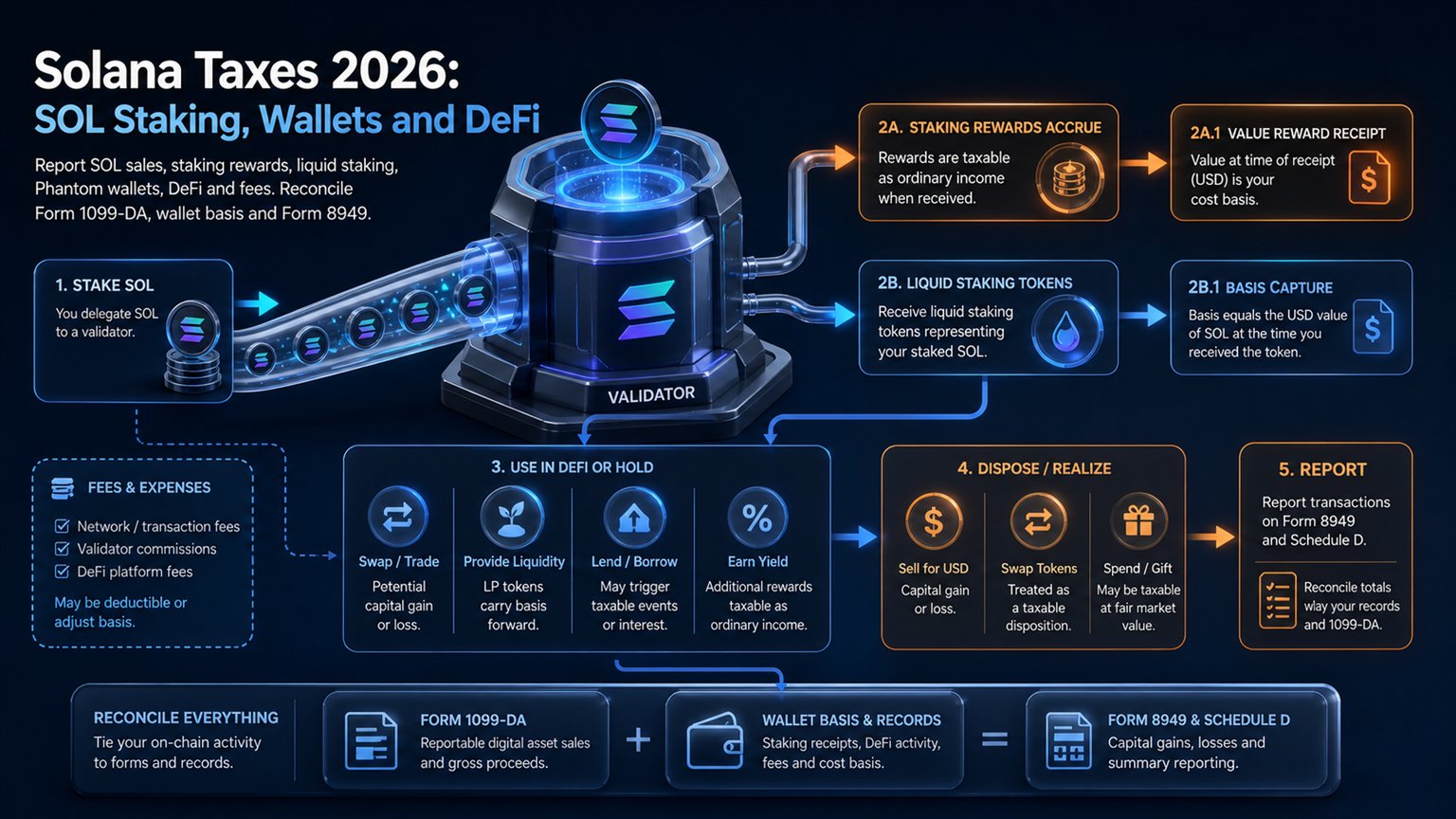
Short answer: how is Solana taxed in the United States?
Prepare Your Crypto Tax Workpapers
Import your transactions, review the results and generate detailed tax workpapers without building the entire calculation manually in spreadsheets.
Start for free →The IRS treats digital assets as property. Buying SOL with dollars and holding it generally is not a realization event. Selling SOL for dollars, swapping it for another token, spending it, or using it to pay transaction costs can create a disposition. An investor normally recognizes capital gain or loss equal to value received minus adjusted basis.
New SOL received as a staking validation reward can be ordinary income. Revenue Ruling 2023-14 says a cash-method taxpayer includes the fair market value of proof-of-stake rewards when the taxpayer gains dominion and control, measured at that date and time. A later sale of those reward units is a separate capital event using the income value as basis.
| Solana activity | Typical federal review | Evidence |
|---|---|---|
| Buy SOL with USD | Acquisition, generally no current gain | Units, price, fee, account |
| Sell or swap SOL | Capital disposition for an investor | Proceeds, basis and holding period |
| Move SOL to an owned native stake account | Generally no disposition if beneficial ownership stays the same | Stake and withdraw authorities |
| Receive available epoch rewards | Potential ordinary income and new basis | Reward time, units and USD value |
| Exchange SOL for an LST | Potential taxable exchange; facts and rights matter | Tokens surrendered and received |
| Close an empty token account | Reconcile returned rent reserve; not automatically a reward | Account creation and close instructions |
SOL transactions that may create gain, loss or income
Start with the economic event and then interpret the instructions. A single Jupiter swap may contain token-account creation, wrapped SOL, transfers, program calls, priority fees and account closure. Those lines support one transaction; they are not automatically separate sales.
- selling SOL or an SPL token for U.S. dollars;
- swapping SOL for USDC, JitoSOL, mSOL or another digital asset;
- spending SOL for an NFT, product, service or transaction cost;
- receiving SOL or SPL tokens for services, referral activity or rewards;
- claiming airdrops after satisfying eligibility conditions;
- depositing assets into DeFi when materially different rights or tokens are received;
- selling an NFT, liquidity position, receipt token or governance token.
An own-wallet transfer generally is not taxable. IRS FAQ 81 confirms that moving digital assets between wallets, addresses or accounts belonging to the same taxpayer does not create income, gain or loss, except for digital assets used or withheld to pay transaction services. Carry basis and acquisition date to the destination instead of creating a new purchase.
Native Solana staking: stake accounts and epoch rewards
Solana's official documentation explains that a native stake account has its own address and separate stake and withdraw authorities. One stake account delegates to one validator, and an owner can split or merge accounts. Delegation and deactivation can take one or more epochs; rewards are issued once per epoch into the stake account and are automatically re-delegated.
Creating, splitting, merging, delegating or deactivating a stake account should not be treated as income merely because the account address or state changes. If the same taxpayer retains beneficial ownership and receives no materially different property, the operation is generally an internal position-management event. Preserve the authorities and transaction signatures so the relationship can be proven.
The reward is different. Under Revenue Ruling 2023-14, the relevant time is when the taxpayer can sell, exchange or otherwise dispose of the reward. A report should capture each issued reward or use a supportable aggregation that preserves date, units and USD value. It should not wait until the taxpayer withdraws all principal years later if dominion and control existed earlier.
- Discover every stake-account address controlled by the wallet.
- Record delegation, split, merge and deactivation instructions as non-income metadata unless facts show a transfer of ownership.
- Extract epoch reward credits separately from principal movements.
- Determine when each reward became transferable under the actual account conditions.
- Value the reward in USD using a consistent timestamped source.
- Create a new basis lot for the reward and retain it after automatic re-delegation.
Validators can have commission, voting rewards, operating expenses and business activity beyond passive delegation. The correct schedule depends on the taxpayer's activity. A node operator should not assume the same presentation as an occasional delegator.
Liquid staking tokens are not native stake-account entries
Solana stake pools accept SOL and issue SPL tokens representing an interest in the pool. Those liquid-staking tokens can be transferred or used in DeFi, which makes them economically different from SOL remaining in a native stake account under the same owner's authorities.
Neither an app label nor a one-to-one-looking deposit proves that exchanging SOL for mSOL, JitoSOL or another receipt is tax-neutral. Determine whether the taxpayer surrendered SOL for materially different property, what redemption right exists, how rewards accrue and whether additional tokens are distributed. U.S. guidance does not provide a Solana-specific blanket rule for every liquid-staking protocol.
If the entry exchange is treated as a disposition, compute SOL gain or loss and establish basis in the liquid-staking token at fair market value. If the protocol's value increases without distributing separate units, income timing and later gain remain fact-sensitive. Document the chosen position and avoid also booking synthetic daily “rewards” that never entered the wallet.
The IRS staking guide explains dominion and control, while the U.S. DeFi guide addresses token exchanges and protocol positions.
Solana swaps, liquidity pools, NFTs and airdrops
Decoded program instructions must be grouped into an economic event. For a swap, the asset surrendered has proceeds measured by the fair market value of property received, while the received asset obtains a new basis. Slippage and fees must be allocated consistently.
Liquidity deposits can involve an exchange of tokens for an LP token or concentrated position. Withdrawals can return assets in different proportions. Record all contributed units, position identifiers, accrued fees and assets returned. Do not calculate gain only from the final wallet balance.
Airdrops are not automatically taxed simply because a spam token appeared in an associated token account. Analyze whether the taxpayer has dominion and control, a market and the ability to transfer the asset. Rewards obtained for services or protocol participation can be income, while unsolicited unusable tokens require evidence of their actual status.
NFT purchases made with SOL include a disposition of SOL and a basis in the NFT. NFT sales create a separate disposition. Royalties received by a creator can be business or ordinary income rather than investor capital gain. Compressed-NFT mechanics change data extraction, not the need to reconstruct ownership and value.
Associated token accounts, rent refunds and SOL fees
Solana uses separate token accounts for SPL assets. Creating an associated token account can lock a rent-exempt reserve in lamports. Closing an empty token account returns those lamports to a destination account. The official Solana documentation describes this as recovery of the account reserve, so a tax importer should connect the outgoing reserve and later refund instead of labeling the refund as staking income.
Base fees, priority fees and token-account costs require transaction context. Paying a fee with SOL disposes of a small amount of SOL. The federal treatment of that cost follows the underlying activity and applicable transaction-cost rules. A report must avoid both deleting the SOL disposal and deducting the same fee twice.
Wrapped SOL instructions often temporarily move SOL into an SPL token account for a swap. Group wrapping, synchronization, swap and closing instructions. Otherwise, the ledger can invent extra purchases, sales or negative balances.
Form 1099-DA, wallet basis and the U.S. return
For 2025 broker transactions, Form 1099-DA generally reports digital-asset proceeds. For sales after 2025, basis reporting phases in for covered digital assets. A broker form does not necessarily include Phantom, Solflare, Jupiter, validator or other self-custody activity, and an inbound transfer may lack historical basis.
Beginning in 2025, digital-asset basis must be tracked by wallet or account under the applicable transition and identification rules. Moving SOL to another owned address does not reset the basis or holding period. Specific identification must be supported at the required time; it is not an unrestricted year-end optimization.
- Import every exchange, main wallet, token account and native stake account.
- Group multi-instruction transactions into swaps, stakes, claims and transfers.
- Reconcile broker 1099-DA proceeds to detailed exchange activity.
- Restore basis and holding period for transfers into a broker.
- Report investment dispositions on Form 8949 and Schedule D.
- Report staking, services and business income on the schedule appropriate to the activity.
- Review the Form 1040 digital-asset question under current instructions.
- Retain raw JSON/CSV, signatures, price evidence and reconciliation notes.
A CoinTaxReporting U.S. report can prepare Form 8949 working papers while keeping missing basis and unresolved DeFi treatment visible. Use the Phantom wallet guide for address coverage and the Form 1099-DA guide for broker reconciliation.
Frequently asked questions
Is moving SOL into a native stake account taxable?
Generally not by itself when the same taxpayer retains beneficial ownership and receives no materially different property. Preserve the stake and withdraw authorities to support the treatment.
When are Solana staking rewards income?
For a cash-method taxpayer, the IRS rule focuses on when the taxpayer gains dominion and control over the issued reward, valued at that date and time.
Is swapping SOL for JitoSOL or mSOL tax-free?
Do not assume so. Liquid staking involves a separate token and protocol rights; whether the exchange is a taxable disposition requires a facts-and-circumstances analysis.
Is a returned token-account rent reserve taxable income?
It should first be matched to the lamports previously placed in the account reserve. A return of that reserve is not automatically a reward.
Does Form 1099-DA include Phantom wallet activity?
Do not assume it does. Self-custody swaps, staking, NFTs and DeFi must be imported and reconciled separately.
Are spam SPL tokens taxable when they appear?
Appearance alone does not settle dominion, control or value. Record whether the token can actually be transferred or sold and avoid inventing income from a misleading wallet display.
Official sources
- IRS Revenue Ruling 2023-14: proof-of-stake rewards
- IRS: digital-asset transaction FAQs
- IRS: Understanding Form 1099-DA
- Solana official documentation: stake accounts
- Solana official staking and rewards FAQ
- Solana official documentation: SPL token accounts
Sources reviewed September 2, 2026. This guide covers common federal issues; state tax and unusual validator or protocol arrangements need separate review.
Related Resources
Generate Your Crypto Tax Report
Import your transactions, review the results and generate a detailed PDF report with a transaction-level audit trail.
Start for free →Disclaimer: This article is for general informational purposes only and does not constitute tax advice. For individual tax advice, consult a licensed tax professional.