ZenLedger Review 2026: Plans, Tax Reports and Data Checks for 2026
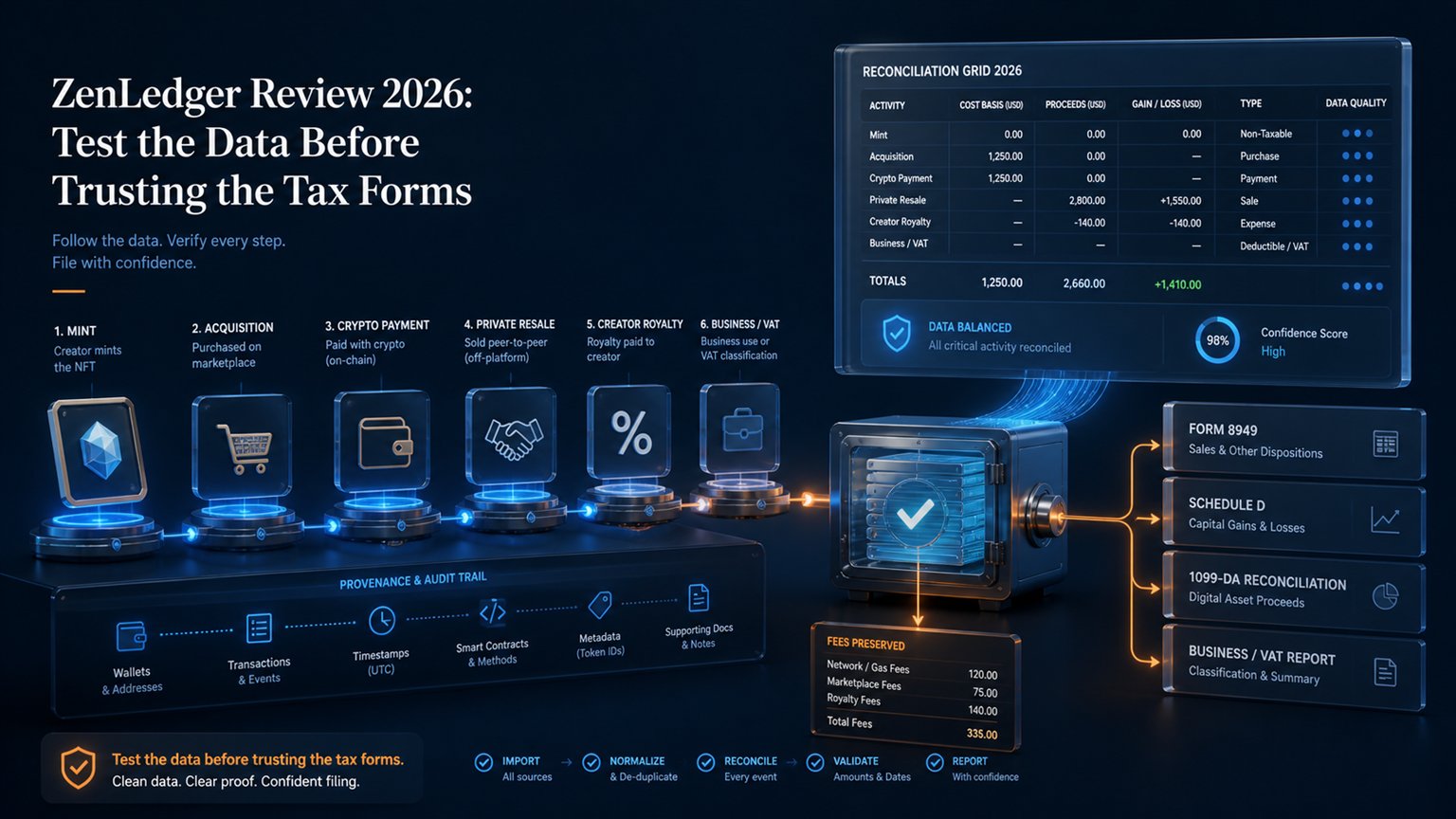
ZenLedger remains an active US-focused crypto tax application in 2026, but the plans and transaction limits shown in many older reviews are no longer current. This review verifies the public pricing and advertised forms, then applies a stricter test: whether an imported ledger can reconcile transfers, wallet-level basis, Form 1099-DA, DeFi, NFTs, income, and derivatives before it generates Form 8949 and Schedule D.
CoinTaxReporting, another crypto-tax software provider, publishes this article. It is not an independent consumer-lab review. ZenLedger statements are based on the official product pages linked below and can change.
ZenLedger review 2026: short verdict
Prepare Your Crypto Tax Workpapers
Import your transactions, review the results and generate detailed tax workpapers without building the entire calculation manually in spreadsheets.
Start for free →ZenLedger is a real, currently available US crypto tax platform. Its public product pages advertise Form 8949, Schedule D, a crypto income report associated with Schedule 1, tax-loss-harvesting analytics, audit and valuation reports, TurboTax and TaxAct integrations, and support for centralized exchanges, wallets, DeFi, staking, margin activity, and NFTs.
The platform is most relevant to US taxpayers who want to aggregate a multi-platform ledger and produce US filing worksheets. It should not be chosen merely because an exchange or protocol appears on a marketing list. The decisive question is whether ZenLedger correctly decodes the taxpayer’s actual records and preserves the reporting categories required for the tax year.
Our verdict is therefore conditional:
- Potentially suitable: US capital-asset portfolios whose exchanges, wallets, transfers, income events, and Form 1099-DA totals reconcile after review.
- Requires detailed testing: high-volume DeFi, bridges, liquidity positions, NFT minting, margin, derivatives, bankrupt exchanges, gifts, inherited assets, and transferred lots.
- Not a substitute for local software: taxpayers who need German, Austrian, Swiss, UK, Canadian, or other country-specific tax reports.
ZenLedger pricing in 2026
As checked on September 4, 2026, ZenLedger’s public DIY pricing page lists:
| Plan | Published annual price | Published transaction limit | Advertised scope |
|---|---|---|---|
| Silver | $49 | Up to 100 | Detailed reports; DeFi, staking and margin trading |
| Gold | $199 | Up to 5,000 | Detailed reports; DeFi, staking and margin trading |
| Platinum | $399 | Up to 15,000 | Detailed reports; DeFi, staking and margin trading |
| Unlimited add-on | $600 added to Platinum | Unlimited | Also advertises one hour of live support |
The site says account creation and data import are free, while access to downloadable tax reports is purchased per tax year. It also states that the required tier can change after the imported transaction count and transaction types are calculated. Users should import representative data before assuming a particular price.
The public pricing page contains inconsistent refund wording: a navigation section refers to a one-year refund policy, while the detailed pricing section states 14 days. The help center and checkout terms should be treated as controlling only after the user verifies the live purchase screen. This review does not promise a refund period.
Tax-professional preparation and consultation are separate services. Published package prices are estimates and the site warns that the actual cost can be higher depending on the case. DIY software access should not be confused with a signed tax return prepared by a credentialed professional.
Forms and features ZenLedger publicly advertises
ZenLedger’s current features page identifies the following core outputs:
- Form 8949 for sales and exchanges of digital assets held as capital assets,
- Schedule D summary of capital gains and losses,
- crypto income report for categories such as airdrops, forks, staking and DeFi income,
- audit trail and end-of-year valuation reports,
- tax-loss-harvesting dashboard for reviewing unrealized positions,
- TurboTax and TaxAct filing integrations,
- tax professional access and multiple lot-identification methods.
These are provider claims, not an independent certification that every imported event is correctly classified. A form generator can produce a perfectly formatted Form 8949 from an incomplete ledger. Users must reconcile data before treating any output as filing-ready.
US filing scope matters
The IRS does not report every crypto event on the same form. Capital-asset disposals generally flow through Form 8949 and Schedule D. Ordinary income from staking, mining, forks, compensation, or business activity may belong on Schedule 1, Schedule C, or another form depending on facts. Section 1256 contracts, lending arrangements, and business inventory can require different treatment.
A software label such as “income,” “reward,” or “margin” is only the start of the analysis. The source event, legal right, taxpayer activity, and reporting document determine the final form.
Exchange and wallet support: count less, test more
ZenLedger’s public pages currently use more than one integration count. The exchange directory says 400+ exchanges, 50+ blockchains, and 100+ DeFi and NFT protocols; the how-it-works page refers to 500+ exchanges and wallets. These figures may count APIs, CSV templates, wallets, chains, and protocols differently.
An integration logo does not guarantee that every historical export version, subaccount, futures ledger, earn product, or API endpoint is supported. Before paying:
- Import a full year from each important exchange and compare row counts.
- Confirm deposits and withdrawals pair as own-wallet transfers.
- Compare year-end holdings against exchange and wallet balances.
- Review negative balances and missing purchase history.
- Check fees paid in a third token and network fees on own-wallet transfers.
- Confirm canceled, failed, duplicate, and spam transactions are excluded.
- Verify timestamps and tax-year boundaries in the intended time zone.
If a source is supported only through CSV, preserve the untouched original file and the exact template used for any conversion. A manually edited CSV should not replace the audit source.
Cost basis, wallet-level identification and Form 1099-DA
The 2025 Form 8949 instructions created dedicated digital-asset reporting categories. Short-term digital-asset transactions use boxes G, H, or I; long-term transactions use J, K, or L. The category depends on whether the taxpayer received Form 1099-DA and whether basis was reported to the IRS.
For transactions after 2025, US brokers generally must report basis for covered digital assets acquired and held in the same custodial account under the applicable rules. Noncovered assets and transferred assets may still lack broker-reported basis. ZenLedger must therefore distinguish:
- broker-reported proceeds and basis,
- broker-reported proceeds without IRS basis,
- dispositions with no Form 1099-DA,
- taxpayer adjustments to reported figures,
- unknown basis that remains unresolved.
The IRS applies identification rules by wallet or account. For units in an unhosted wallet, timely specific identification requires records identifying the units no later than the sale, disposition, or transfer. Without adequate identification, the default generally uses the earliest units of that asset in that wallet. A universal portfolio-wide HIFO or FIFO selection is not automatically valid merely because the software offers the button.
For each sale, the account or wallet, acquisition lot, contemporaneous identification record, proceeds source, basis source and Form 8949 category should be traceable. Those elements should be reproducible before the output is relied upon for filing or audit documentation.
The Form 8949 guide explains the G–L categories and adjustments in detail.
Form 1099-DA reconciliation workflow
- Import the broker’s complete trade history and the Form 1099-DA statement separately.
- Match each broker-reported disposition by asset, sale date, units, and proceeds.
- Preserve the proceeds shown to the IRS even when a correction is required.
- Compare basis only where the form says it was reported to the IRS.
- Record the correct basis and adjustment code where the official instructions require reconciliation.
- Place transactions without a 1099-DA in I or L rather than the former C or F digital-asset categories.
- Reconcile final Form 8949 totals to Schedule D and all broker statements.
Receiving no form does not make a transaction nontaxable. The IRS states that all digital-asset income, gains, and losses must be reported whether or not the taxpayer receives Form 1099-DA.
DeFi, staking, NFTs and derivatives
ZenLedger markets broad DeFi and NFT support. These areas need more review than a simple spot trade because an on-chain transaction can contain multiple economic events.
| Activity | What to verify |
|---|---|
| DEX swap | Both disposed and received assets, gas allocation, token decimals, and USD value |
| Liquidity pool | Deposit versus transfer, LP-token basis, fees, rewards, withdrawal, and impermanent-loss data |
| Bridge or wrap | Continuity of ownership, protocol fee, destination chain, and duplicate representation |
| Staking | Control and dominion, receipt date, fair market value, validator or platform fees, and resulting lot |
| NFT | Mint cost, marketplace fee, royalty income, creator/business status, and spam-token exclusion |
| Borrowing | Loan proceeds, collateral transfers, interest, liquidation, repayment, and debt-token mechanics |
| Futures or perpetuals | Contract type, realized close P&L, funding, fees, and correct filing form |
Opening a derivative position or importing a position snapshot is not realized profit. Only the exchange’s actual close, settlement, liquidation, or other realized event should create P&L. The legal contract also matters: software should not place every offshore perpetual automatically on Form 6781 simply because it is called a future.
For a broader derivatives workflow, see the US crypto futures tax guide.
Tax-loss harvesting: useful screen, not an automatic tax result
ZenLedger advertises a tax-loss-harvesting dashboard. It can help identify assets whose current value is below their tracked basis. The loss becomes relevant only after a valid disposition, and its amount depends on accurate basis and lot identification.
A dashboard should not make the sale for the taxpayer, guarantee deductibility, or assume that a repurchase has no consequence. Capital losses first offset capital gains; if losses exceed gains, the individual deduction against other income is generally limited to the statutory annual amount, with the balance carried forward. Business, dealer, security, straddle, related-party, and other rules can change the result.
A 30-minute evaluation before purchase
- Create the free account without buying a report.
- Import one centralized exchange, one self-hosted wallet, and one complex protocol actually used.
- Compare transaction and balance totals to original sources.
- Open several sales and inspect the exact lots selected.
- Check whether transfers preserve acquisition date and basis.
- Review missing-basis, negative-balance, duplicate, and uncategorized warnings.
- Compare a sample Form 1099-DA transaction to the proposed Form 8949 category.
- Confirm the final tier and price shown after all transaction types are recognized.
- Read privacy, API permission, deletion, and live refund terms.
Compare the result, not the marketing table, with other products in the 2026 crypto tax software comparison. A sample audit-trail report also shows the level of transaction detail worth demanding.
Frequently asked questions
Does ZenLedger have a free tax plan?
ZenLedger says account creation and importing are free. Downloading or accessing tax reports for a year requires the applicable paid plan. Verify the final tier after imports are counted.
What does ZenLedger cost in 2026?
On September 4, 2026, the public page listed Silver at $49 for up to 100 transactions, Gold at $199 for up to 5,000, and Platinum at $399 for up to 15,000, with a $600 unlimited add-on. Prices can change.
Does ZenLedger generate Form 8949?
Yes, the provider advertises Form 8949 and Schedule D. Users must still verify the new digital-asset categories, broker-reported values, basis, and adjustments.
Can ZenLedger reconcile Form 1099-DA?
The ledger should be tested against every 1099-DA. A provider feature does not eliminate the need to match proceeds, determine whether basis was reported, and explain adjustments.
Is every listed DeFi integration automatic?
No integration directory can guarantee every contract version or economic event. Test protocols and chains actually used and inspect the decoded transactions individually.
Can I use global HIFO for all wallets?
Not automatically. Current US identification rules operate by wallet or account and require timely, adequate specific identification. Without it, default ordering rules generally apply within the wallet or account.
Is ZenLedger suitable outside the United States?
Its advertised forms and this review focus on US filing. A taxpayer needing another country’s official methods and forms should use a verified country-specific engine.
Official and primary sources
- ZenLedger: current DIY and professional pricing
- ZenLedger Help Center: how pricing and upgrades are calculated
- ZenLedger: advertised tax forms and product features
- ZenLedger: exchange, blockchain, DeFi and NFT directory
- IRS: 2025 Instructions for Form 8949
- IRS: 2026 Instructions for Form 1099-DA
- IRS: digital-asset transaction and lot-identification FAQs
- IRS: digital assets filing overview
Product, pricing, and source status checked September 4, 2026. This is an editorial review of public product information and tax-reporting controls, not a certification of every ZenLedger integration.
Related Resources
Generate Your Crypto Tax Report
Import your transactions, review the results and generate a detailed PDF report with a transaction-level audit trail.
Start for free →Disclaimer: This article is for general informational purposes only and does not constitute tax advice. For individual tax advice, consult a licensed tax professional.