DeFi Taxes in the US for 2026: What the IRS Has—and Has Not—Decided
US federal tax law clearly covers digital-asset sales, token swaps and staking rewards under general property and income rules. It does not yet provide a complete tax code for liquidity pools, wrapping, liquid staking, bridges or crypto lending. This guide separates published IRS authority from defensible but unconfirmed positions, explains the 2026 Form 1099-DA changes and gives DeFi users a practical reporting workflow without presenting uncertain protocol mechanics as settled law.
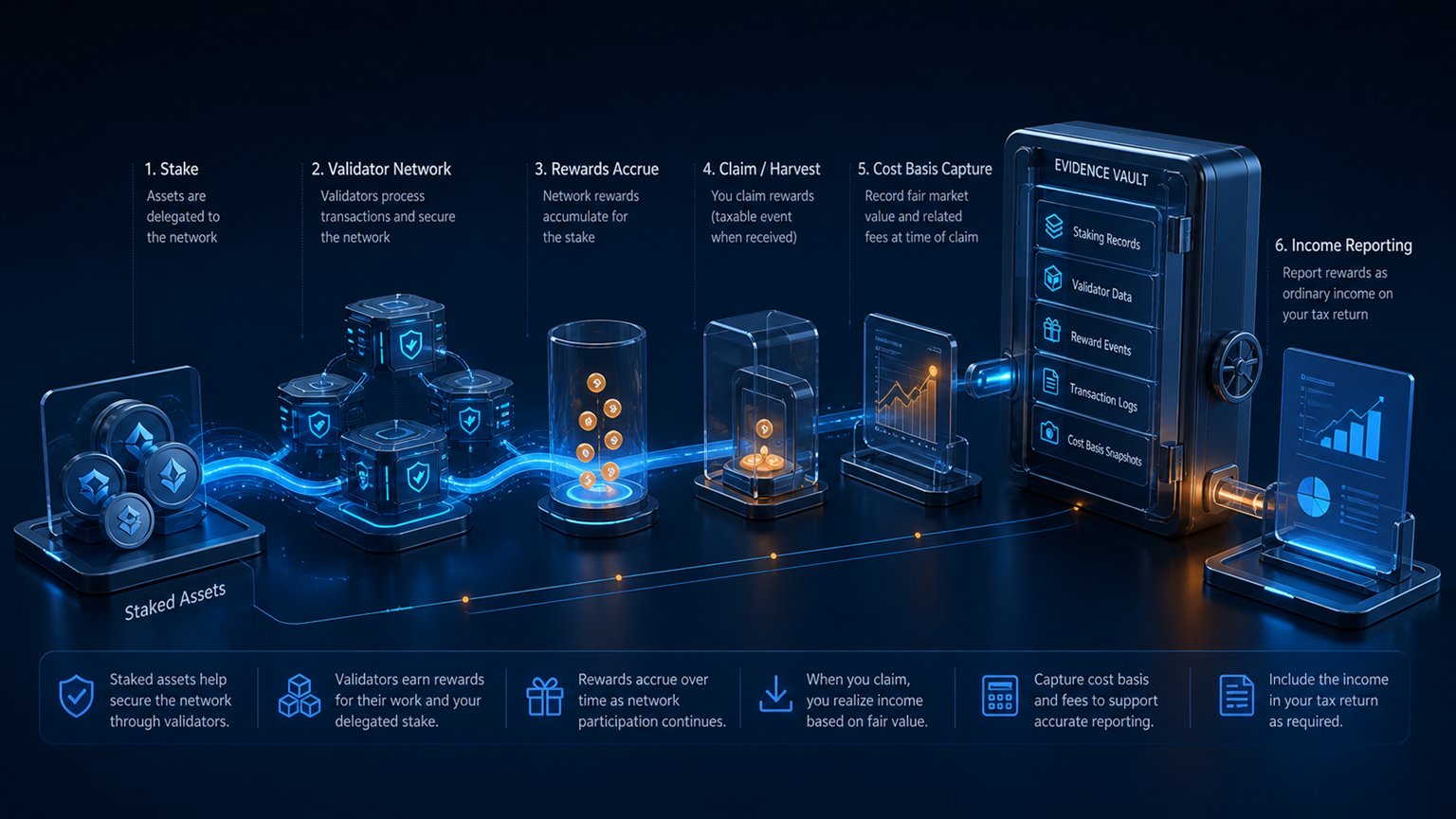
The short answer: DeFi is taxable, but not every step is settled
Prepare Your Crypto Tax Workpapers
Import your transactions, review the results and generate detailed tax workpapers without building the entire calculation manually in spreadsheets.
Start for free →| DeFi activity | Federal tax status | Primary reporting concern |
|---|---|---|
| Token A exchanged for materially different Token B | Taxable disposition under the IRS property framework | USD proceeds, basis, fee and holding period |
| Native proof-of-stake validation rewards | Ordinary income when a cash-method taxpayer obtains dominion and control | Date, time, units and fair market value |
| Hard-fork airdrop | Income when received with dominion and control under Rev. Rul. 2019-24 | Do not extend this ruling mechanically to every promotional airdrop |
| Liquidity deposited for a transferable LP token | No definitive transaction-specific IRS income-tax ruling | Whether legal and economic rights changed enough to create an exchange |
| Wrapping, liquid staking and digital-asset lending | Substantive treatment remains unresolved in material respects | Contract rights, asset identity, basis and dominion |
| Transfer between wallets owned by the same taxpayer | Not taxable by itself, except for digital assets disposed of to pay transaction services | Prove common ownership and preserve wallet-level basis |
| Collateral liquidation | Usually includes a disposition of collateral | Amount realized, debt discharged, fees and remaining liability |
Notice 2014-21 says convertible virtual currency is property for federal income tax purposes. General property principles therefore apply when a taxpayer sells or exchanges a digital asset. But “property” does not mean every transfer to a smart contract is automatically a sale. The transaction must be reconstructed: what property or contractual right was surrendered, what was received, and did it differ materially in kind or extent?
DEX swaps: the clearest DeFi disposition
Exchanging ETH for USDC, DAI for WBTC or one governance token for another generally disposes of the outgoing asset and acquires the incoming asset. The outgoing gain or loss is the amount realized in US dollars, less adjusted basis and the transaction-cost treatment required by the regulations. The fair market value used for the incoming asset generally establishes its new cost basis when purchased in the exchange.
Example: ETH-to-USDC swap
- Adjusted basis in 1 ETH disposed: $2,100.
- USDC received before separately analyzed fees: $3,000.
- Pre-fee realized gain: $900.
- The ETH holding period determines short- or long-term character if ETH was a capital asset.
- The received USDC starts a new basis and holding-period record.
A stablecoin swap is not automatically ignored. USDC-to-USDT can produce a small gain or loss even when both trade near one dollar. The IRS digital-asset question and disposition rules do not contain a general stablecoin de minimis exception for taxpayers.
Routers and multi-hop swaps
A DEX router may emit several internal transfers even though the user authorized one economic swap. Tax software should not count router custody steps as separate taxpayer dispositions without analyzing beneficial ownership. It should retain each log in the audit trail, group the economic action and reconcile the actual assets leaving and reaching the taxpayer’s wallet.
Gas and protocol fees: the old “always add to basis” rule is wrong
The 2024 final digital-asset regulations added substantive transaction-cost rules. The treatment depends on the transaction:
- For a purchase of digital assets, qualifying digital-asset transaction costs generally increase basis in the acquired asset.
- For a sale, qualifying costs generally reduce amount realized.
- For an exchange of one digital asset for a materially different digital asset, the final rules allocate the applicable digital-asset transaction costs to the disposition of the transferred asset rather than splitting them between disposition and acquisition.
- If a separate digital asset is used or withheld to pay transaction services, that fee asset is itself disposed of, potentially creating gain or loss.
- Gas for a claim, transfer, approval or other nonpurchase transaction does not receive a universal automatic basis or deduction treatment. The underlying purpose and general tax rules matter.
Store gas asset, units, USD value, transaction purpose and whether the fee was taken from the outgoing or incoming asset. A single negative “fee” field cannot reliably apply these rules.
Liquidity pools: show the position, do not invent certainty
The IRS has not issued a definitive income-tax ruling that every automated-market-maker deposit is taxable or that every LP-token redemption is tax-free. The final broker regulations and Notice 2024-57 acknowledge liquidity-provider transactions while deliberately postponing certain information reporting. They do not settle the substantive tax result.
Two analyses commonly appear:
- Exchange analysis: the depositor gives up tokens and receives a distinct, transferable LP token or contractual pool interest with materially different rights. Under section 1001 principles, that may be a taxable exchange.
- Continuity analysis: the receipt token may evidence continuing ownership of the deposited property rather than a materially different asset. The strength of this position depends on the protocol contract and facts, not the label “deposit.”
A defensible report therefore preserves both the underlying transfer and the received position token, records the protocol rights and marks the tax position as confirmed by the taxpayer or adviser. It should not silently select the result that produces less tax.
LP fees and position growth
Pool economics vary. A protocol may distribute separate fee tokens, make rewards claimable, increase a wallet balance, or embed value in the LP position. Income timing depends on whether the taxpayer has an accession to wealth and actual or constructive receipt or dominion and control under the applicable accounting method. “Fees accrue every block” is not enough to prove that a cash-method taxpayer could transfer or sell them at every moment.
Record at least the time an amount becomes separately claimable, the actual claim, restrictions, USD fair market value and later disposition. If fees remain economically embedded and cannot be separated, the exit analysis may differ from a separately distributed reward.
Impermanent loss is not a standalone tax deduction
Impermanent loss compares a pool position with a hypothetical strategy of holding the original assets. The tax code does not generally deduct a lost hypothetical opportunity. Tax gain or loss comes from actual recognized transactions, adjusted basis, amount realized and any applicable limitation. When a pool position is exited, the economic effect may be reflected in the recognized result, but a software-generated “impermanent loss” metric should not be added again to Form 8949.
Staking, yield farming and airdrops
Native proof-of-stake rewards
Revenue Ruling 2023-14 holds that a cash-method taxpayer includes the fair market value of native proof-of-stake validation rewards in gross income in the tax year the taxpayer obtains dominion and control. The value is measured at the date and time that control exists. The ruling also applies when a taxpayer stakes through a cryptocurrency exchange and receives additional units as rewards.
The decision does not say every balance shown by every DeFi interface is immediately taxable. An IRS Chief Counsel memorandum distinguished rewards credited and freely transferable before an account freeze from amounts merely accrued during a lockup that the taxpayer could not sell, exchange or transfer. The record therefore needs the claimable or credited time, restrictions and evidence of disposal power—not just a protocol’s annual percentage yield.
Liquid staking and restaking
Receiving stETH, rETH or another liquid-staking token raises two separate questions: whether exchanging the deposited asset for the receipt token is a taxable property exchange, and when embedded or separately distributed rewards become income. Revenue Ruling 2023-14 addresses newly created native validation rewards; it does not comprehensively decide the receipt-token exchange, rebase mechanics or restaking points. Treating every stETH balance change as settled daily ordinary income overstates the published authority.
Airdrops and incentive tokens
Revenue Ruling 2019-24 specifically addresses a hard fork followed by an airdrop. It finds income when the new cryptocurrency is received and the taxpayer can transfer, sell, exchange or otherwise dispose of it. A promotional governance-token airdrop is not the same factual scenario, although section 61 and dominion-and-control principles may still produce ordinary income.
- Identify why the token was received: fork, service, liquidity incentive, retroactive reward, gift claim or another reason.
- Determine when the taxpayer could control or dispose of it.
- Use a supportable fair market value at that time; a later CoinGecko listing is evidence, not automatically the value on an earlier receipt date.
- If there was no reliable market, document the valuation limitation rather than assuming either zero or a later peak price.
- Carry the income amount, if recognized, into basis for the later sale to prevent double taxation.
Lending, borrowing, liquidation and bridges
Digital-asset lending
Cash loan proceeds are generally not income because the borrower has an obligation to repay. A DeFi loan can share that result, but the transfer of digital assets to a protocol and receipt of aTokens, cTokens or another claim require separate analysis. Digital assets do not automatically qualify for the nonrecognition rule applicable to certain securities loans under section 1058, and the substantive treatment of transactions described by market participants as digital-asset lending remains unresolved.
Do not label every Aave deposit “nontaxable collateral.” Record whether the user transferred beneficial ownership, received a materially different token, retained an unconditional return claim, could rehypothecate the receipt token, earned a rebase or exchange-rate return and bore protocol risk. Those contract rights support the tax position.
Liquidations
When collateral is taken and sold or transferred to satisfy debt, the taxpayer generally has a disposition to analyze. Amount realized may include debt discharged and other consideration, while protocol penalties and fees require their own treatment. The report should reconcile:
- collateral units removed and their adjusted basis,
- USD value at liquidation,
- principal and interest extinguished,
- liquidation bonus or penalty,
- any collateral returned and remaining loan balance.
Cross-chain bridges and wraps
A transfer between wallets owned by the same taxpayer is not taxable by itself, apart from assets used to pay transaction services. A bridge may fit that rule when ownership and the same property continue across chains, but some bridges lock an asset and mint a distinct claim or wrapped token. There is no IRS rule making all bridges tax-free.
Link source and destination transactions, message ID, both wallet addresses, token contracts, amounts and fees. Then determine whether the resulting asset is materially different in kind or extent. If that legal conclusion is unresolved, keep the event in a review schedule. The DeFi audit-trail guide provides the full evidence checklist.
Where DeFi activity goes on the US tax return
| Result | Common federal form | Qualification |
|---|---|---|
| Sale or exchange of a digital asset held as a capital asset | Form 8949 and Schedule D | Separate short- and long-term dispositions; exceptions to Form 8949 can apply |
| Staking, fork or other ordinary digital-asset income outside a business | Schedule 1 | Use the current-year instructions and a clear description |
| Rewards or services from a trade or business | Schedule C for a sole proprietor | Net earnings and self-employment tax may apply |
| Interest-like lending return | Depends on legal character | Do not force every protocol return to Schedule B or Schedule 1 without analysis |
| Section 1256 or other derivatives | Potentially Form 6781 or another regime | Contract status—not the exchange’s “futures” label—controls |
For a step-by-step capital-disposition workflow, see the Form 8949 and Schedule D guide. The ordinary-income versus business distinction should be confirmed before exporting DeFi rewards.
Form 1099-DA does not complete a DeFi return
US brokers began reporting gross proceeds for covered transactions occurring in 2025. For 2026 transactions, basis reporting is phased in for covered digital assets acquired after 2025 and continuously held in the same custodial broker account. Assets acquired before 2026, transferred into the broker or held in self-custody are generally noncovered for this purpose.
The IRS has stated that DeFi brokers and some foreign brokers are not required to provide Form 1099-DA under the current rules. Notice 2024-57 also postpones reporting for specified DeFi transaction categories. Whether a form arrives or not, the taxpayer must report taxable income, gains and losses.
- Reconcile 1099-DA gross proceeds with wallet transactions; do not add the form a second time.
- Check whether basis is present and whether the asset is marked covered or noncovered.
- Do not expect a custodial broker to know self-hosted-wallet basis or an earlier DeFi acquisition.
- Retain protocol rewards and transactions excluded from 1099-DA reporting.
- Use the Form 1099-DA guide for box-by-box reconciliation.
Basis identification and wallet-by-wallet records
Beginning January 1, 2025, the final regulations apply basis identification by wallet or account rather than treating every wallet as one universal pool. A taxpayer using specific identification needs contemporaneous records that identify the units disposed under the applicable rules. Without adequate identification, the default ordering rules apply within that wallet or account.
Every DeFi position should therefore preserve acquisition date and time, units, USD basis, wallet or account, transaction costs and later movement. Moving an asset between owned wallets is not a sale, but the basis record must move with it. Creating a new seed backup or viewing several addresses in one interface does not merge their tax lots.
DeFi recordkeeping checklist
- List every owned wallet, exchange, smart account and chain used during the year.
- Archive native chain data, transaction hashes, contract addresses and protocol exports.
- Group router logs into economic actions without deleting raw events.
- Record USD fair market value and price source at each recognized disposition or income event.
- Track basis by wallet or account and link transfers between owned addresses.
- Separate swaps, LP positions, rewards, loans, collateral, liquidations and gas.
- Flag missing prices and unknown receipt tokens as not calculable rather than zero.
- Document each uncertain tax position and the contract facts supporting it.
- Reconcile end balances and any Forms 1099-DA or other information returns.
- Preserve the final report, source files, settings and manual change log.
Frequently asked questions
Is every Uniswap swap taxable in the United States?
An exchange of one digital asset for another asset that differs materially in kind or extent generally realizes gain or loss. Router transfers that merely execute one user swap should not be multiplied into unsupported extra dispositions.
Is adding liquidity always a taxable exchange?
The IRS has not issued definitive substantive guidance for every LP structure. A transferable LP token with materially different rights may support exchange treatment, while another structure may support continuity. The protocol contract and chosen position must be documented.
Can I deduct impermanent loss?
Not as a standalone comparison with simply holding the tokens. Tax gain or loss comes from recognized transactions, basis and amount realized; adding a separate impermanent-loss deduction can double count the economics.
When are staking rewards taxable?
For a cash-method taxpayer within Rev. Rul. 2023-14, native validation rewards are included when the taxpayer obtains dominion and control, valued at that date and time. Locked or merely accrued amounts require a factual control analysis.
Are DeFi loans tax-free?
Borrowed proceeds under a genuine repayment obligation are generally not income, but transferring digital assets for receipt tokens may raise a separate taxable-exchange question. Digital-asset lending lacks a universal IRS nonrecognition rule.
Is a cross-chain bridge a sale?
Not necessarily. An own-wallet continuation may be a nontaxable transfer, while receipt of materially different property may be an exchange. Link both sides and analyze the rights instead of relying on the label “bridge.”
Will I receive Form 1099-DA for DeFi?
Often not under current rules. DeFi brokers may fall outside current reporting and Notice 2024-57 postpones reporting for specified transactions. Missing information reporting does not eliminate the taxpayer’s reporting duty.
Where do DeFi rewards go on Form 1040?
Nonbusiness ordinary digital-asset income commonly goes to Schedule 1 under current IRS guidance. A trade or business may require Schedule C, while lending returns can require a more specific character analysis.
Official IRS sources
- IRS Digital Assets hub: reporting, basis, forms and current guidance
- IRS Notice 2014-21: virtual currency treated as property
- Revenue Ruling 2023-14: proof-of-stake rewards and dominion and control
- Revenue Ruling 2019-24: hard forks and airdrops
- IRS Notice 2024-57: temporary broker-reporting exceptions for identified DeFi transactions
- Treasury Decision 10000: digital-asset reporting, basis and transaction costs
- IRS Digital Asset FAQs: transfers, fees, basis and records
- 2026 Instructions for Form 1099-DA
- IRS Fact Sheet 2025-06: DeFi, records and 1099-DA reconciliation
Reviewed against official federal sources through September 2, 2026. This article addresses US federal income tax for individual taxpayers and is not legal or tax advice. State tax, entity, partnership, trader, international, derivatives and protocol-contract issues can produce different results.
Related Resources
Generate Your Crypto Tax Report
Import your transactions, review the results and generate a detailed PDF report with a transaction-level audit trail.
Start for free →Disclaimer: This article is for general informational purposes only and does not constitute tax advice. For individual tax advice, consult a licensed tax professional.